
Labour · In Defence of Marxism · · 2h
Spain: Sánchez calls early elections – the streets demand a general strike
English (original) · Read in Deutsch ⇄
The last ten days have turned Spanish politics upside down. The eviction of 87-year-old private renter, Maricarmen, from her flat in Sainz de Baranda street in Madrid on 23 September set off a chain of events which very few expected, but which nevertheless were implicit in the situation.
Housing has been a major issue in Spain for over 15 years now. It was a key question in the 2011 ‘indignados’ (or 15M) movement, in which thousands occupied public squares across Spain on 15 March, in protest of the consequences of the 2008 crisis. One of the triggers of this mass movement was home repossessions of those who were unable to pay their mortgages. In response, an active and militant housing movement emerged, which, among other things, organised to physically prevent evictions.
15 years later, nothing has been resolved – if anything, the situation has become worse. Rampant housing speculation has seen the purchase of residential buildings by ‘vulture funds’. They use all means at their disposal to evict existing tenants in order to massively increase rents – which is exactly what happened to Maricarmen – or use the apartments for highly lucrative short-term holiday lets.
The brutal police eviction of Maricarmen, who had lived in her flat for 70 years and is wheelchair-bound, acted as the proverbial spark which lit a highly flammable prairie.
Tens of thousands marched in Madrid the following Saturday in a mass demonstration of anger, which culminated in the establishment of an encampment in Puerta del Sol, in scenes reminiscent of the original 15M movement in 2011.
Pedro Sánchez’s government, propped up by a fragile parliamentary majority, was already on the ropes. Its rhetoric of being ‘the most progressive government in history’ did not match the reality of the living conditions of working class families and, above all, the working class youth.
SPAIN UPDATE: Mass mobilisations for housing rights over the weekend. A clamour for a general strike. Sanchez to call early election. https://t.co/ZLz7W1u12x https://t.co/0ZpMn3X0BC
While he was filming ‘good-vibes’ videos with Zohran Mamdani in New York, riot police under the authority of his government were removing an old lady from her flat on an ambulance stretcher, after having used gratuitous violence against housing activists.
The Sol encampment shared features with the one established in the course of the 15M movement, but there were also important differences. In 2011 there was a very strong anti-political mood amongst a layer of the indignados. Left-wing organisations were received with suspicion, not being allowed to display their flags or bring their materials, and in some cases they were met with outright hostility.
This time, red flags flew proudly over the square and communist organisations are playing an open role in the organisation of the encampment. Times, and consciousness, have moved on.
The Sánchez government sensed an opportunity to regain lost ground. In discussions with its government partners and outside supporters, it cobbled together two decrees with a series of measures to deal with the rental crisis.
The idea was cunning: to make some mild concessions in order to de-activate the movement while at the same time restoring the government’s progressive image.
The mass movement in the streets did not think that the decrees went far enough. Subsequently, the idea of stepping up the struggle by calling for a general strike began to gain support.
But the best-laid plans of the Sánchez government soon went awry. The Catalan petty-bourgeois party Junts, after having agreed to the contents of one of the decrees, decided to oppose both, joining the reactionary Spanish right-wing nationalists of PP and Vox. When it comes to the ruling class, class interests always trump national divisions.
And so, on Friday 2 October, the government decrees were defeated, to the cries of ‘shame, shame’ and ‘you do not represent us’ from the thousands of protesters outside. In most cases, the mild reforms contained in the decrees had the support of 75 percent of the population, including a majority of the voters of the right-wing parties.
Pedro Sánchez has now called early elections for the end of November, in the hope that he can frame them as: ‘I do want to carry out progressive measures, but I need you to give me the necessary majority.’ But in response, many will think: ‘well, he had seven years to carry out these measures, the only reason he moved now was because of pressure from the streets… and for cynical political calculation.’ They would not be wrong to think this.
Madrid: Sanchez govt housing decrees defeated as PP, Vox and Catalan nationalist Junts vote against. These decrees contained mild housing reform measures to attempt to de-activate the mass movement in the streets. Fuel to the fire, general strike is posed. https://t.co/QeasDuNbyr
For those on the streets protesting, and the millions who support them, Sánchez’s decrees were too little too late.
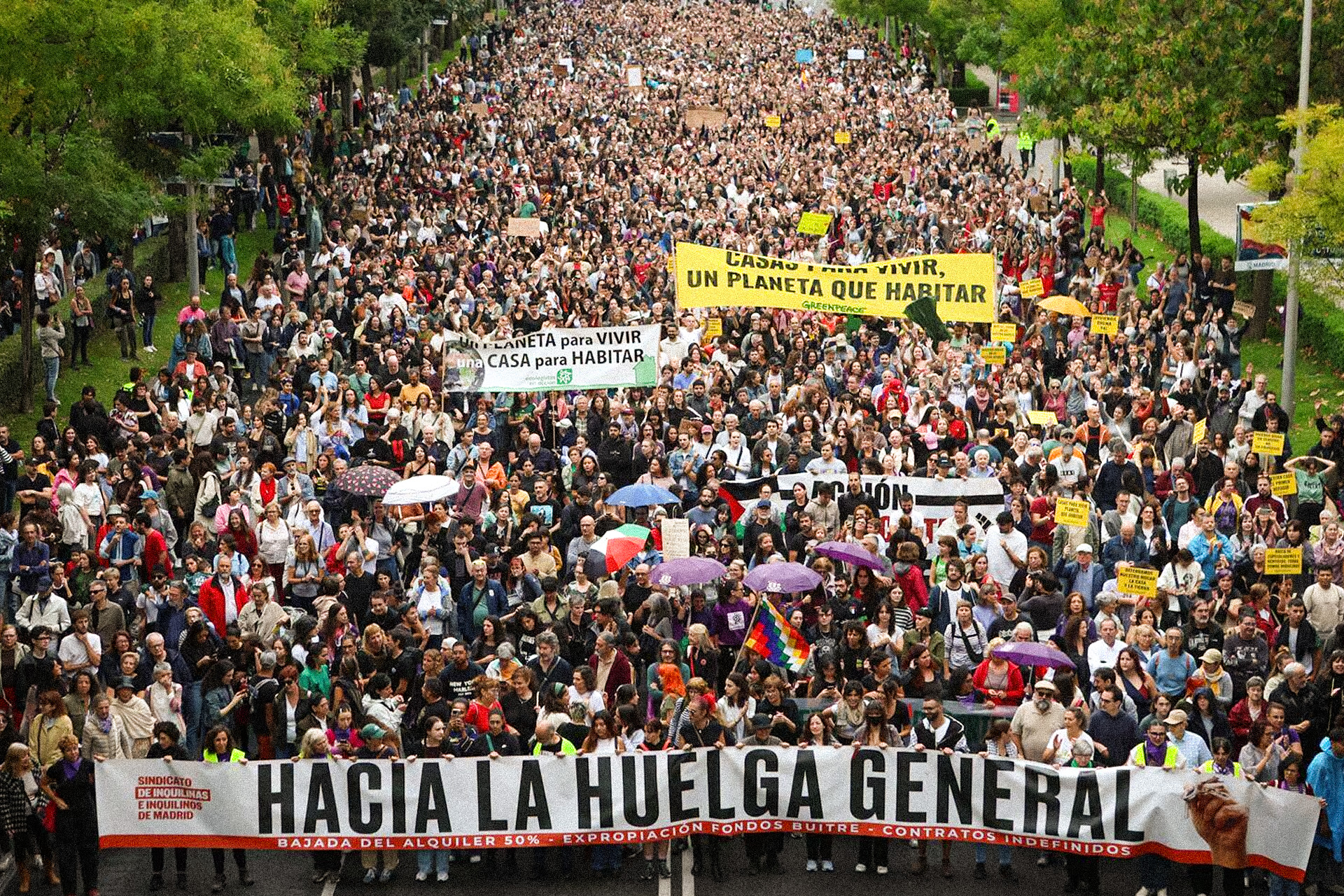
Over the weekend there were again mass demonstrations across the country, the largest one being in Madrid on 3 October, where about 200,000 people took to the streets. Four different columns converged, bringing protesters from the capital’s working class neighbourhoods. The presence of revolutionary socialist and communist organisations at these demonstrations was noticeable, as there was a sea of red flags being waved.
The demonstration, called by the Renters’ Union (SI) was headed by a large banner calling for a general strike in large letters, accompanied by the three demands of the movement: a 50 percent reduction of rents, indefinite rental agreements, a ban on evictions and the expropriation of the vulture funds. These demands go much further than the mild government reforms contained in the decrees that were defeated on Friday.
There were also large demonstrations in Seville, Granada, Malaga, the Basque Country, Oviedo, Galicia, Burgos, and in the Canary Islands. In Valencia, a huge crowd broke through police lines to get to Palau de les Arts where a ‘Real Estate Summit’ was taking place. In Barcelona the protest was postponed because of a flooding danger alert.
Small fascist gangs attempted to get organised to clear the encampments in Madrid and Seville, but were swiftly and decisively dealt with by thousands of militant anti-fascist youth who came together to chase them away.
Last night fascist gangs (numbering 50 thugs) tried to attack the housing rights encampment in Sol, Madrid. Anti fascist youth broke through police line to chase them away https://t.co/pRcTMsNyvs
As the parliamentary road is shut for now due to the defeat of the two decrees, the ball is now firmly in the court of the mass mobilisations on the streets.
The Renter’s Union has proposed a general strike and the idea has caught the imagination of millions. On Saturday 3 October, El Diario published an opinion poll revealing that 73 percent of the population would support a general strike over housing issues, including over 60 percent of those who vote for the right-wing parties PP and Vox.
The mass movement accompanying it has transformed the panorama of Spanish politics, which for weeks had been dominated by right-wing chauvinistic and anti-migrant discourse, after tens of thousands had breached the Spanish border in the enclave of Ceuta. After weeks of pretending to defend the rights of ‘Spaniards first’, right-wing demagogues did not know what to say about Maricarmen, a Spanish citizen evicted by a predatory Spanish company.
Many, including many on the left and even on the revolutionary left, were lamenting the so-called ‘rise of reaction’, depicting a pessimistic vision of a ‘shift to the right’, if not the immediate danger of fascism coming to power.
The truth is that the crisis of capitalism has led to a massive crisis of legitimacy of all institutions of the bourgeois regime. If no clear anti-capitalist anti-establishment answer is given by the left, then the rise of anti-establishment demagogues on the right is inevitable, though they are far from being in a strong and solid position.
Whenever an alternative is offered on the left, the situation can change quickly, and in an explosive manner. This is what we have witnessed in France with the school student protests and this is what we have witnessed in Spain over the question of housing rights.
An opinion poll showed that 83 percent of the population supports, totally or partially, the demands of the movement, and that includes 65 percent of those who vote for the right-wing PP and, even more significantly, 65 percent of those who vote for Vox!
The eviction of Maricarmen, the defeat of Sánchez’s decrees, and the Sol encampment were hammer blows which shook consciousness, but of course consciousness has already been shaped by the deep housing crisis which has affected Spain, particularly since 2008.
The dominant idea today, which has become the established common sense, is that housing cannot be a commodity, but rather it has to be a right. The Renter’s Union slogan currently is ‘to put an end to the housing business’. This is a profound conclusion, which goes directly against the foundations of the capitalist system. Furthermore, it is a conclusion backed by concrete demands that go precisely in that direction. The question of housing cannot be solved within the capitalist system, and many in the movement are already starting to draw that conclusion.
The events in Spain in the last few days contain many lessons. One of them is that the only effective way of pulling the carpet from under the feet of reactionary demagogues is to offer a bold anti-capitalist programme to deal with the real social problems which they use to advance their ideas. At the same time, the small fascist gangs which organise on the fringes must be cleared off the streets through the militant direct action of thousands.
What next? Sánchez has already called early elections for the end of November. But it seems that internal polling commissioned by PSOE shows that he is in a precarious position, and it is not guaranteed that he will win in November. This bears the risk of creating an even worse balance of power, should PSOE lose seats.
Other than trying to strengthen his own position, Sánchez has also called an early election as the ruling class is in panic at the potential implications of this movement. An election would be the best way to provide a safe electoral channel for the anger in the streets and avoid a general strike.
The housing movement has achieved more in ten days of mass action than years of parliamentary debates. This is the way forward. A general strike would not in and of itself solve the question, but would massively shift the balance of forces. A 24-hour protest strike cannot overthrow capitalism, but nevertheless it makes the working class aware of its own power, that is why the trade union leaders fear it.
It is not by chance that the movement in Spain is taking place simultaneously with yet another mass social explosion in France. The brutal police repression of the school student protest movement has thrown petrol to the flames. Already different sections of the working class were mobilising, and now they are joining together.
Education unions have called for strike action in support of the students on 6 October. All major trade union federations have called for solidarity with the school student movement on the same day, though typically, they shy away from making a clear call for a general strike. Local, regional and sector unions are calling for joint strike action with the students. The agricultural union Confederation Paysanne has also called for solidarity with the students and appealed for its members to bring tractors to the demos.
The question of the physical defence of the school students brutalised by the police has taken a central place in the movement. In several major cities (including Le Havre and Bordeaux), union militants have come out to form protective barriers to defend the students from riot police.
UnitéCGT, the militant left wing of the main trade union federation, has correctly posed the question of the need for a general strike and factory occupations:
“This therefore implies, like the call for a general strike in May ‘68 in solidarity with the students and in response to workers’ demands, a call for a national interprofessional strike as quickly as possible.
“This also implies that we must raise awareness, everywhere, of the absolute necessity of engaging, all of us together, immediately in the struggle through strikes, action on the economy, and the occupation of workplaces.
“LET’S MOBILIZE, THROUGH STRIKES WHEREVER POSSIBLE, TO AMPLIFY THE MOVEMENT, UNITE ANGER, AND PREVENT POWER FROM TOUCHING OUR CHILDREN!”
The French bourgeois paper Le Monde, warned in its editorial about the danger of “a coalition of the angers”, referring to a joint movement of students and workers. But then, it correctly pointed out how “France’s public deficit and state debt deprives the government of any room for manoeuvre."
If Spain and France are boiling over, surely Italy is not far behind. In Belgium there have also been school student protests.
These events are an answer to the pessimists and skeptics who talk of a ‘rise of reaction’ and ‘a general period of shift to the right’. They show that there is an accumulation of combustible material everywhere, which can be set alight by any number of accidental sparks.
The movements in Spain and France are happening on the first anniversary of the massive ‘block everything’ strikes in France and the political general strikes for Palestine in Italy, which at the time were expressions of a deep malaise among workers and youth across Europe.
The whole of the continent is a powder keg, at the root of which there is the deep crisis of European capitalism. Massive debts and budget deficits force governments to carry out massive cuts and austerity measures, which in turn make them extremely unpopular and risk provoking a massive social explosion in one country after another.
Mass movements are on the order of the day. The crucial question is to build a revolutionary leadership capable of leading them to victory.
Read the full story at the source
Source: In Defence of Marxism