
Politics · In Defence of Marxism · · 2h
Something is rotten in the state of Ukraine
English (original) · Read in Deutsch ⇄
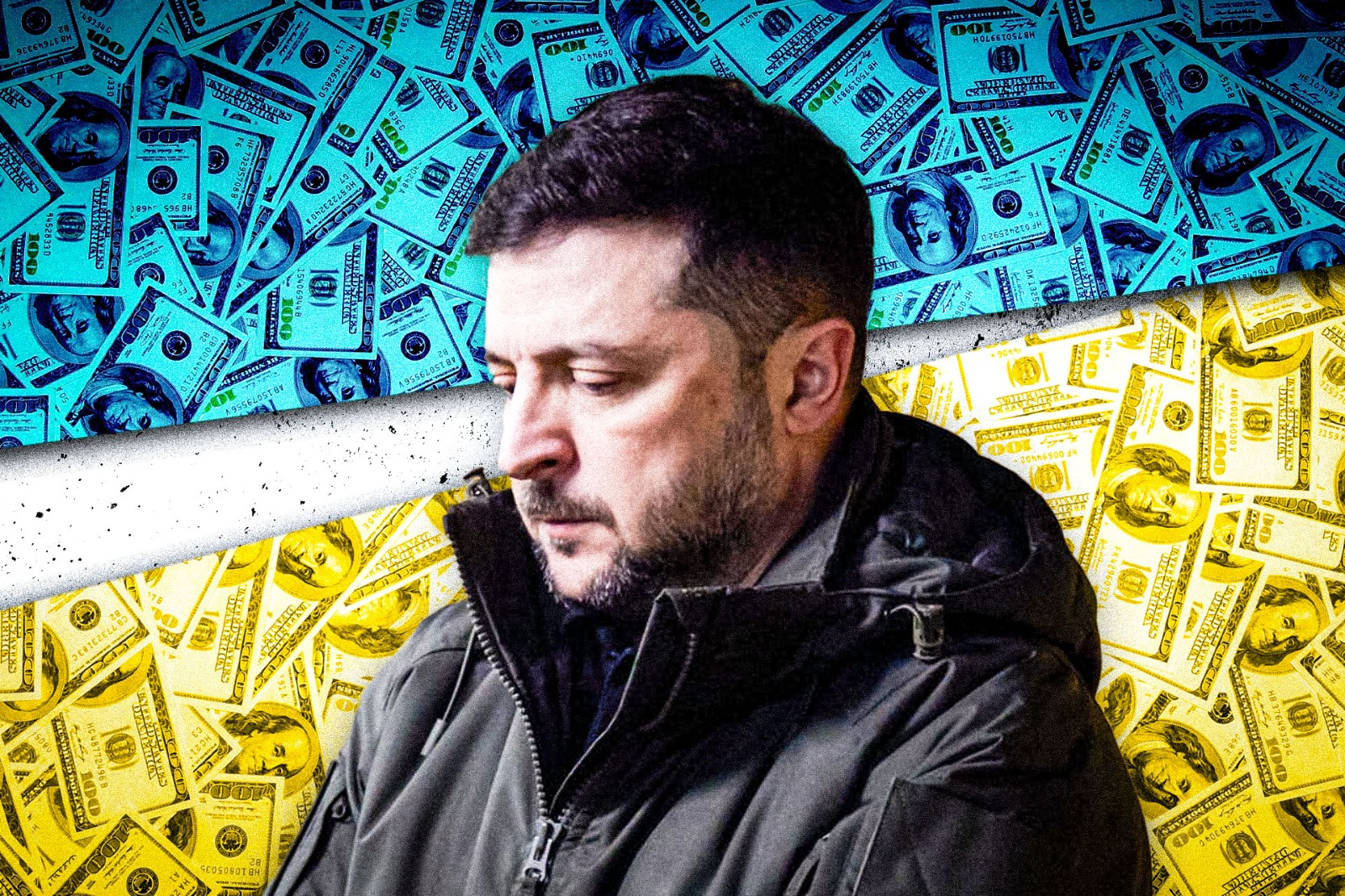
Not that you would have heard about it in the western media, but Ukraine has been rocked by a series of corruption scandals reaching the highest echelons of law enforcement in the last few days.
On Monday, 14 September, the Prosecutor General fled the country while filing criminal cases for corruption against the heads of the National Anti-Corruption Bureau (NABU) and the Specialised Anti-Corruption Prosecutor’s Office (SAPO). The reason he fled? Allegations that his office was at the heart of a racket extracting protection money from hundreds of scam call centres.
Behind these corruption scandals is a very serious struggle for political power among different oligarchic factions. No wonder a majority of Ukrainians polled (54 percent) think that corruption is a greater threat to the country’s development than the Russian military aggression (39 percent)!
Image: Kyiv International Institute of Sociology
In the murky world where corruption allegations are used to advance political interests, it is very difficult to separate fact from fiction. Let us at least try to follow the developments of the last ten days.
On the morning of 4 September, the NABU and SAPO publicly launched ‘Operation Carthage’, an investigation into a protection racket that was taking payments from call centres involved in phone scams. Allegedly, hundreds of scam call centres were paying protection money (about $20,000 a month, each) to people high up in the police, the secret service and the prosecutor’s office.
Furthermore, this criminal syndicate was laundering millions of hryvnia in bribery proceeds by purchasing high-end real estate and jewellery. According to the anti-corruption agencies, the criminal operation controlled and protected as many as 500 fraudulent call centres, with tens of thousands of workers, across the country. This allowed the racket to net up to $3.5 million per month in bribe revenue. Protected call centres were given advance warning of police raids, while those who refused to pay were targeted by law enforcement.
Ukrainian media speculates that it was the attempt by some at the top of the racket to increase protection fees which then led some of the call centres to pass to NABU the information that is now being used against the Prosecutor General.
As part of this operation, NABU and SAPO agents raided the state prosecutor’s office and charged Serhii Kropyva, the deputy head of its International Cooperation Department. Raids were also carried out at premises associated with Deputy Prosecutor General Mariia Vdovychenko and Oleh Kiper, head of the Odessa Oblast Military Administration.
The allegation was that the prosecutor general’s office was taking a cut of $7,000 a month from the protection fees from each call centre. However, Kropyva was not at the top of the food chain. In wiretap recordings released by the anti-corruption agencies, he is heard referring to a “chief”, which he names as “Andriiovych”. There is talk of renovations to a mansion paid for out of the proceeds from the protection racket.
Ruslan Kravchenko, the Prosecutor General, moved to a luxury estate in Kozyn earlier this year, one which had just been renovated, and – wait for it – his patronymic is Andriiovych! It was clear to everyone that the final target of the investigation was Kravchenko; however, at no point was he arrested or charged.
For a period of about 12 hours after the raid on his office, Ruslan was missing. He eventually reappeared and had a meeting with President Zelensky, after which he announced he was tendering his resignation. Meanwhile, his wife left the country through the Moldovan border.
NABU and SAPO are on a political offensive against Zelensky. Rather than hitting at him directly, they are targeting his close associates. You may remember a certain gold toilet which was found in the apartment of one Ukrainian oligarch called Timur Mindich. That was in November 2025.
The anti-corruption agencies launched Operation Midas into a $100 million embezzlement and kickback scheme which was siphoning money from Ukraine’s state nuclear energy operator, Energoatom. In a raid on Mindich’s luxury apartment in Kyiv, they found a gold-plated bathroom containing a solid gold toilet.
Mindich is a close associate of Zelensky, the owner of the TV company which produced the clown-president’s show that raised Zelensky to prominence in the first place. Mindich’s gold toilet flat was used for all sorts of private parties, celebrations and strategy meetings. Zelensky owns a flat in the same apartment complex.
As a result of these revelations, a huge political scandal engulfed the president’s office, forcing the resignation of his Chief of Staff, Yermak, the ministers of Energy and Justice, as well as the deputy chief of staff. Also implicated was the former deputy prime minister, Chernyshov.
Somehow, Zelensky survived the scandal and Mindich escaped to Israel where he continues to exercise strong influence in Ukrainian business and political affairs.
The trigger for Operation Midas seems to have been an attempt by Zelensky to take legal measures to curtail the formal independence of NABU and SAPO, precisely at the time when the agencies were wire-tapping his close associates.
Then, as now, a battle for political influence is being waged through the medium of corruption allegations.
So, how is it possible that the Prosecutor General, Ruslan Kravchenko, allegedly at the head of a huge corruption scandal affecting his office was allowed to leave the country, destination unknown?
What has happened is clear: Zelensky had a meeting with Kravchenko in the middle of last week. The conversion must have gone more or less along the following lines: ‘I give you safe passage abroad, you can take your money and your wife, and in exchange you give me something I can use to get NABU and SAPO off my backs.’
A battle for political influence is being waged through the medium of corruption allegations / Image: own work
Early in the morning of 14 September, Kravchenko announced on his Telegram channel that he was “on a business trip abroad”. Half an hour earlier, he had posted copies of documents detailing an official ‘notice of suspicion’ (a legal document opening a criminal investigation) against the head of the NABU, Semen Kryvonos and the wife of the head of the SAPO.
Technically, though he had publicly announced his resignation, Kravchenko was still the Prosecutor General at the time he issued the notices of suspicion against his rivals, as his resignation had to be voted on by the relevant Parliamentary commission.
The allegations he is flinging at NABU and SAPO are related to old cases, bribery, impersonation, real estate corruption, going back to 2014. The question immediately arises – if he knew about these cases, why did not raise them before?
In the world of corrupt officials, it is good to keep a few cards up your sleeve. Things you can use for protection or to blackmail others. Kravchenko has also claimed, from an unknown location outside of the country, that NABU and SAPO agents carrying out the raids on his office took away files relating to criminal proceedings against anti-corruption agency officers. Precisely.
What these scandals reveal is a power struggle between different oligarchic factions, each protecting their own interests, each controlling different parts of the state apparatus, each having at their service different political parties and individual politicians, each being linked to different factions inside and outside of Ukraine (in the US Democrat establishment, the European Union bureaucracy, etc.).
NABU and SAPO were created after the Maidan overthrow of Yanukovitch in 2014, at the instigation of the IMF and the EU. The stated aim was to clean the Ukrainian state of corruption. In reality they have become one of the tools through which western imperialism exercises pressure on Ukrainian politics, all in the name of defending the country’s national sovereignty.
Media reports say that NABU and SAPO have about 65 members of parliament in their sights. This is way of exercising leverage over their voting intentions at a time when the EU is exercising intense pressure on Ukraine to pass a series of anti-popular ‘reforms’, which Zelensky is partially resisting (for his own self-serving reasons).
It is not that the Zelensky administration is not corrupt. Quite the opposite. All bourgeois oligarchic political factions in Ukraine are corrupt. Perhaps those which have direct access to the levers of power are more corrupt, by virtue of having greater opportunity.
Operations Carthage and previously Operation Midas are just the tip of the iceberg of a rotten oligarchic regime. On 15 September, the day after the raid on the Prosecutor General, NABU and SAPO also uncovered another massive $65 million corruption ring involving Ukrnafta, the country’s oil and gas company. The group illegally siphoned off 100,000 tonnes of petroleum products – representing roughly 20 percent of all fuel sold at Ukrnafta filling stations. The stolen proceeds were laundered via a complex network of shell-companies in offshore tax havens.
According to the anti-corruption agencies, a high ranking official in the State Security Service (SBU) was passing information about the investigation to the criminal gang involved. Amongst those charged were associates of Ukrainian oligarch Ihor Kolomoiski, who once helped Zelensky come to power but has since become his adversary.
The Zelensky regime is corrupt to the core, and so are his opponents. It is using increasingly authoritarian methods to stay in power. One by one, Zelensky’s political opponents are being charged, sanctioned or forced into exile. The latest is Iulia Mendel, his former press secretary, who on 13 September was severely sanctioned by Zelensky. Her crime? Having publicly denounced the president and his politics.
We have not even mentioned the shootout between members of the military intelligence (GUR) and the SBU on 2 September in Kyiv. The apparent reason? The SBU had kidnapped Stepan Kaplunov, a neo-Nazi member of the so-called Russian Volunteer Corps (a military unit operating under the umbrella of the GUR), and so armed members of the GUR turned up to get him released. The reason why the SBU kidnapped Kaplunov is not known, but the clash is part of a wider struggle for power and control between different wings of the state apparatus, which cannot be very far removed from the other corruption scandals.
Add to all of this a massive financial crisis in the state budget and widespread resistance to mobilisation, and the picture that emerges is alarming to say the least.
Meanwhile, the western public is kept in the dark about these scandals. For good reason. It is already very difficult for European governments to justify their full support and funding for the war in Ukraine, which comes at a high cost for workers in their countries. If the real picture of what is happening in Ukraine emerged, it would become impossible.
The whole of the capitalist oligarchic state in Ukraine is rotten to the core – and it is being funded by European governments desperate to fight Russia to the last drop of Ukrainian blood. European and Ukrainian workers are being made to pay the price.
Read the full story at the source
Source: In Defence of Marxism