
Politics In Defence of Marxism
Pakistan: mass movement in Kashmir, which way forward?
The Revolutionary Communist Party salutes the working people, youth, women, and even children of Kashmir for the magnificent history they have written in their struggle against five months of ongoing
English (original) ·Read in Deutsch ⇄
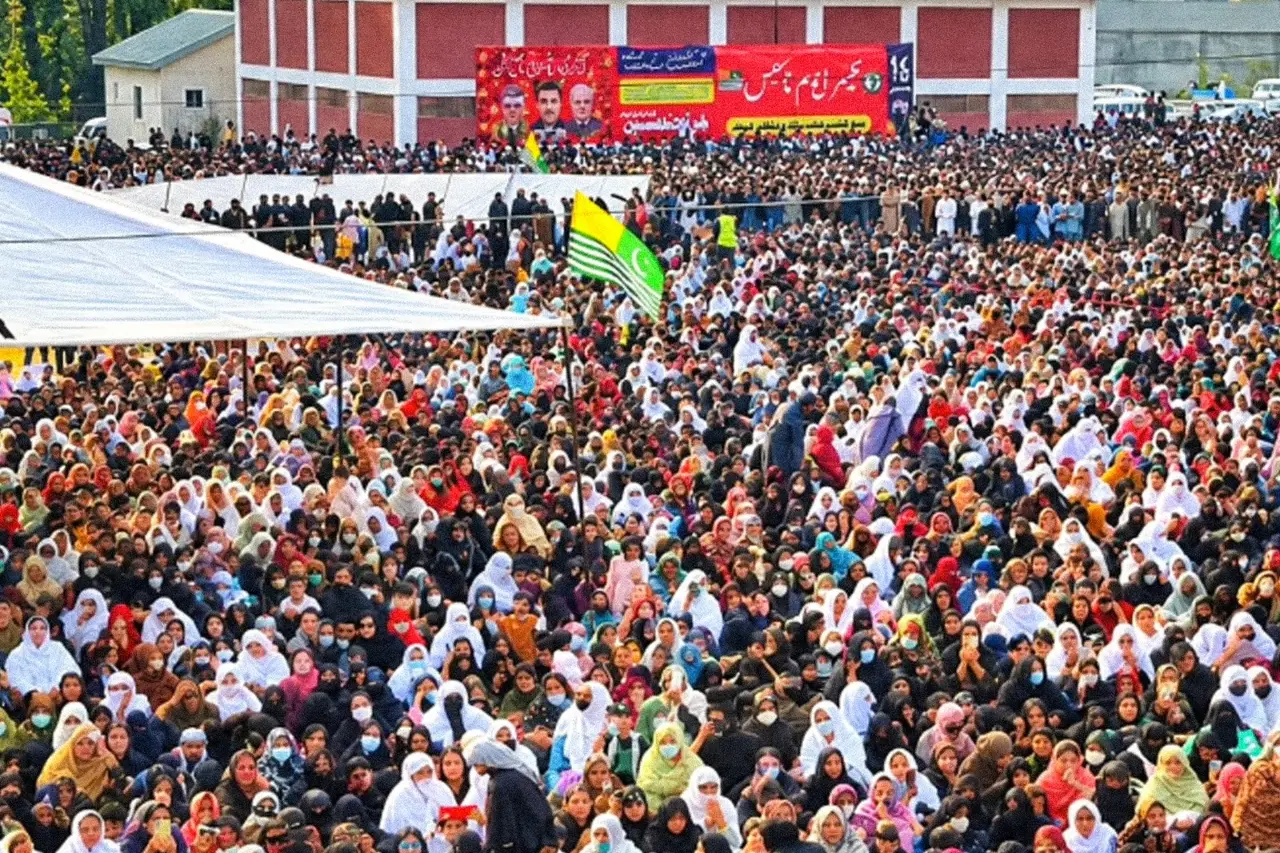
The Revolutionary Communist Party salutes the working people, youth, women, and even children of Kashmir for the magnificent history they have written in their struggle against five months of ongoing state repression. This struggle has been marked by courage, immense sacrifices, and revolutionary fervor.
The working people of Kashmir have demonstrated that whenever the toiling masses of a region step onto the stage of history they acquire the capacity and strength to overcome every obstacle in their path. They have waged a collective struggle against the old order and its rulers – seeking solutions to their grievances and their own liberation.
While the working people, youth, and women have played an unparalleled role in this five-month-long revolutionary struggle, the movement has yet to achieve victory. The reasons for this must be examined and understood.
For any movement in any region to succeed, the unity of the working people and their conscious intervention in the struggle are essential. Equally vital, however, are sound ideas, a clear programme, and the correct strategy and methods. It is the duty of the leadership to provide these.
A review of the events of the past five months reveals that the masses, especially women, played their part admirably at every juncture – responding to every call from the leadership – and never shied away from making any sacrifice. For over fifty days, all of Kashmir remained under a complete shutdown. Hundreds of thousands of people repeatedly participated in ‘dharnas’ (sit-ins) around Rawalakot, hoping that the leadership would announce a decisive struggle – yet, each time, they were left disappointed.
The call for a march was repeatedly postponed in anticipation of negotiations, with sit-ins continuing instead. When it was finally decided on 27 July to advance the march – following total disillusionment with the negotiation process – there was still no concrete plan. Nevertheless, the public, relying on their collective strength and courage, refused to retreat even under a hail of bullets, ultimately forcing the security forces to withdraw from Rawalakot.
However, instead of taking control of the city and continuing the march, the leadership opted to stage another sit-in at a nearby intersection in Rawalakot – a protest that continues to this day. A detrimental consequence of this strategy was that the state, through the use of force, managed to end the lockdowns in the Muzaffarabad and Mirpur divisions.
Currently, the movement’s practical activities are confined to the Poonch division, where the state is tightening its siege. In light of this, if we assess the struggle that has unfolded over the past five months, it becomes clear that even before the current phase of the movement began, the state’s actions signaled that the ruling authorities – unlike in the previous three years – had no intention of engaging in easy negotiations.
Instead, their objective is to completely crush the movement. The leadership of the movement – organised as a 'Joint Committee' – refused to grasp the reality of the situation. Instead, they persisted with the flawed strategy of continuing sit-ins while awaiting negotiations – an approach that has, to date, yielded no results.
Given this, the Revolutionary Communist Party considers it its revolutionary duty to present its clear position to the working masses and the youth. In a series of consultative meetings held with members of the Joint Committee since 22 June, the Revolutionary Communist Party has consistently argued that the policy of sit-ins has become ineffective.
The masses, especially women, played their part admirably at every juncture / Image: fair use
We proposed that the movement should advance by explicitly declaring the establishment of a 'popular revolutionary government' – composed of elected representatives from the committees. However, the committee leadership disregarded these proposals and clung to the ineffective and misguided policy of sit-ins.
In doing so, they squandered a precious, rare opportunity – the kind that may only emerge only once every few decades – to not only secure victory for the movement but to establish Awami rule through a revolution.
Consequently, the movement now faces an extremely precarious situation. To hesitate or waver when faced with a revolutionary situation – a rare historical juncture – is a grave historical error and an act of betrayal against the revolution. The consequences of such a failure are borne for a long time, not only by the leadership but by society as a whole.
Driven by their reformist mindset and the rottenness of their ideas, the ‘Joint Committee’ leadership has led the movement into a dead end. Those who subscribe to reformist ideologies – while attempting to resolve issues within the confines of an archaic, anti-people system – often end up committing grave historical crimes, such as allowing movements to be drowned in blood.
Proponents of such ideologies are only capable of playing a constructive role in a movement as long as the ruling authorities remain willing to address certain grievances through negotiations. The situation regarding the 'Joint Committee' followed this very pattern: for the past three years, the authorities – following bouts of repression – would offer solutions or make hollow promises to resolve issues.
However, at this critical juncture, the ruling classes opted not for negotiation but for a brutal state assault aimed at crushing the movement. While the people of Kashmir fought back with immense courage, the central leadership’s misguided policy of waiting for negotiations ultimately steered the struggle away from success.
On the other hand, due to these very same antiquated notions, they did not rely on the power of the working masses, but rather on various factions of the ruling state apparatus, as well as on ineffective imperialist institutions like the United Nations. While it is true that the Joint Committee continues the struggle through sit-ins, it is an even greater crime to persist in a flawed and ineffective policy in the hope it will lead to success. Over the past five months, this has served only to weaken the movement.
The Revolutionary Communist Party maintains that, although a vast amount of precious time and the immense energy of the masses have been squandered due to the misguided strategy of relying on sit-ins and awaiting negotiations, the possibility of leading the movement to victory still exists. That is, provided it is advanced boldly and upon the correct foundations.
First and foremost, it is essential to discard the misconception – or perhaps the naive hope – that the ruling class will concede to the movement’s demands through negotiations, simply under the pressure of sit-ins. Furthermore, given the loss of life sustained during this five-month-long struggle, the argument that sit-ins are a superior strategy for avoiding further casualties has been proven entirely false.
In fact, the number of lives lost during these sit-ins is likely double that which might have been lost during the march originally planned for 27 July – and this toll continues to mount.
On this basis, the Revolutionary Communist Party asserts that it is imperative to carry the movement forward according to the following principles:
1 - A definitive decision and declaration must be made: due to the immense sacrifices of the people, this struggle is no longer merely about the implementation of specific demands. It has transformed into a fight for the right to collective ownership and for power by the toiling people of this region.
Achieving this is only possible by overthrowing the capitalist system through a revolution and establishing a popular revolutionary government. Therefore, there can be no reconciliation or compromise with the ruling class through negotiations at any stage.
If, under the pressure of the movement, the rulers are ever forced to enter into negotiations, they will inevitably resort to deception – as they have in the past – and, should the movement retreat, they will impose even harsher state repression than before. Furthermore, whatever might be gained through such negotiations would be insignificant compared to the magnitude of the toiling people’s struggle and sacrifices.
2 - This struggle – aimed at ending the capitalist system and establishing rule by the people – is a class struggle of the working class against the ruling elite. Workers across the globe, including those in Pakistan, can serve as allies to the Kashmiri people. Therefore, this struggle must be advanced by forging solidarity with the working class – both in Pakistan and internationally – on a class basis.
We also appeal to all Kashmiri workers living abroad – particularly in Europe and the United States – to seek solidarity with the working class and labour organisations of those countries. Workers must not look toward the so-called ‘liberal’ rulers of Europe, the United Nations, or other similarly ineffective global imperialist institutions.
3 - The march should be advanced with thorough preparation, guided by the clear objectives of ending the current government and establishing a popular revolutionary government. It must be ensured that the general public and the youth participate directly in all decisions concerning the future of the movement.
To this end, the current decision-making authority – which is restricted to a few individuals within a 'Joint Committee' – must be immediately abolished. Instead, the entire movement should be structured on democratic foundations, fostering democratic debate starting from the local committees, alongside the democratic election of committees at various higher levels.
The Kashmiri people can only be brought to a successful conclusion through the building of a revolutionary party / Image: fair use
It is our collective duty to ensure the full participation and inclusion of women – who serve as the vanguard and the most militant segment of the movement – within all its elected bodies. Every individual, as well as every organisation playing a positive and constructive role, should be encouraged to openly articulate their positions regarding the movement's future.
This will enable the majority of the public and the youth to engage in debates over various opinions and proposals, allowing them to accept or reject any suggestion based on a conscious, informed choice.
Constructive political criticism and debate will elevate the movement's level of political consciousness and strengthen it. It will help eliminate personality cults and blind adherence, accelerating the development of a collective leadership – a prerequisite for the movement's success.
All decisions within the movement must be reached through comprehensive democratic debate and voting during general assemblies of the people's committees. Furthermore, all necessary measures must be taken to exclude from the movement any reactionary or right-wing, anti-people organisations that have historically operated under the patronage of the ruling class.
The current phase has also demonstrated that a leadership structure – such as a joint committee composed of individuals with diverse and conflicting viewpoints – proves incapable of providing guidance during the revolutionary stages of a movement, or its decisive battles. This is due to the inherent ideological limitations of such a body, especially when it lacks a grounding in the revolutionary scientific theories relevant to the current situation around the world.
On this basis, the Revolutionary Communist Party maintains that the future struggle of the Kashmiri people can only be brought to a successful conclusion through the building of a revolutionary party. This party must be anchored in a correct revolutionary theory – which, in the present age, can only be scientific socialism, or communism.
We commend the solidarity campaign in support of the mass movement in Kashmir, organised by workers across the world – and in particular by the Revolutionary Communist International. We are confident that the Revolutionary Communist International will continue to play its revolutionary role in expanding international working-class solidarity in the future.
This struggle – aimed at the complete dismantling of the capitalist system and the establishment of Awami rule – can only be brought to victory if it is organised strictly on the basis of the scientific theories of socialism and communism.
Therefore, the Revolutionary Communist Party calls upon all active and politically conscious elements within the movement to draw the correct lessons from their own experiences of struggle. Join the Revolutionary Communist Party, and play a revolutionary role in ensuring the future victory of this great movement of the Kashmiri people and youth.