
World · In Defence of Marxism · · 2h
It’s the dying days of an empire
English (original) · Read in Deutsch ⇄
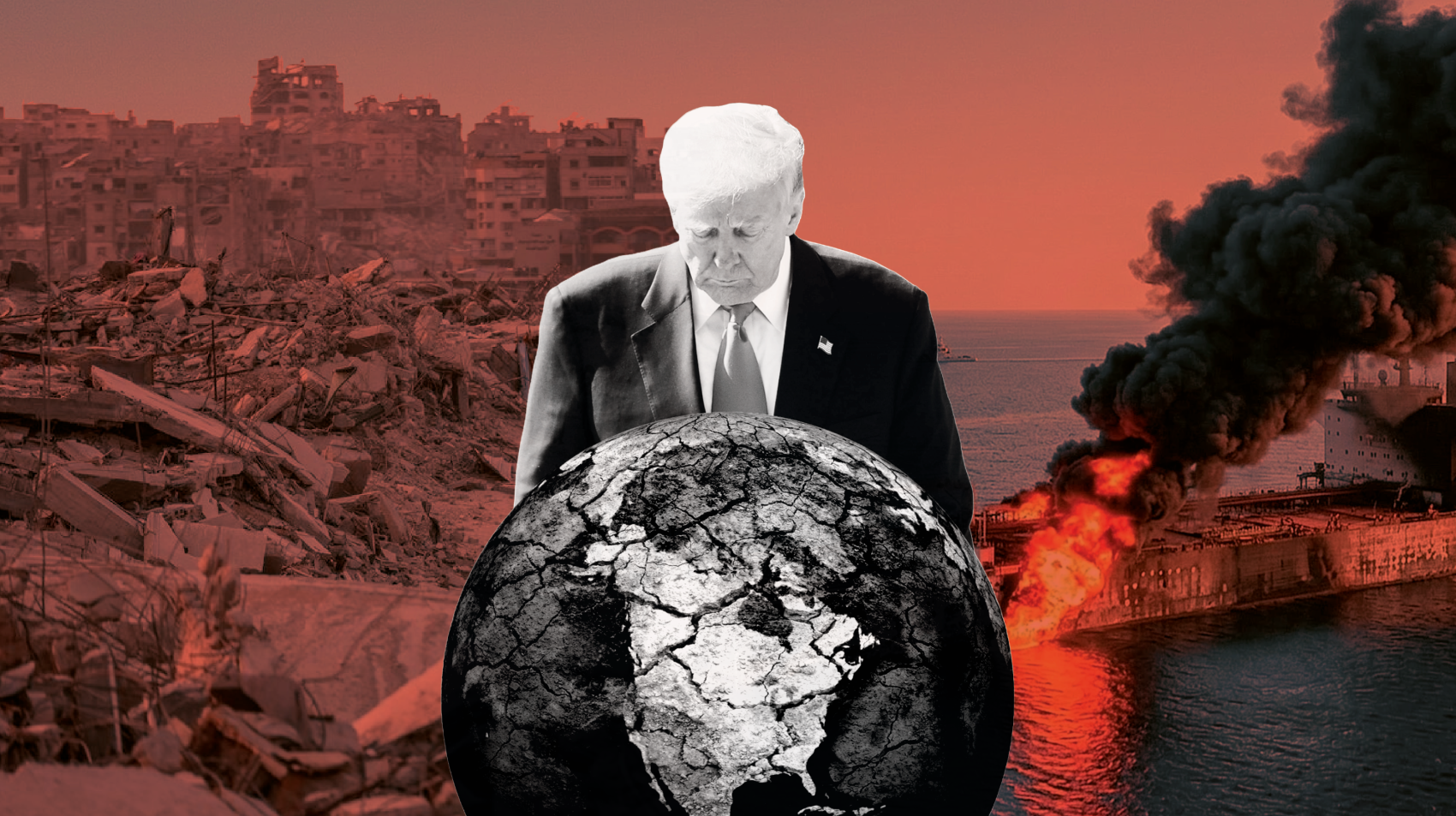
“We’re standing there with our eyes closed getting punched in the face.” That’s how one active-duty US serviceman described the Iran war.
[Originally published at communistusa.org]
After months of downplaying or ignoring the widespread damage and destruction of American bases in the Middle East, the mainstream media has now published photos of bombed-out buildings and barracks. As the serviceman, who spoke to CBS last month, put it, “This is major damage to our bases that hasn’t been communicated to the American public … We’re not defending these bases. We’re just watching them get destroyed.”
Indeed, the whole world is watching the decline of US imperialism in real time.
Unable to resupply at bases in the Persian Gulf, conditions aboard ships like the USS Gerald Ford and USS Abraham Lincoln deteriorated during their marathon deployments. Sailors survived on small servings of revolting rations. They took minute-long showers with no soap, brushed their teeth without toothpaste, and went weeks without laundry service.
These appalling conditions sparked a mental health crisis on the ships. Multiple sailors attempted suicide by jumping overboard. At a San Diego town hall for family members of those deployed on the ships, one woman tearfully recounted her husband telling her “he hopes he doesn’t wake up tomorrow.”
There’s even evidence indicating that sailors on the Lincoln and Ford sabotaged their vessels in hopes of forcing them to return to port.
The Navy is the most proletarian of all the armed forces. The vast majority of sailors aren’t directly involved in combat. Instead, they spend their time running and maintaining massive ships, which are like giant factories on the high seas.
The Navy is also the most important branch of the armed forces for projecting power around the world. The shocking decline of morale and discipline among the sailors is an ill omen for the ruling class.
At time of writing, the Lincoln is limping back to port in San Diego. When it docked in Thailand, photographers caught a glimpse of its heavily rusted hull—a stark illustration of the rot eating away at US imperialism.
The US imperialists have spent unimaginable sums of money on the Iran disaster. For the first time, the Pentagon has reported the costs of the war as $43.6 billion. That is likely a vast underestimate, and Hegseth is requesting as much as $70 billion in additional emergency funding.
Writing in the circumspect style favored by bureaucrats the world over, the Pentagon’s Inspector General reported, “The munitions expenditure [in Iran] has resulted in strategic inventory shortfalls and revealed industrial base bottlenecks for munitions resupply … While the Department of War has begun to implement mitigation strategies, the defense industrial base requires significant lead time to expand production.”
In plain English: the US imperialists are dangerously low on weapons and munitions and are unable to make more in the immediate future.
Military sources have confirmed that the US used “virtually all” of its long-range, precision ATACMS, and PrSM missiles in a vain attempt to subjugate Iran / Image: Department of Defense, Flickr
Military sources have confirmed that the US used “virtually all” of its long-range, precision ATACMS, and PrSM missiles in a vain attempt to subjugate Iran. Stockpiles of Patriot and THAAD interceptors are also dwindling.
Trump himself admitted as much in an Oval Office press conference: “The ammunition—if you talk about low—we have tremendous amounts, unlimited amounts, of mid-grade and older stuff that’s also very powerful. We’re only talking about what we call the elite stuff … But we can always take from other sources.”
He also threatened, viaTruth Social, to imprison anyone within the administration caught reporting on the low stockpiles: “The ‘leakers’ of these treasonous statements are being hunted down. Long-term jail sentences will be sought!”
The missile shortage illustrates the difference between the American and Iranian approaches to war. Patriot interceptors, for example, cost $4–5 million a piece. The US expended these exorbitantly priced projectiles trying to take down Iran’s $30,000 Shahed drones. While US munition stockpiles are running dry, the Iranians are in a position to continue fighting through the midterms and beyond. According to the Foreign Policy Research Institute, “At the current build rate … it would take three years [for the US] to replace what was used in a little over a month.”
The quagmire in Iran is striking blows at the highest levels of US imperialism’s bureaucratic machine. At the beginning of his administration, Trump and his Secretary of War, Pete Hegseth, purged the military clique of elements they deemed insufficiently loyal. Since the Iran debacle began, a new wave of senior officials at the Pentagon and US spy agencies have resigned, fleeing like rats from a rusty aircraft carrier.
At least 25 senior generals and admirals have been fired, forced into early retirement, or resigned, including the Secretary of the Army, the head of US Southern Command, the Army Chief of Staff and Vice Chief of Staff, and the head of Allied Land Command. The ruling class spent decades and millions of dollars training these top cadres of US imperialism, who have now taken their talents to private-sector consulting firms and golf courses across the country.
Colonel Lawrence Wilkerson, a life-long Republican, former national security advisor under Ronald Reagan, and chief of staff to Secretary of State Colin Powell, recently reflected on the state of the military’s leadership:
"My friends and I … probably spent a half century in the security establishment or connected with it. To a person, what they say to me now is “I can’t believe I’ve lived to see this … We do not have the leadership in the American armed forces today that we need.” It’s really sad to come to the end of your time on this planet, and have devoted a half century of your time to the government of what you thought was a truly decent nation, all things considered, to find out it is just as corruptible as any nation in the past, and perhaps even more so because of its power."
Having run out of ideas, US Central Command is so desperate that one of its intelligence officers sent a crowdsourcing email asking military analysts for “new creative and unconventional ways to pressure and punish Iran.”
If ever he has a moment of sober reflection on this shambolic situation, Hegseth, a religious fanatic, might well recall David’s lamentation from 2 Samuel: “How the mighty are fallen, and the weapons of war perished!”
The imperialists have failed to achieve any of their strategic goals—Iran’s nuclear program and military capabilities are intact, its ability to strike the Gulf States and Israel is greater than ever, its grip on Hormuz is solid, and the government’s support among the population has been bolstered by its steadfast stand against the hated Americans.
Meanwhile, Russia continues to wear down US imperialism’s proxy in Ukraine. Ukraine’s manpower shortage is so severe that military recruitment has devolved into mere kidnapping. The practice, colloquially known as “busification,” involves “recruiters” scouring the streets, abducting young and middle-aged men, and throwing them in the back of vans bound for “training” centers. These tactics have caused fighting in the streets. In some cases, active duty soldiers have joined in anti-draft riots—even in Lviv, traditionally a far-right nationalist stronghold.
Seeing this chaos, “middle” powers around the world are waking up to the fact that they can no longer rely on the US imperialists to guarantee the security of their regimes. These states will be hedging their bets, looking increasingly towards Russia and China.
After the fall of the Soviet Union in 1991, US imperialism stood unchallenged, capable of dominating the entire planet. Just 35 years later, the former colossus looks increasingly like a colossal wreck.
In 1993, the US military adopted the “two major wars” doctrine, projecting a capability to fight major conflicts in two theaters simultaneously. Two decades later, they were forced to reduce their ambitions to one major war. Now, they aren’t even able to win a regional war against a mid-grade power like Iran.
How have the mighty fallen so fast? In the final analysis, military power is a reflection of industrial power—and American industry is in deep decline. In 1979, manufacturing employed nearly one in five workers in the US. Today, that figure is only 8%. Over the same period, manufacturing’s share of US GDP has fallen from around 25% to less than half that.
While their imperialist rivals, China and Russia, boast state-owned military industries oriented towards their strategic goals, America’s military production is run for profit / Image: kremlin.ru, Wikimedia Commons
In search of profits, the capitalists outsourced manufacturing to countries where lower wages prevailed, hollowing out the US industrial base. Unable to make a profit producing useful commodities, the capitalist class poured its money into usury and stock-market speculation. As a result, the American capitalists enjoy record profits, but their global position is in decline.
China is now the world’s premier industrial powerhouse, having increased its share of world manufacturing output from 2–3% in 1978 to around 30% today. The global balance of power is shifting to reflect the country’s increasing economic might.
While their imperialist rivals, China and Russia, boast state-owned military industries oriented towards their strategic goals, America’s military production is run for profit. The Iran war may be a disaster on the battlefield, but in the boardrooms of Raytheon and Lockheed Martin, it’s been a stunning success. In addition to the $22.3 billion worth of munitions the US expended in the war’s first three months alone, US arms manufacturers racked up a further $45 billion in sales to beleaguered American allies in the Middle East.
Over and above their military humiliation, the economic consequences of the war may prove even more damaging to the ruling class. Brent crude once again topped $105 a barrel last month, while the average price of gas pushed towards $4.50 a gallon. Diesel—the workhorse of fuels powering locomotives, tractors, and big rigs—surged to an all-time record of over $6.50.
In an attempt to keep prices down, the US has drawn down its strategic petroleum reserve to below 300 million barrels. The massive drawdown means the ruling class will not be able to respond to energy shocks caused by future wars or natural disasters, and even threatens the structural integrity of the salt caverns in which the oil is stored.
The spike in energy costs is fueling inflation. Prices will only continue to climb as the Iranians remain masters of the crucial Strait of Hormuz, and Ansar Allah, also known as the “Houthis,” consolidate their control over the Bab al-Mandab Strait.
Inflation and instability sent 10- and 30-year Treasury bond yields—the interest rates on long-term national debt—above 5% for the first time since before the global crisis of 2008. It’s an indication that investors are losing confidence in the US government’s ability to control inflation and, ultimately, to repay its $40 trillion debt.
In response, Treasury Secretary Scott Bessent spent much of last month trying to force down rates, taking out more short-term debt to buy back long-term Treasuries and cutting deals with Japan and UAE to stop them from dumping Treasuries on the market. All these efforts have been totally unsuccessful.
The US is projected to pay over $1 trillion in interest on the debt this year alone. That’s nearly $3 billion a day flowing into the pockets of bankers and other capitalists. The US debt-to-GDP ratio now stands at 125%. The only way to lower the ratio is to cut spending or grow the economy. But the federal government is spending more than ever and GDP growth in the second quarter of this year was a sclerotic 1.5%.
David Kelly, the Chief Global Strategist at JP Morgan Funds, had this to say about Bessent’s impotent intervention:
"It’s just moving around a bunch of borrowed money. That’s not going to move the needle. Unless they can find a way to truly change the trajectory on our debt, the government is powerless to stop this. We’ve maxed out the credit cards. The only foolproof way to get a major bond market rally is to have a massive recession. That would do it."
Indeed, an all-out recession is being prepared. No one can predict exactly when, but the working class will eventually face the turmoil of an economic crisis. Mass unemployment, hunger, evictions, and foreclosures are all on the horizon.
Ovid wrote in The Metamorphoses, “Nations and empires flourish and decay, by turns command, and in their turns obey.” After commanding the world for decades, the American ruling class now finds itself forced to obey, not a new overlord, but the laws of history itself.
To be sure, US imperialism remains the most reactionary force on the planet. From the Caribbean to the Middle East, it’s lashing out in a mad rage, like a wounded animal, destroying countless lives in its attempt to remain on top. But its days are numbered.
American capitalism is at an impasse. Reinvigorating US industry, growing the economy, and paying down the debt would require massive investments in infrastructure with little hope of immediate profit. It would also require vicious attacks on the working class to drive wages and conditions down to the level of its international competitors.
This is a finished recipe for class struggle.
Read the full story at the source
Source: In Defence of Marxism