War & Militarism de.indymedia
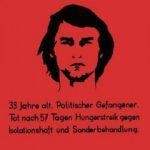
Background to Holger Meins, who died on November 9, 1974 in the fight against isolation torture
Holger was a film student and active in the 67/68 movement and he would be there on October 26th. turned 80 years old. He joined the RAF in 1970 and they began their May Offensive in 1972. In this J
Deutsch (original) ·Auto-translated to English
 Symbolbild · Andrew c at English Wikipedia / CC BY 3.0 · Wikimedia Commons
Holger was a film student and active in the 67/68 movement and he would be there on October 26th. turned 80 years old. He joined the RAF in 1970 and they began their May Offensive in 1972.
This year, the United States intensified its already barbaric war in Vietnam with the systematic bombing of civilian targets and the mining of North Vietnamese ports in order - as a responsible General Westmoreland put it - to bomb this country back into the Stone Age. These attacks are coordinated via a mainframe computer at the US European headquarters in Heidelberg. Years of unsuccessful protests, which were crushed by police means, had not led to an end to US aggression in Vietnam.
That is why the RAF took a military side in this war: it attacked the headquarters of the 5th US Corps in Frankfurt on May 11, 1972 and the US Army headquarters in Heidelberg with car bombs on May 24.
The statement from the “Petra Schelm Command” (1) states the justification for the Frankfurt action:
"For the extermination strategists of Vietnam, West Germany and West Berlin should no longer be a safe hinterland. They must know that their crimes against the Vietnamese people have created new bitter enemies for them, that there will no longer be a place for them in the world where they can be safe from the attacks of revolutionary guerrilla units."
On May 12th, the RAF carried out attacks on the police headquarters in Augsburg and Munich. On May 16th there was an attack on Federal Court Judge Buddenberg. With this action, the RAF is targeting the isolation torture conditions to which political prisoners are subjected:
“We demand from the justice system that the lives and health of prisoners are no longer systematically attacked and destroyed.”
On May 19th, two bombs exploded in the Springer skyscraper in Hamburg. Despite receiving three telephone warnings in advance, Springer does not allow the building to be evacuated. 17 workers are injured. The RAF did not expect this cynicism and therefore criticized itself:
“We didn’t judge Springer for the pig he actually is.”
In June and July of the same year, a large part of the RAF was arrested: Ulrike Meinhof, Gudrun Ensslin, Brigitte Mohnhaupt and Irmgard Möller,
Holger was arrested on June 1st in Frankfurt along with Andreas Baader and Jan-Carl Raspe.
Detention
Holger was completely isolated until his death on November 9, 1974. All the cells around him were emptied and all contact with other prisoners was excluded. All details about the prison conditions are determined by the Federal Criminal Police Office and made into “resolutions” by the class justice system.
After 2 collective hunger strikes in 1973, the political prisoners went on a new hunger strike on September 13, 1974 against isolation and special treatment, which aims to destroy the revolutionary identity.
Over 40 prisoners fought together against this torture until February 5, 1975.
During the hunger strike that lasted almost 5 months, Holger Meins died as a result of force feeding. (11/9/74). A total of 9 political prisoners were murdered in prison.
The execution of Holger Meins was the clearest expression at the time that the state's warfare against the RAF did not stop at prison. The hostage status of the prisoners is obvious; the prisoners are to be destroyed in order to stifle the RAF's policies.
The fight continues
The day after Holger Meins' death, Berlin Chamber Court President Drenckmann was shot dead by a commando from the “June 2nd Movement”.
On April 24, 1975, the RAF “Holger Meins Command” occupied the German embassy in Stockholm. The command underlines the demand for the release of 26 political prisoners with ultimatums, which it extends several times without the federal government responding. After the ultimatums expire, the command first shoots the military attaché von Mirbach, and when their demands are not met even after that, the economic attaché Hillegaart. The police stormed the building and the explosive device installed by the command was detonated by a mobile task force. A member of the command, Ulrich Wessel, dies. Siegfried Hausner suffers severe burn injuries, but although he is unable to be transported, he is flown to Stammheim, where he dies as a result of his injuries on May 4th.
But the RAF's appeal didn't stop there. Other comrades continued the fight until 1998.
(1)The RAF member Petra Schelm was shot dead during a vehicle check on July 15, 1971.
Source: The Red Army Faction A brief introduction to the history of the RAF
gi 431/2022
https://www.fangen.info/3122/hintergruende-zu-holger-meins/">https:/...
https://kontrapolis.info/wp-content/uploads/2026/11/Holger-Meins-Beschre...decoding="async" src="https://kontrapolis.info/wp-content/uploads/2026/11/Holger-Meins-Beschre...width="150" height="150" alt="Holger-Meins-Bescription.jpg" style="display:inline-block" />
web address: https://kontrapolis.info/18930/author/group: Network freedom for all political prisoners feed date: Monday, November 9, 2026 - 11:56