
Germany · de.indymedia · · 3h
Bremen, October 2nd: What you celebrate: social cuts, militarization, anti-feminism!
Deutsch (original) · Auto-translated to English
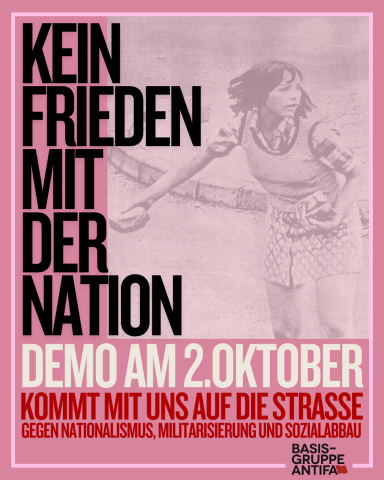
Everything harmless except Nazis?
Patriotism, love of homeland, pride or dominant culture are different terms for the same social relationship: nationalism. However, a supposedly relaxed or cosmopolitan patriotism is not and has never been harmless. The “summer fairytale patriotism” of 2006 paved the way for the national normalization on which authoritarian and right-wing forces have been building ever since.
However, nationalism does not simply function as manipulation from above, but is based on a real material basis. In a capitalist society in which people constantly compete for work, living space, recognition and security for the future, the national community appears to be an apparent way out of isolation and powerlessness. The interest in the success of one's own state and one's own nation then acts as one's own interest.
Nationalism must always create an inside and an outside. Anyone who does not belong to the nation is declared a threat, competition or burden, exploited, excluded or left to die at the external borders. Anyone who identifies with the nation, on the other hand, always says yes to the relationships of power and violence that hold it together.
Anyone who takes part has nothing to fear? Oh but!
Internally, social peace was achieved in the past through social equalization and the involvement of some wage earners in mass consumption. This was able to work because the national economy was doing very well: industrial growth, fossil energy and successful global market competition made it possible to combine the welfare state and location policy.
Today these foundations no longer exist. Climate change, scarcity of resources, fragile supply chains and geopolitical power shifts are limiting Germany as a business location and the ability to buy social peace. In order to ensure the competitiveness of the location, those who are not capable or willing are now increasingly devalued and sanctioned. There will be cuts in addiction support, youth services, women's shelters and health care. For those who are not yet dependent on these offers, real wages are falling or stagnating - a constant fear of decline hovers over them. The logic of this constant threat was recently formulated remarkably openly by SPD leader Bärbel Bas: “Anyone who takes part has nothing to fear.” Participation doesn't just mean working and consuming. Young people in particular are increasingly expected to put themselves at the service of the location: through pressure to perform at school, training and work, through “compulsory social years” or the return of compulsory military service. While social security is dwindling, expectations of those who will bear the consequences of the crisis are growing.
No peace with the nation
Externally, nations or states compete for markets, raw materials, trade routes, zones of influence and geopolitical power. In this order, peace was never the overcoming of competition, but only its temporary regulation. The nationalism of others is often easy to understand: the Russian great power fantasy, America First, etc. It is more difficult to recognize one's own national mobilization as part of the same logic - especially where it acts as an “advocate of international law”. The competition between states, which is increasingly carried out militarily, is reflected internally as the militarization of society. While billions are being invested in tanks, ammunition and arms production, the population is gradually being prepared for the new situation: conscription debate, reservist service, Veterans Day. War should once again appear as something for which one must be prepared - and young people as the ones who should lead it if in doubt.
The threat of relegation and militarization in turn fuel an increasingly authoritarian nationalism: the pressure for self-optimization on the one hand and the fear of relegation and isolation on the other create needs for belonging and orientation. The nation offers both: the authoritarian fantasy of being able to master social contradictions through strength, control and military discipline. Willingness to sacrifice, defensiveness and assertiveness appear again as social virtues and, not least, shape gender relations - patriarchal enough, there is more and more backlash.
“A man remains a man and a dog remains a dog” – Ikkimel
Soldierish masculinity means being tough. Against others - and against yourself. Empathy, caring or vulnerability are devalued, while toughness, assertiveness and obedience are celebrated as virtues again. This fits well with a society that increasingly wants to respond to its crises with competition, discipline and military strength.
The nation therefore promises belonging, but only at the price of an authoritarian order based on traditional gender roles. If you want to be strong, you also need those who are protected, guided or excluded. Nationalism and traditional gender roles have therefore always belonged together.
A look at the increasing attacks on reproductive rights shows this clearly. The survival of the nation is regularly explained as a matter of birth rates. Where the population becomes a national interest, the bodies of those who can bear children also become a target. Nation therefore always also means population policy.
Once the people are gone, there is room for people again
The motto of this year's citizens' festival "Many strengths - one country" means renunciation, competition, patriarchal harshness. Between the state mile, the blue light mile, the Bundeswehr presentation and the democracy spectacle, national unity is staged as an ideological response to the crisis of the location. What is celebrated there are social cuts, militarization, anti-feminism. Nationalism is not the answer to the crisis. It is the form in which the crisis is managed. The concerns of individuals become concerns about Germany. Time to turn this tables around. Therefore, come with us to the streets against the unity celebrations - loud, angry, anti-national - to remind people that they are, above all, human beings and not (just) Germans. Turn the spectacle of nationalism into a disaster!
Pictures: web address: basisgruppe-antifa.orgLicense of the article and all embedded media:
  Creative Commons by-sa: Share Alike
Read the full story at the source →
Source: de.indymedia