
Labour Green Left (Australia)
Update from France: Towards an explosive general strike?
The sharp upturn in class struggle continues in France, with school students and workers demanding more for ordinary people and far less for bankers and billionaires, reports John Mullen .
English (original) ·Read in Deutsch ⇄
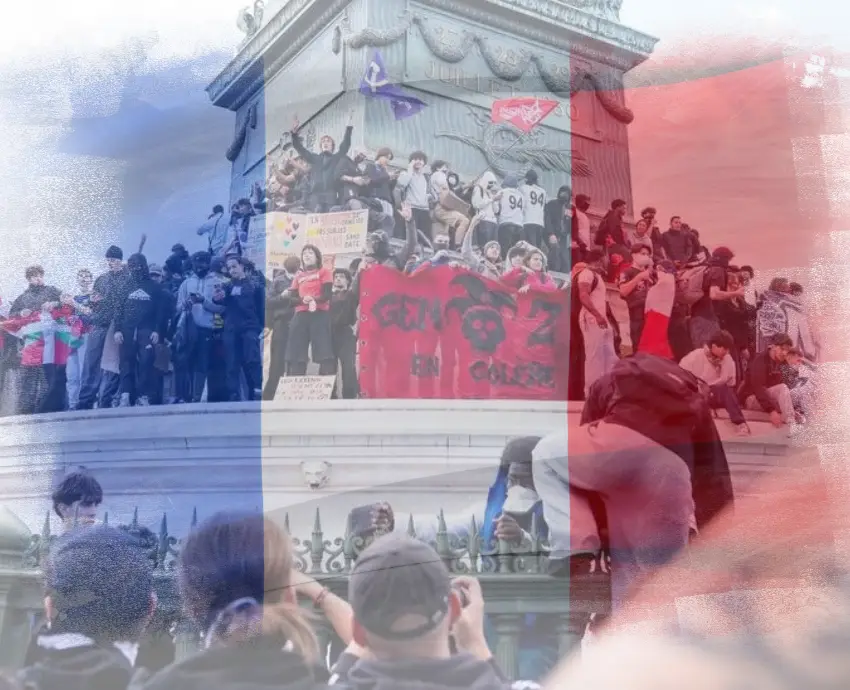
The sharp upturn in class struggle continues in France, with school students and workers demanding more for ordinary people and far less for bankers and billionaires.
The Emmanuel Macron government is setting up ever more authoritarian institutions and practices, demanding harsh sentences for those arrested, and mutilating teenagers, while making minor concessions. The trade union leaderships are calling, mostly half-heartedly, for mass strike action this week. An explosion is possible.
The hundreds of demonstrations on October 24 and 31 were a major victory for the movement. The government's attempt to scare people off the streets failed. Despite bans and curfews and a solemn presidential speech ("we recommend that people do not demonstrate"), despite invented figures about injured cops and the cost of damage to public buildings, the movement is going forward.
Many were too frightened to go to these protests (two more people were mutilated by cops on the 24th), but more turned up, in an atmosphere of joyous revolt. Support is flooding in from very varied places: the magistrates' union, for example, has denounced the "brutality" of police action, a group of Catholic activists published an open letter to their right-wing bishops entitled "We are proud to take part in the uprising", and the Louvre museum was blockaded last week by Fine Arts students.
The repression was ratcheted up. For the 31st, demonstrations were banned in many city centres and peripheral routes were imposed. More than 100 towns and cities have been affected by curfews or restrictions on assembly.
This week, using the excuse of the rioting in mid-October, Macron is trying to push through parliament a new law. It increases penalties for looting, but would also impose heavy punishment for refusing to leave a demonstration when the police tell you to; it would give police the power to ban individuals from attending protests for up to three years, and allow the authorities to confiscate wages or social benefits of people "present in an assembly" where looting takes place (even if the individuals involved are not accused of any offence).
The far right, which hopes to win the presidency next May, applauds every new repressive measure.
The government seems to make additional minor concessions each week. We have seen 3000 replacement teachers hired, smaller classes (of 28 pupils) announced for 15-year-olds, 15,000 more student places promised in higher education, small increases in grants for poorer students, and more loans for regional governments to rebuild crumbling high schools.
This week Macron announced "a complete remoulding" of the hated Parcoursup platform, which controls who gets into which university … in 2028, long after the next elections! Some concessions answer student demands directly, but far more is needed.
Working-class combativity has long protected some aspects of French education from neoliberalism: enrolling in university costs less than €300 a year, for example. But this movement is not a defensive one. It is demanding more: 250,000 more places in higher education and €5 billion for school buildings, for a start.
As high schools and universities finished their autumn break on November 2, there was little sign of calm. A regional university student coordinating meeting, with representatives from a dozen universities, met for the second time on October 31: just one example of the important grassroots initiatives building the revolt.
That same day, almost all docks in France were closed as workers struck both against war and against proposed cuts in welfare being discussed in parliament. Their demands include an increase in the minimum wage for all workers.
As I write, the general strike for November 5 is being prepared, in support of the high schools and for increases in wages and hirings. It will be huge.
After a delay by union leaderships — which it is difficult not to describe as criminal — one month after the beginning of the movement, mass strike action has finally been called across the economy by five of the six biggest union confederations.
One of the biggest, the General Confederation of Workers (CGT), is asking strikers to organise workplace meetings and to "generalise the strike on the 5th November and afterwards". (The "renewable strike", re-voted in general meetings every couple of days, is an excellent tradition in the French workers' movement, but it can also be used as an excuse by leaderships to avoid organising stronger action themselves.)
This mix — of a long young people’s revolt the government will not satisfy, rising anger among workers about the cost of living, and a budget being prepared by Macron ‘s government this month aiming at slashing tens of billions of euros from public spending — may be explosive.
In the public sector in France less than 20% of workers are members of a union, and in the private sector less than 10%. One reason for these low figures is that many benefits of union influence are available to non-members. Millions of non-members nevertheless vote for, and are represented by, union candidates for health and safety committees, company councils, industrial tribunals, regional and sectoral wages councils, and other such bodies. Agreements signed by trade unions generally apply to all workers.
The right to strike is part of the French constitution, and non-union workers are legally fairly well protected by the strike declarations made by unions. This relatively solid legal protection means it is very common, on days of action, to have minorities in a workplace taking strike action. One school or bus depot might have 20% on strike, another 80%.
A key historical weakness of the union movement here is its division into six — sometimes competing — confederations. In some sectors, workers tend to just join the biggest union in their workplace. Frequently, though, people choose the union according to their politics. The CGT (which used to be extremely close to the Communist Party) is generally more combative than the French Democratic Confederation of Labour (CFDT). Solidaires (Solidarity) is the most combative and the most left-wing, and less politicised workers don't generally join it.
The bosses and the government can play the federations off against each other, and the union leaders from the more combative confederations can and do use the excuse that "the others weren't ready to fight" to give up the struggle quickly themselves.
National union leaders in France do not receive the exorbitant salaries their counterparts in countries like Britain do, but they are still professional negotiators, and have a strong interest in movements not exploding out of their control.
During the movement to defend pensions in 2023, the big unions called at least 11 one-day strikes, generally a week or two apart. After each day of action, all six confederations met behind closed doors to decide what to do next, and always agreed to move at the pace of the slowest. The result was that the movement did not achieve its aims. There should have been mass rallies in front of the building during each of those meetings!
Rank-and-file workers may vote on the 5th to extend the strike, and this is the main hope for an escalation. But those who say the union leaders should be completely ignored are mistake. We pay their wages, they have mass influence, and we should demand loudly that they lead a general strike. There is easily enough support in the country to make this a realistic option. The government is rattled, so much so that this week they are talking about raising the national minimum wage (by a little). After the May 1968 revolt, with 10 million on strike, the minimum wage was raised by 35%, so the best strategy is not hard to work out.
The upcoming presidential election is on everyone's mind, especially as polling suggests a second-round showdown between fascist Marine Le Pen and Jean-Luc Mélenchon of the radical-left France Insoumise (FI). Placards supporting Mélenchon are a common sight among protesters; FI MPs are actively backing the movement and opposing police violence, drawing loud applause at demonstrations. Meanwhile, right-wing presidential hopeful Bruno Retailleau has gone so far as to call for the organisation to be banned.
What happens over the next couple of weeks will heavily shape the broader political landscape and the elections ahead. Escalation is needed now.
[John Mullen is a revolutionary socialist living in the Paris region, and a supporter of the France Insoumise. His website is randombolshevik.org.]