
Politics Green Left (Australia)
Brazil: Lula’s election victory was won in the streets
Brazilians and their supporters in Australia mobilised ahead of Sunday’s election in Brazil, which delivered a comprehensive win to Lula da Silva, following his first-round defeat, Cas Smith reports.
English (original) ·Read in Deutsch ⇄
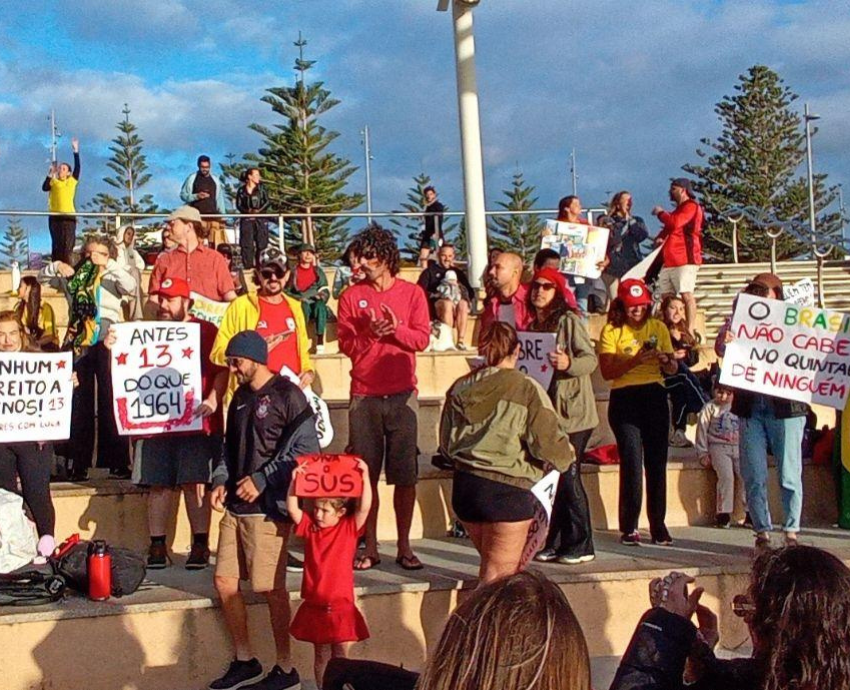
Australia’s Brazilian community joined their compatriots worldwide in a wave of street mobilisations in support of incumbent President Luiz Inácio “Lula” da Silva, ahead of his election victory on October 25.
Lula, who was first elected president in 2002, pulled ahead of right-wing opponent Flávio Bolsonaro — the son of jailed former President Jair Bolsonaro — winning the second round run-off election by 4.4 million votes.
Significantly, this came after Bolsonaro won the first round on October 4, which prompted Brazilians to hit the streets in a significant movement to bolster Lula’s profile, and to prevent a “second Bolsonaro” presidency.
Students and the country’s working class largely led these mobilisations, which included a gathering of more than one million Lula supporters on Rio de Janeiro’s Copacabana Beach the day before the election.
Around Australia, similar protests were held prior to the election, including at Scarborough Beach in Boorloo/Perth, on October 22. Organiser Pedro told Green Left that many Brazilians were afraid their country could become mired in corruption and instability under a Bolsonaro government.
“Unfortunately, we experienced Bolsonaro snr’s government for four years between 2018 and 2022,” he said.
“They were the ones in power during the [COVID-19] pandemic, which was devastating for the country in many ways, because we were denied access to vaccines and the government failed to invest in our healthcare system; the doctors were completely ignored.
“This was only a tiny part of what this government did — we have seen enough.”
Pedro said Flávio Bolsonaro’s close ties to United States President Donald Trump was a concern, highlighting Trump’s coup against Venezuelan President Nicolás Maduro earlier this year and his influence on far-right Argentine President Javier Milei.
The October 25 election delivered a comprehensive win to Lula, who received 64.3 million votes, compared to Bolsonaro’s 59.8 million. This was the first time that a candidate won the presidential election after a first-round defeat.
Despite Lula’s victory, when the new Congress convenes in February next year, Bolsonaro’s party will control 28 seats in the Senate (35% of the total) and 121 seats in the lower house (24%) as well as five governorships (19%), which — once alliances are factored in — will mean the right will have bigger majorities in both houses for Lula’s next administration.
“We are trying to unite the maximum number of people in this movement,” Pedro said.
“We want to show that we are here for our freedom, our democracy, and we have something to defend against the people who are trying to take over the government again in Brazil.”
Despite Bolsonaro’s initial pledge to annul the outcome, the leader of his Liberal Party, Valdemar Costa Neto, issued a statement on October 26 accepting the election result.
Bolsonaro’s protest revolved around a last-minute extension to voting hours, which prompted him to say, in a post-election speech to supporters, that “We will take legal action.”
This was despite the fact that both sides had called for the extension: Bolsonaro’s camp said that heavy rains in the country’s south (where he enjoys popular support) would prevent people from reaching polling stations.
Lula’s side meanwhile, said that extended voting hours were necessary, citing the alleged restriction of public transport by some city administrations, which they said was an attempt to curtail the working-class vote. Bolstering this interpretation were media reports that Pablo Souza, a transportation official in the city of Salvador, had been arrested on election day.
The decision to extend voting hours was made by Supreme Court Justice Cristiano Zanin, who had been appointed to the court by Lula in 2023, and had previously been the president’s personal lawyer. These factors prompted Bolsonaro to cry foul, claiming the decision negatively impacted his voting base.
However, close analysis of the election results suggests the extension allowed for only 35,000 additional votes across Brazil, comprising 0.03% of the total. Given Lula’s victory by 4.4 million votes, this appears negligible.
Some of Bolsonaro’s supporters questioned the result, with Trump describing it as “another rigged election”. However, he did not go so far as to promise intervention on behalf of Bolsonaro.
Given Jair Bolsonaro’s failed coup against Lula after the latter’s election victory in 2022, many analysts are watching to see what his son will do next. Brazilian news outlet Folha de S.Paulo reported on October 26 that legal advisors and political allies encouraged Bolsonaro to drop his annulment request, based on Lula’s significant victory margin, in addition to its validation by the Supreme Court and election authorities.
Analysing the election, Revista Movimiento, the publication of Brazil’s Socialist Left Movement (MES), said: “The victory, however, has not resolved the country’s political contradictions. Although Lula gathered enough votes to win, the new Congress continues to be predominantly conservative, and will likely hinder any social, economic, and environmental measures or partial implementation of Lula’s program.
“Lula’s re-election demonstrates that the advantage gained in the first round was not irreversible. The combination of in-person mobilisation, digital organisation, a change in strategy and greater voter turnout allowed the president to overcome the initial disadvantage and win another term.
“The result also highlights the limitations of a presidential contest isolated from the composition of the legislature. The left won the national election, but will have to face a strengthened parliamentary opposition and a society that remains politically divided.
“The next term will therefore be marked by a dual requirement: to transform the commitments made during the campaign into concrete policies, and to preserve the mobilisation capacity that helped produce the electoral turnaround. The strength demonstrated in the streets and on social media will be an important political asset, but its influence will depend on the continuity of popular organisation and the ability to convert social support into effective achievements.”
As reported in International Viewpoint, journalist and ecosocialist Iain Bruce, who was in Brazil for the election, said: “This is the most important defeat for the far right we have seen anywhere in the world in recent times, and its impact will be felt worldwide. Seeing those millions and millions of people pour onto the streets across this vast country to celebrate was enough to make you weep.
“The seemingly impossible turnaround in the second round is not a simple electoral victory. It was won in the streets and on socials.
“Immediately after the far-right candidate, Flávio Bolsonaro, won in the first round, thousands of mainly very young people took to streets in Niteroi, across the bay from Rio de Janeiro, to demonstrate against the likelihood of a neo-fascist government in Brazil. The same thing happened in cities in the Northeast, the most impoverished region. This was repeated throughout the country in the three weeks between the rounds.
“In parallel, younger members of congress from a smaller party supporting Lula’s Workers Party, completely revamped the campaign’s lacklustre social media presence. Lula’s Army, a Whatsapp channel launched by André Janones of the Rede party, went from 50,000 followers to a million in two days. Now, it has 10 million.
“What the Brazilian people have achieved can be a huge inspiration for all of us facing resurgent varieties of neo-fascism and the far right in different parts of the world. But they will also need support. We should be thinking now about how to organise that solidarity.”