
Germany · CrimethInc. · 1970-01-01
As long as the iron is hot
Deutsch (original) · Auto-translated to English
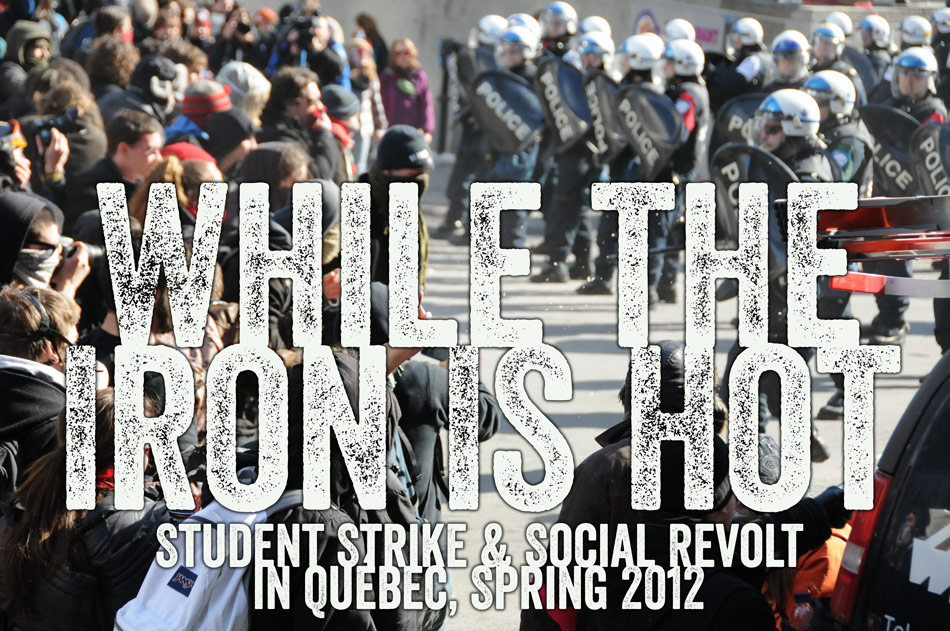
This is the first part of a two-part series; for an anarchist analysis of the events depicted here, read While the Iron is Hot. Anarchist analysis of the revolt in Quebec
In February 2012, as the Occupy movement was in decline, a strike broke out against austerity measures in Quebec's higher education system. As the strike was held back from building occupations that were still possible in 2005, the student movement shifted to a strategy of disrupting the economy: stores were blocked, conferences and tourist events disrupted, and chaos spread on the streets. At its peak, the resulting unrest surpassed any protest movement in North America in a generation. In this comprehensive report, we trace the strike action by action, from its clumsy beginnings to the height of the revolt and the emergency measures that the government sought to suppress. At each stage of development, we examine why the strike took the forms it did and analyze the forces that struggled to drive, suppress, or co-opt it. Like the Oakland port blockade on November 2, 2011, the strike offered a path forward out of the strategic impasse created by the evacuation of the occupations. He also showed that developing confrontational capacity is an infrastructure project, just like any other community institution.
The CÉGEP system is made up of all collèges d’enseignement général et professionel, or cégeps for short, in the province of Québec. Most Quebec students enter these schools at age 17, the same time students elsewhere in North America enter grade 12. There are essentially two options at cégep: programs that prepare students for university and usually last two years, and vocational training programs that usually last three years and provide the student with a type of trade license at the end. For anarchists, the most interesting aspect of the Cégeps is that they are full of teenagers who are not as jaded as their older counterparts and who understand that criminal records are less serious before the age of 18.
FÉCQ, the Association of Students at Quebec Universities (i.e. The Cégeps), and FEUQ, the Association of Quebec University Students are two different student associations that represent most students in the province of Quebec. Even though they represent different parts of the population, their policies are similar and their internal structures are similar.
ASSÉ, the Association for Union Student Solidarity, is the other student association in Quebec. She represents both Cégeps and university students. In contrast to its counterparts FÉCQ and FEUQ, the raison d'être of the ASSÉ is to enforce free and generally accessible education in the province. Her analysis has always been feminist and anti-neoliberal, but not anti-capitalist.
Immediately before the 2005 student strike, ASSÉ and some independent student associations began to form a larger coalition to facilitate organizing. This was CLASSÉÉ, the “expanded coalition of ASSÉ,” whose name rhymes with the French adjective of “totally broke” as well as the verb “to break.” CLASSÉÉ was disbanded after the 2005 strike ended.
For the 2012 strike, a new coalition was formed, called CLASSE – the “grand coalition of ASSÈ”. This name can refer to both school classes and class relationships.
CLAC, the Concentration of Anti-Capitalist Struggles, is a Montreal organization with a long history. In addition to organizing the anti-capitalist May Day demonstrations over the past three years, she has been involved on the Montreal side in mobilizing against both the FTAA summit in Quebec City in 2001 and the G20 summit in Toronto in 2010.
CRÉPUQ, the Conference of Quebec University Rectors and Leaders, is an organization that represents the interests of university administrations across Quebec. Its headquarters are located in downtown Montréal in the Loto-Québec building.
Québecor is a media and communications company that owns, among other things, the right-wing newspapers Journal de Montréal and Journal de Québec. It also owns the Sun News Network, an English-language television channel that can be considered the Canadian equivalent of Fox News
Hydro-Québec is Quebec's state-run water company.
The SPVM is Montréal's municipal police force, while the SQ – the Sûreté du Québec, literally "the security of Québec" – is the provincial police force.
The word "casserole" usually means a casserole dish in French, but in May 2012 it became an adjective added to the word demonstration or manifestation to draw attention to something new: a demonstration in which people march through the streets banging on pots and pans. In Montreal English this is referred to as casserole demo or simply as casserole.
Blocking the entrance to class is arguably what distinguishes a student strike from a student boycott. Both the media and the anti-strike students, who had to talk their way through a strict picket line, often tried to explain to the activists: "Look, you are not clear about what you are doing. This is a boycott and because it is a boycott, other students should not be prevented from going to classes and professors should not be prevented from teaching." The standard argument is that students are consumers, not workers; They are not refusing a service but rather the use of a product that they have already purchased. This is eyewash. Universities are social factories. They produce specially trained workers that Quebec's capitalist economy needs to function: not only skilled workers, but also disciplined workers capable of following orders. At the moment they are producing too many trained workers and therefore production has to be reduced. This threatens many people whose survival or at least their quality of life is tied to this system. One of the best ways to fight back is to stop all production and prevent all parts of the factory from functioning.
While they support the strike to a greater or lesser extent, some unions insist that only workers' associations can legally go on strike; therefore, what the students of Quebec are doing is a boycott. Of course, there were times when anything that could be called a strike was strictly illegal. The fighting spirit of the labor movement encouraged entire states to integrate hierarchical unions into the prevailing order and grant them the right to engage in limited strike action under certain conditions. Background: Prehistory of the 2012 strike
The Liberal government made the decision to convert most of the scholarships in the student financial aid program called Loans and Grants into loans that have to be paid back. All major student associations from the reformist FÉCQ and FÉUQ to the “militant syndicalist” ASSÉ rejected the reform.
The strike began on February 21, when the Association of Anthropology Students at the University of Montreal – a member of CASSÉÉ – approved a strike mandate. Things actually began three days later, on February 24, when more than 30,000 members of CASSÉÉ went on strike. DÉCQ and FÉUQ called strikes on March 4 and March 9 respectively, and by March 15 over 100,000 students from across the province were on strike.
The strike, which lasted a month and a half, was the longest and most disruptive strike in Quebec's history. There were numerous demonstrations during its course: blockades of bridges, blockades of the port and the casino, sabotage of gas stations, disruption of underground shopping centers. There were also confrontational demonstrations with attacks on police and private property. For the government, the negative impact on the economy became more significant than the savings that would have been achieved by cutting scholarships.
The government finally decided to negotiate with “the students” – that is, the leaders of FÉCQ and FÉUQ, but not of CASSÉÉ. Unlike the 2012 strike, in 2005 the reformist associations represented the majority of striking students, and the leaders of these organizations were happy to return to teaching once the government rolled back the reforms. To be clear, they backed down just as the government found itself in a position of profound weakness, missing the opportunity to further increase pressure to secure major concessions. The activists associated with CASSÉÉ denounced the leaders of FÉCQ and FÉUQ as traitors; During one infamous operation, they let rats into FÉUQ's offices. Still isolated in the face of police repression, CASSÉÉ could not continue the strike for long and was soon forced to disband.
For some, 2005 was the year school ended and the strike began.
2005 was the first year in which the student movement used the red square as a symbol, indicating that students were “all red” – an expression that works in both French and English. Without knowing its origins, the students used this symbol of the direct action movement against homelessness that had been quite strong in Quebec just a few years earlier. On March 30, 2005, some activists hung a red square on the huge cross on Mont Royal that towers over the entire city. This became a memorable image of the strike.
Tuition fees have been increased. Enrolling in university cost Quebec students $100 more than last year.
As part of an effort to organize a longer-term, indefinite general strike in 2008, general assemblies at a few isolated schools throughout Quebec, mostly associated with the ASSÉ, issued a strike mandate for November 12th, 13th and 14th. Rigorous picketing was organized, including at Dawson College, the first English-speaking school ever to take part in a student strike. There was also an occupation of the Cégep du Vieux Montréal, which was brutally suppressed by a police operation. It is remembered as the “Tuesday of the Batons”. Efforts to block access to classes were ineffective because of the repression.
There was no strike in 2008. The movement was disorganized. The following year, tuition for Quebec students was increased by an additional $100 and then continued to increase gradually over a specified period, until the 2011-12 school year.
The Liberal government, in power since 2003, met with representatives of CRÉPUQ and the three student associations. Busloads of students came from all over Quebec, but mostly from Montreal, to demonstrate outside the meeting. Inside, the government and CRÉPUQ confirmed to students that tuition fees would increase by $325 every year for the next five years; they insisted that the decision had already been made and there was no alternative. That forced the student representatives to leave the meeting, whereupon a ragtag group of anarchists, communists and other activists tried to get in: they infiltrated the building, spray-painted walls and tried to set up barricades and break down the doors to the conference room before Quebec City police chased them out.
Better than nothing, but not a repeat of the siege of Millbank Tower in London, England, less than a month earlier.
The Social Alliance - an association of seven workers' unions plus FÉCQ and FÉUQ - called for a demonstration on March 12, 2011 to demand a "sensible budget". In a call for an anti-capitalist bloc, anarchists denounced this organization, its rhetoric - especially its appeal to the middle class - and its short-sighted strategy of replacing one political gang with another. When the day finally came, union peace officers identified 12 people wearing black as troublemakers to the police: They were arrested before the demonstration could even begin and charged with criminal conspiracy and carrying weapons. A contact ban was also imposed between them. The conspiracy charge was quickly dropped.
A spontaneous solidarity demonstration was called for that night. Mainly anarchists appeared and there were clashes with the police. A popular saying that night was LE 15 MARS. LA VENGEANCE" (MARCH 15TH, REVENGE!), referring to the annual anti-police demonstration a few days later. Unfortunately, the anti-police demonstration on March 15th was dispersed after only forty-five minutes.
On March 24, the offices of the Montreal finance minister were briefly occupied, followed by a riotous march. A week later, on March 31, during a nationwide demonstration called by all three student associations, the CRÉPUQ offices in the Loto Québec building on Sherbrookestrasse were occupied by some activists affiliated with ASSÉ, including some anarchists. The occupiers quickly negotiated with police to be let out of the building, but people continued to gather outside and refused to disperse until police used stun grenades.
These clashes were indecisive and the strategy behind them was unclear at the time. Nevertheless, they showed that some participants in the student movement were willing to disrupt normal operations.
Shortly after Occupy Wall Street failed to take over Wall Street on September 17th, people in Montreal - as elsewhere in North America - organized their own affiliates. Instead of generating momentum for a strike, many people preferred to shift their energy to Occupy Montréal, a movement that quickly took on many dubious characteristics. These included strict pacifism, the fetishization of the General Assembly, and allowing the participation of a nationalist vigilante group used by civic supporters and advocates of the idea of white supremacy to recruit new members. While established anarchist contexts elsewhere in North America have at least attempted to intervene in the local manifestations of the Occupy phenomenon, anarchist involvement in Occupy Montréal was short-lived.
While others worked to challenge the popular perception that nonviolence was a viable strategy for an anti-austerity movement, Occupy Montréal gave this fallacy renewed credibility. Just as people were struggling to tease out the intensification of capitalist exploitation in its Montreal specificity, Occupy Montréal readily adopted a simplistic analysis unnecessarily imported from the United States. As activists strategized about occupying something, Occupy Montréal had the unfortunate effect of making many people shy away from the word, lest they be associated with the 99% rhetoric.
As rich as Montreal's own tradition of resistance is, it could not compete with a mass-produced zero-eighteen protest culture imported from south of the border.
During the summer of 2011, FÉCQ, FÉUQ and ASSÉ agreed to present the government with an ultimatum for November 10th: Give in to our demands or we will strike. A staggering portion of the movement's resources went into promoting this ultimately appeasing demonstration. Because of the betrayal of the 2005 strike, the involvement of FÉCQ and FÉUQ was controversial among the more radical students.
The day began with pickets at several schools. Some of them, particularly at English-speaking college campuses such as Concordia and Dawson's College, were "soft" picketers who did not attempt to block access; Others, however, were “tough” – although not always effective, such as at UQÀM, where many workers and students were able to slip through the picket line into school.
The demonstration began in the afternoon with some contingents from the universities and the Cégeps of the downtown area meeting on McGill College Avenue. The demonstration marched downtown for a long time, and when it finally returned to McGill University, there was a confrontation outside the Montreal offices of Jean Charest, during which one activist was arrested. This was partly the fault of the demonstration organizers associated with FÉUQ, who sabotaged efforts to attack the building. Several others were arrested nearby during the occupation of the McGill University administration building. Again, the demonstration organizers, this time including ASSÉ activists, sabotaged the efforts of those who wanted to inform the crowd about what was happening near them. Organizers insisted it was time for students to head back to their buses, deliberately ignoring that much of the crowd was from Montreal.
November 10, 2011: riot police enter McGill campus for the first time in 42 years.
If November 10th had been declared a day of confrontation, along the lines of recent actions in defense of education in Italy, Greece, Chile and even England, there would have been fewer people on the streets. But how useful were the additional participants if the result is a passive demonstration that can be ignored by the government? Even if one considers it desirable to issue an ultimatum to the government, would it have been more convincing to underscore that threat by doing something and threatening to continue doing it?
The ultimatum of November 10th was ignored - so the strike began. Two faculty at Laval University and one faculty at UQAM voted in favor of the strike and joined CLASSE. From that point on, the number of strikers grew every day for about a month and a half.
On February 17, 2012, Cégep du Vieux Montréal students voted to go on strike and join CLASSE. The school management had already stated that if the ballot vote was successful, they would close the building to prevent a university occupation like in 2005 and briefly in 2007. The ballot took place online, but as soon as the results were announced, students voted to occupy the building in a general assembly held in the Cégep cafeteria. It is possible that in the course of this discussion it was agreed that barricades should be erected; it is also possible that this possibility was merely discussed. In any case, some began to build it, while some others called on students from other universities to also come to this Cégep, and others still spoke in the assembly.
The brief occupation of the Cégep du Vieux illustrates the negative influence of Occupy in the opening phase of the student strike. The general assembly has long had a permanent place in most French-speaking schools. In this case, a significant proportion of participants treated it as an end in itself rather than a means to an end. As more activists and police arrived at the school, the meeting continued to discuss issues that became increasingly irrelevant to the immediate situation. Furthermore, the participants turned out to be completely unworldly - symbolized by the fact that they continued to discuss whether the building should be barricaded when others had already done so.
A barricade on the escalators leading from the second floor to the third floor during the Cégep du Vieux occupation.
Many Cégep students who were against the strike or simply hostile to foreign aid went around harassing people, preferably anglophones, especially if they were less fluent in French, asking them what they wanted in “our school”. The barricade builders were threatened and provoked, although no real fighting broke out. Elsewhere, some argued violently with "outsiders" and "troublemakers" who had armed themselves with fire extinguishers in preparation for a subsequent police siege, ultimately frustrating them so much that they decided to leave. Still others used the fire extinguishers anyway, but by then many had already left the location with the feeling that things would end badly. There had been a call for general participation, but this was irrelevant to an angry minority who probably did not want anyone to become unruly and found it easiest to attack those who could not speak French or who did not study at that very institution.
There was no plan for the occupation, and while it remains uncertain whether it could have been held successfully if there had been a plan, the lack of preparation did not help. Many people had little idea of the location of the building, which sits on the side of a large hill. This gives the police the opportunity to enter from one of the upper floors and then work their way down into the lobby, where the general assembly and mass of occupiers would have moved at some point. Certain activists began building large barricades on the entrance steps and others on higher floors. Other people were drinking and partying.
During the occupation, no one took action to remove the school's security guards. They were allowed to roam freely and, without being able to stop what was happening, to collect evidence that was later used in criminal proceedings. For the most part, the cameras were neither sabotaged nor at least blocked. One person involved filmed everything, obviously with good intentions. But police later confiscated his camera and used his footage as additional evidence. These failures of action, these failures of thought and the failures to tell people stop the fucking filming, tabernak de câlisse! cost them dearly when subsequent police investigations uncovered a great deal of evidence against those who had committed “acts of vandalism” that night.
Despite a dangerously permissive attitude to surveillance during the Cégep du Vieux occupation, at least one camera got what it deserved.
All told, the occupation lasted nine hours. The last activists in the building were a small group of students who had locked themselves in a lecture hall. The brief occupation of the Cégep du Vieux was the only attempt at a permanent occupation of a university or Cégep building during the entire strike, and its failure had a major impact.
In contrast to 2005, when many of the main buildings were occupied, the police and university administration made it clear from the outset that permanent occupations would not be tolerated. This forced people to take to the streets day after day, making the 2012 strike more visible and disruptive than the previous one.
Two and a half weeks after the strike began, March 7th marked a turning point. There had already been several demonstrations and some blockades of key infrastructure, for example the blockade of the Jacques Cartier Bridge on February 23rd. Until then, the SPVM had refrained from using stun grenades and tear gas; The use of batons and pepper spray was deemed sufficient to push back the students. On March 7, it was high time for the SPVM to expand its operational tactics; it was surprising that this hadn't happened before.
The day recalled the events of March 31, 2011. As on that day, the crowd gathered on Rue Sherbrooke in front of the Loto-Québec building, although this time no one entered the CRÉPUQ offices. The intention was obviously to enter the building and occupy it. The crowd also dragged metal fencing from the area and used it to set up barricades on Rue Sherbrooke, one of the city's main thoroughfares. Riot police attacked these barricades and used pepper spray and batons on the crowd, arresting some people. When the crowd did not disperse, stun grenades were used to disperse people. Shrapnel hit one of the participants, Francis Grenier, in the face. This caused the lens of his sunglasses to be pushed into his right eye, resulting in permanent disability.
Had this been just another moment in which a crowd realizes that the police are no friends - and yet just another incident in which the police cripple someone without any consequences - the incident would have had no significance to anyone except those directly affected. However, things turned out differently.
An Occupy-like meeting was called in Berri Square that evening, with organizers appealing for calm and promising people the opportunity to “express their outrage” later at the meeting. However, as the crowd gathered, angry activists, who wanted nothing to do with the organizers' appeasing rhetoric, urged them to keep their mouths shut. This small group of instigators, the loudest element of the crowd, called on those gathered to take to the streets and most followed them. During the ensuing demonstration, projectiles were thrown at police officers, police vehicles in a parking garage on Boulevard Réné-Lévesque were vandalized, and, in a truly epic moment, people used barriers as battering rams against the main entrances to the SPVM's headquarters while police were still busy gathering their riot uniforms. Sadly, it was the peace police who wrested the barriers from the indignéEs [the outraged] because, in the eyes of the organizers of the meeting, these were not an appropriately passive expression of their outrage.
One of the most audible chants that night was Le 15 Mars, La Vengeance. This was first shouted a year earlier, on the night of March 12th, 2011, implying that the police would pay for their abuses at the upcoming anti-police demonstration held annually on March 15th. This did not occur in 2011; 2012, on the other hand, saw the largest demonstration in the history of this event.
In the week of March 7-15, three developments paved the way for this. Anarchists aggressively distributed flyers and posters for the demonstration on March 15th. There was also an extremely important step in the political development of CLASSE, immediately followed by a very interesting day and night on the streets.
In stark contrast to the FÉCQ and the FÉUQ, all CLASSE decisions are made in a strictly democratic manner. Since February, delegates from the student associations that make up CLASSE and independent activists have met every weekend for two days at so-called congresses to make decisions together. Whatever the problems of direct democracy, the decisions that emerge from these congresses clearly illustrate the attitudes and political consciousness of those present. On March 11, the second day of a convention held in Montreal, members voted to support the anti-police demonstration on March 15 and call on activists to attend in large numbers. This was unprecedented in the history of the student movement - the CASSÉÉ Congress had soundly rejected the idea during the 2005 strike - and the decision had enormous influence on the streets.
This is what direct democracy looks like.
Meanwhile, CLASSE's Social Struggles Committee organized a demonstration on March 13 to link the struggle against austerity and neoliberalism - but not capitalism - in Quebec with similar struggles in Greece, Spain, Chile and Colombia. In front of the high-rise building that houses the Colombian consulate in Montreal, a small group of black bloc activists fought the police and spray-painted a police car. A dispute broke out between pacifists and activists who had come prepared for a confrontation. Images of this were broadcast in the media and used to highlight divisions in the student movement or as evidence that anarchists had infiltrated the student movement. At this point, most of the mainstream media in Quebec attempted to portray some students as legitimate and others as violent. This strategy later changed when the entire movement was demonized and only “the 60% of students who rejected the strike and attended their classes peacefully” were praised.
An Unlimited Creation Night was announced for this evening at the Hubert-Aquin Pavilion on the UQÀM main campus. Activists at this university had called on participants in the movement and the general population to “come to democratize art in a broader sense” – whatever that means. While the advertising was initially vague and surreal, it was obvious that a university building was to be occupied and used for more creative purposes than normal.
The university administration, unsurprisingly, did not want this event to take place. In the days leading up to this, a note on the homepage of the UQÀM website announced: “There is no student-organized event under the name Unlimited Creation Night, regardless of where this information comes from.” On the day itself, the Hubert-Aquin Pavilion, with its large, spacious courtyard, was closed and guarded by university security services; some of the organizers and other activists who showed up at the beginning of the evening were neither willing nor prepared to break in. However, the administration had left another building open.
Pavilion J.-A.-DeSève, right next to the Pavilion Hubert-Aquin, was a less desirable space, but a gigantic party broke out in it and lasted long into the night. Furniture looted from the building was placed on the street, free food was distributed in the entrance hall and people began passing alcohol and other intoxicants around. The “democratizers of art in the larger sense” ran through the corridors with paint rollers, graffiti bloomed in the area around the building and participants sang anti-cop songs; It ended with a spontaneous late-night demonstration through the city, attacking police cars and causing excessive vandalism, before people escaped through the subway, destroying surveillance cameras.
All of this took place in a joyful atmosphere that was very different from the so-called “solemnity” of average passive protest marches. In addition to the fleur-de-lysé flags and empty rhetoric about democracy, such marches are usually depressing for anarchists because young, capable people cheer and look like they're having a good time while having absolutely no reason to celebrate; they race towards destitution without doing anything to defend themselves. During Unlimited Creation Night, people created something new and enjoyable that was worth defending and spreading - something that the state would do everything it could to extinguish as soon as possible. The improbability of the event and the unexpected success were worth celebrating, within and without.
This last aspect makes March 13 very different from the events on the Cépeg du Vieux campus a few weeks before. In this previous occupation, the prevailing view - or at least the most unbearably obvious one - was that the sole purpose of the occupation was to put pressure on the administration and government. This time, however, the cast offered a glimpse of how to relate in a different way, both to one another and to one's urban surroundings.
This brings us to the events of March 15th. In 1997, March 15 was designated International Day Against Police Violence, with Montreal the only city where it has been observed regularly since then. The demonstration usually attracts many young people - mainly homeless youth from the city center and Hochelaga, or black and Arab youth from across the city - as well as anarchists, Maoists and other activists, many of whom are willing to take action against the police. The 2010 and 2011 demonstrations were muzzled by excessive police presence, preemptive arrests of Collective Opposed to Police Brutality organizers, and poor choice of demonstration route and starting points.
This trend was completely reversed in 2012. With CLASSE's support of the march, the number of people gathering at Berri Square far exceeded that of previous years. Although police were able to divide the crowd after being attacked, the demonstration did not disperse. Instead, for the first time since the strike began, several rioting groups roamed different parts of the city center and the police lost all control of the situation. Condominiums, police vehicles and stores were attacked, graffiti bloomed everywhere and some people even managed to loot a Future Shop.
Shocked pacifist in background: “MADAME AND/OR MONSIEUR, what are you doing to my peaceful student movement!?”
Upon attacking a street fighter engaged in property destruction, a vigilante is attacked himself.
One Molotov cocktail was thrown—the first in the course of the strike.
It was not surprising that March 15 was confrontational - it is always confrontational, although not always successfully confrontational. There was no reason to believe that this would change the course of the strike and for several weeks it did not. However, a significantly larger number of people took part than in previous years, and as during the resistance to the G20 summit in Toronto in 2010, they learned that those who resist have a much better chance of escaping. The mass arrest - in which around 100 people were arrested out of the 226 arrested that day - took place late in the evening near the Berri-UQÀM metro station and mainly affected people who were insisting on their right to demonstrate peacefully - long after the SPVM declared the demonstration an illegal assembly.
The fact that there were more people on the streets helped those who came looking for confrontations with the police; Although most people did nothing, they created a significant logistical problem for police officers, who tried everything they could to disperse the crowd or at least push it back onto the sidewalk. The disturbingly warm weather was also a blessing. Unfortunately, as in recent years, no attempt was made to build longer-term connections with the young people who always take part in large numbers on March 15th, but are very rarely seen at other demonstrations. There is little evidence that the city's fringe saw the strike as relevant to them.
At the beginning of March, CLASSE, FÉCQ and FÉUQ had decided that another nationwide demonstration would take place on March 22nd in the same style as on November 10th 2011, with another ultimatum formulated for the government: "If our demands are not met this time, we will launch a joint campaign to disrupt the economy."
Instead of threatening disruption to the economy and showing what movement in that direction could achieve, CLASSE's strategy was once again to win over the public via mass media. This is certainly important, but it should not be the primary focus when considering the evolving collective power.
Anarchists attempted to blockade Montreal's port to give the day a more confrontational moment. However, without the institutional support allocated to the passive demonstration in the city center, it was not as successful as hoped.
Another image from March 22: “The strike starts today.” An inaccurate statement, but CLASSE’s concerted campaign of economic disruption started soon after.
As the anarchists expected, the government ignored one of the largest demonstrations in Canada's history, with more than 200,000 participants in the streets. As hesitant as the CLASSE Congress had been in expressing support for economic disruption, this led all members of the coalition to believe that the time was now. CLASSE threw itself into the project of stopping the flow of capitalist economics in Montreal, Quebec's economic engine. It progressed from simply supporting demonstrations and actions on the website, most of which were organized by individual student associations or informal groups, to organizing such actions itself. The first semaine de perturbation économique [Economic Disruption Week] began on March 26th. Many more followed.
The demonstrations organized by CLASSE brought huge numbers of people to the streets, but other demonstrations - smaller ones organized independently of CLASSE and with fewer resources available - also saw significant increases in numbers. Trickle-down economics is nonsense, but the trickle-down effect seems to work in popular revolts.
Before we go into what happened, we should note all the demonstrations and actions that have already taken place. ASSÉ activists had already organized various demonstrations and actions during the 2010/11 school year; Their political culture – which was greatly diluted by the inclusion of less militant student associations in CLASSE – was very much oriented towards direct action. In February 2012, student organizations that were members of ASSÉ before 2012 independently organized several demonstrations and actions: a protest march on Highway 40, an attempt to shut down the Center du Commerce Mondiale [World Trade Center] and a blockade of the Jacques Cartier Bridge. These were no small matters, although they were smaller than some of the huge actions that followed in April 2012.
The defining feature of the demonstrations and actions of the 2012 strike was that they began very early in the morning (often between 5:30 a.m. and 9 a.m., most often between 7 a.m. and 7:30 a.m.). Usually their purpose was to disrupt the working day, either by attempting to make workers late on their way to work or by attempting to prevent them from entering their workplace upon arrival. When CLASSE called for economic disruption, there were suddenly a lot more actions early in the morning: a lot more people got up to take part and a space opened up for people to plan their own actions.
There were dozens of actions between March 26 and April 19. The main offices of SAQ, a state-owned company that distributes alcohol, were blocked on March 27, as was the office responsible for distribution in Montreal on April 5. The port of Montreal was blocked for the second time in a week and, thanks to the large number of participants, which numbered around 1,000 by the time the activists reached their goal, it was much more successful than on March 28th. The police were unable to enter the port for over two hours. Further blockades followed on April 5th and 10th.
On March 29, four separate protest marches began at Square Philipps - each marked by a different color representing Montreal subway lines - and spread to different areas of the city center as part of a demonstration dubbed the Grande Mascarade. Endorsed by CLASSE and conducted with logistical support from the coalition, all participants were encouraged to wear masks. The reason was explicitly stated: to establish/normalize the practice of remaining anonymous in the face of police repression. One participant was quoted as saying that the march organizers "are not calling for violence, but if people do, that is why we are on the streets; why we are on strike. It is about creating an opportune moment."
The orange and yellow banners of March 29. Each banner was themed differently.
A map of the itineraries followed by the four marches on March 29.
Some activists took advantage of the moment created by the Grande Mascarade to riot, but not many. Three people were arrested and charged with criminal damage; they were blamed for everything that happened during the day. One of these people was Emma Strople, who was later singled out for prosecution by the police and justice system. The use of civilian police was crucial to these arrests.
National Bank, the only Canadian bank headquartered in Montreal, was repeatedly targeted during this period. On April 4th, the shareholders' meeting at the Queen Elizabeth Hotel was disrupted, resulting in the first mass arrest in Montreal since the evening of March 15th: 70 people in total. On April 11, when a new demonstration with a different goal started every hour for 12 hours, the blockade of the National Bank headquarters was the first action. It lasted about over an hour. From the northeast corner of the building, businessmen physically attacked activists and were subsequently beaten until police intervened with pepper spray. The blockade on the morning of April 11th was probably the most successful of the “skyscraper blockades” genre.
Blocking a car from entering the parking garage at National Bank on April 11.
At the same time, another action - called for by student associations from various Cégeps from the north of Montreal and the suburb of Laval - disrupted morning rush hour traffic for over an hour by blocking the Viau Bridge, one of the connecting bridges between the Island of Montréal and the Island of Jesus. Later that day, demonstrations moved hourly from Square Victoria, some of them causing further disruption. Activists ran through La Baie, a large department store, causing chaos; There were clashes with security services around midday and in the afternoon as demonstrators attempted to blockade the headquarters of Québecor and later the Montreal offices of CIBC, another bank.
The events of April 11, mostly focused on National Bank in the morning.
On the morning of April 13, Concordia University activists, with enthusiastic outside support, organized an ambitious action: the blockade of the university's Hall Building on the second day of exams. In a qualitative break with all previous strikes in Quebec's history, some of the faculty at the English-speaking Concordia University had taken part in the strike, and there had been several small actions on campus - although the strike was a failure compared to what was happening at French-speaking educational institutions. The blockade on April 13th failed when students eager to write their exams poured coffee on the tiled corridor in front of the activists blocking the exit from the metro station to the Hall Building and counted to three before breaking through the human barrier together. The police did not intervene until the activists took to the streets; It was only at this point that the police used pepper spray.
On April 19, a morning demonstration began at Square Phillips and split straight into two parts. The demonstration was announced under the motto On Shutdown Le Centre-Ville [We are closing the city center]. One of the two groups moved to the Montreal offices of the Canadian Imperial Bank of Commerce and blocked the entrances to prevent employees from entering the building; the other group remained mobile and moved through the city center to spread chaos and distract the police. Eventually, this second group joined the blockers; the two groups were ultimately forced to disband by the police. People kicked cars driven by civilians who tried to drive through the crowd; a practice that has become increasingly common at peaceful demonstrations as it is common knowledge that drivers can injure people this way.
In addition to such mass actions, there were attacks on the economy that required only a small number of people, as well as attacks that were less economic than political in their aim. The latter continued as the movement shifted from morning actions and demonstrations to nightly marches through the city. We can place the looting of the Secretary of Education's office in the latter category; Buses full of activists pulled up to the Line Beauchamps office in northern Montreal and stormed the building, destroying everything and leaving employees terrified. The Battle of Victo on May 4th, discussed again later, is another example of political targeting; here the annual convention of the Liberal Party became the goal.
Perhaps the most important economic attacks were those that targeted the subway system during the morning rush hour. On April 16, bags of stones were placed on tracks around the city, causing some confusion. This was repeated on April 25, when two smoke bombs went off on different metro lines and another exploded in Complexe Desjardins, a shopping center that also houses many corporate offices. On May 10, there was even greater chaos as a result of four smoke bombs going off in some of Montreal's main metro stations. Those being prosecuted for this action are the first defendants to fall under any of the anti-terrorism laws enacted after 9/11, which prohibit anyone from perpetrating a terrorist hoax, defined as creating a situation in which it is rational for those affected to believe that a terrorist attack will or is occurring.
There were other attacks that were less strategic and more individual - graffiti, broken windows, night attacks on parked police vehicles - but together created an atmosphere of tension. Such attacks always happen in Montreal, but the number has increased since the start of the strike. On the night of April 15, there was a coordinated attack on four different government offices in Montreal, with windows broken and unignited Molotov cocktails left in the building, likely as a threat - although the logic behind such a threat is opaque. Other targets included SNC-Lavalin, an engineering firm that built security barriers for the G20 summit in Toronto, and the offices of the tabloid newspaper Le Journal de Montréal.
Gallons of red paint on the Montréal offices of the Ministry of Education, Leisure, and Sports in the early morning of April 1.
The aftermath of an attack on a government minister’s Montreal office on the night of April 15.
The offices of SNC Lavalin early in the morning on April 22.
The offices of the Journal de Montréal were attacked the very next night.
These and many other actions could never have become so militant if they had not been in the context of the larger actions and demonstrations that were taking place in parallel all the time. The latter took place far more often than this short “best of” list can show.
In the spring of 2011, Charest announced a new marketing campaign: Plan Nord, a lifeline for his re-election and that of his party. There was a media frenzy surrounding “one of the largest social and environmental projects of our time,” as the government website described it. Propaganda posters appeared in metro stations explaining how this project would create jobs and bring prosperity to Quebec. Anarchists were worried, but it was initially unclear how to mobilize against this project.
Of course, Plan Nord itself has no substance of its own. It is simply an attempt by the Quebec government to put a stamp on the recently accelerating efforts to colonize the Labrador Peninsula. This consists of expropriating the indigenous people from their land and raw materials and using these raw materials to make quick money. They are intended to restore confidence in the future of Quebec's crisis-ridden capitalist economy. Southern Quebec has already been more thoroughly colonized and exploited and now this area is unproductive compared to other advanced capitalist economies of comparable size. But there is no essential difference between what is happening “in the North” and what is happening “in the South.” It is simply a matter of progress, with the development of the North lagging behind that of the South for various reasons. From the perspective of capitalists, it makes sense to identify potentially profitable areas that are not yet being exploited as efficiently as they could be - so the only truly political aspect of Plan Nord is the government's promise to take this seriously, with specific targets for the next 25 years. The rest is marketing and propaganda.
The Quebec government will allow forests to be cleared on the Labrador Peninsula, damming rivers and digging open-pit mines into the land, including uranium mines. The influx of workers will lead to a population explosion; There will be more residents in the many northern cities and probably many new cities overall. There is even talk of building a deep sea port in Unganva Bay to take advantage of the opening of the Arctic Ocean to maritime trade. To connect all these new mines, clearcuts and settlements, new highways will cut up the land.
Many such projects in the north are already underway, long before Plan Nord was announced. On the one hand, the state-owned energy company Hydro-Québec has been building new dams in the Rivière Romaine since 2009, despite resistance from the Innu of Uashat mak Mali-Utenam. Furthermore, it makes no sense to separate the development “in the north” from the ongoing projects “in the south”. Among other projects, capitalists would like to see a gold mine dug into Mohawk land just northwest of Montreal, a new Atlantic-style highway connecting Sherbrooke and New Brunswick across the forests of northern Maine, and a massive expansion of fracking all along the Saint Lawrence Valley. There are also efforts by the legislature to relax environmental regulations, which will also affect every part of the province. All of these projects, along with urban projects such as the new Turcot interchange in southwest Montreal, are part of an overall strategy to transform unproductive areas into productive ones across Quebec.
Taking into account that development is happening everywhere, there are certain reasons why the government has launched a media campaign focused on “the North”.
First: greenwashing. The government promises that 50% of the land north of the 49th parallel would be protected in perpetuity. For this, Charest has already received praise from the United Nations Conference on Sustainable Development by being favorably distinguished from the climate criminal and general enemy Stephen Harper. Liberal environmentalists who would otherwise have caused trouble by starting a Facebook group or placing an ad in a newspaper will be satisfied by only half of Quebec's portion of the Labrador Peninsula being paved with concrete or otherwise destroyed. As a result, radical Earth defenders who refuse to compromise on this issue can more easily be isolated and denounced as unreasonable. Likewise, the government stressed that many indigenous leaders are fully on board and that creating "economic opportunities" for indigenous people will help solve the "social problems" in their communities caused by colonialism. And what could be a nobler goal than ending indigenous poverty?
Second: fate. The distinctive shape of the Labrador Peninsula has often been used as a symbol of national pride and it is this shape that was used for the Plan Nord logo. Nationalist intellectuals have long harbored the dream that Quebec's vast border would be tamed and settled by French-speaking Québécois de souche, because in the event of independence from Canada this would strengthen Quebec's claim to the entire territory and because it appears desirable in itself - even if this undertaking is undertaken by a federalist government. Instead of the left-leaning, social democratic brand of nationalism currently popular among young people, the development of the North offers a different vision of patriotism for those who see themselves as rugged individuals in search of adventure and opportunity: a nationalism that has better things to do than protest in the streets.
Third: Strengthen confidence in the Quebec economy. Since the spring of 2011, the prime minister has flown around the United States and Europe and twice to Brazil to give potential investors a flashing Power Point presentation about the enormous wealth that would be pulled from the ground. Quebec has long had a bad reputation in international business circles for its (relatively) strong unions, its bureaucracy, its (allegedly greater) corruption and organized crime, its discouraging (largely ignored) language laws, and its (somewhat) unruly population. Amid global financial concerns, the Plan Nord campaign emphasizes two points: first, that there is a solid plan to break out of Quebec's socialist malaise, and second, that this area is one of the largest remaining land masses in the world that is not yet thoroughly exploited - so there is a lot of money to be made there. The campaign also aims to inspire confidence among Quebec workers who may be concerned about employment opportunities in the province.
Before the strike, resistance to Plan Nord consisted only of a few lecture events, a few less hooligan protests against conferences and ministerial meetings, a few pranks against non-political engineering students, and working groups that placed Plan Nord in the context of the ongoing colonization process of Canada and Quebec. When the strike began, this changed. In the context of, but looking beyond, the students' struggle against tuition fees, anarchists were able to mobilize significant numbers of people into action.
On March 5, the SQ dismantle a blockade built by Innu land defenders on Highway 138 in the Côte-Nord region.
Militants block the entrance to a skyscraper in downtown Montréal on the morning of April 2.
On March 12, a week after the Sûreté du Québec dismantled a blockade that the Innu of Uashat mak Mali-Utenam had built on Highway 138 to defend their lands around the Romaine River, about 200 people in Montreal demonstrated their solidarity in front of Hydro-Québec's headquarters. On April 2, there was a morning action to stop workers from entering a downtown skyscraper that houses the offices of Golden Valley Mines, Quebec Lithium and Canadian Royalties, companies that actually have no business existence but are heavily implicated in the re-colonization of the North. This action, which caused significant disruption for about an hour, foreshadowed the major blockades of skyscrapers that would follow.
These actions were part of the rising tide of the struggle against Plan Nord, but they were overshadowed, like almost everything that had happened up to that point in the strike, by what happened when Charest decided to give his rehearsed speech in downtown Montreal at the Salon Plan Nord, a massive job fair/development propaganda festival held on April 20 at the city's main convention center, the Palais des Congrès.
Four demonstrations were called for August 20th: one by No Man is Illegal, one by a group of Unnu women who had walked from the Côte Nord to Montreal in protest, one by anarchists (including the organizers of the events of March 12th and April 2nd) and a fourth - by far the largest - by CLASSE. All four began an hour before noon, so activists had to choose which one they wanted to attend. The anarchists mainly opted for the smaller demos not organized by CLASSE.
When people retell the story of April 20th, the No Man Is Illegal demonstration is often forgotten. On the one hand, because it was the smallest of the three confrontational demos; on the other hand, because it had a different topic than the others. Participants in the other demonstrations may have opposed Plan Nord because neoliberal governments won't redistribute the wealth derived from natural resources according to polite socialist customs, because they want to ruthlessly destroy the industrial death machine called civilization, or because of some other nuanced analysis that takes into account current issues - but everyone was walking to the same place to oppose the same policies and hopefully get uncomfortably close to the same despicable person in the process. The target of the No Man Is Illegal demonstration, however, was a representative of the federal government rather than one of the provincial government: Jason Kenney, the immigration minister, a racist scumbag who certainly deserves some uncomfortable advances of his own.
Kenney was in town to give a lecture titled “Targeted, Fast and Efficient Immigration Systems with a Focus on Work and Growth” at the Hilton Bonaventure Hotel. He essentially argued that market demands should be the primary consideration determining who can and cannot immigrate to Canada. About 100 people were on the steps outside the hotel in a non-confrontational demonstration. There were also two groups of people intent on disrupting the building. The first group entered the building two hours early and waited, dressed as Starbucks customers. The second group arrived just before the event was scheduled and boldly ran into the building before security officers could lock the doors. Both groups united in the building and fought their way past the security guards in the hotel lobby and knocked the last of the doors off their hinges. They broke through triumphantly and, to their surprise, found themselves in an empty room.
At this point they missed the opportunity to knock over tables full of expensive food and glassware, but their faces were not covered and security officers took plenty of pictures. The police who had been monitoring the demonstrators outside by the stairs arrived, but everyone managed to escape into the street. There were no arrests and everything was over by one o'clock in the afternoon, so that participants were able to take part in the later events. Later, when the speech actually began, it was interrupted by some intruders who had tickets.
Meanwhile, the anarchist demonstration started from Phillipsplatz in the city center. Four groups worked together: La Mauvaise Herbe (an eco-anarchist collective), The Collective Against Civilization, the Anti-Colonial Solidarity Collective and PASC (Projet accompagnement solidarité Colombie, which locally organizes solidarity with the struggles of the people of Colombia). Regardless of whether all members of these groups would describe themselves as anarchists, the discourse surrounding this demonstration was explicitly directed against the state and advocated self-determination and autonomous action. Green and black flags on bamboo sticks were distributed among the crowd.
The anarchist demonstration leaves Square Phillips on April 20.
The decision for this demonstration was made long before CLASSE called for the demonstration. The original plan was to march through the city center and give speeches at specific locations - in front of buildings housing offices of companies involved in mining, construction, etc. Eventually it would arrive at the Palais des Congrès and split into a troublesome section and a more child-friendly section. However, that didn't happen. While the demonstration was still roaming through the city center, participants received calls that more people were urgently needed at the Palais des Congrès.
Some participants in the CLASSE demonstration.
CLASSE's demonstration started from Berri Square and marched directly to the palace to confront Charest. She reached the eastern side of the palace via Saint-Urban-Strasse. Activists bypassed the riot police line at the front door by storming the parking garage. In the palace's eastern lobby, there was a lengthy standoff between unarmored police and protesters determined to take the escalators up to the job fair. Eventually, riot police arrived to push the crowd out of the building and then out of the entire area. Many had already decided to retreat before police forced everyone out.
Militants invade the Palais des congrès and fight to enter the job fair.
This was the news that the participants of the anarchist demonstration received from the Palais des congrès. Some of them wanted to abandon the original plan and rush to the palace; others stuck to the planned route; while others wanted to join the Innu women's demonstration in front of the Hydry-Québec headquarters, just up the hill from the palace. This discussion, conducted in two languages in the middle of an ongoing demonstration, took too long for those who wanted to proceed immediately to the palace; they split off. Shortly thereafter, organizers announced that the remainder would go to Hydro-Québec. This meant that both groups were heading in the same direction on parallel streets, with the first group a block and a half ahead.
At this point, all four demonstrations were converging on roughly the same area, but it was still a fairly large area with an enormous number of people. Some demonstrators were closer to the Hydro-Québec headquarters on Boulevard Réné-Lévesque, others were on Saint-Urban Street and were being chased by riot police from the east side of the Palace, while still others fought with unarmored cops and broke the windows on the west side of the Palace at the intersection of Bleury Street and Viger Avenue. At Hydro-Québec, many urged people to go back to the palace, while others argued that people should stay put so as not to give rise to repression against the Innu elders. Meanwhile, the riot police moved down the Viger from the eastern side of the palace to the western side. Coming from the crowd on Réné-Lévesque, from the anarchist demonstration or elsewhere, most of the activists willing to fight headed towards the intersection of Viger and de Bleury. This place became a constant source of trouble.
Fighting with the police at the palace's northwest entrance.
The demonstrators repeatedly tried to approach the Palais de Congrès while the police tried to prevent them, beating demonstrators bloody. First, the riot police carried out a few attacks, once driving the entire crowd down the Vigar, west of Victoria Square. But people stuck with it, came back and quickly realized that they didn't all have to run straight down the street, but could just as easily escape into the open space southwest of the intersection or toward the parking lot on the hill to the northwest. If the police ventured too far out, they could in turn be surrounded: an entire group of riot police were briefly surrounded and pelted with stones before they could use their superior weapons and armor to force an escape route. They could also be injured: During a police attack, two cops were hit with stones and had to be carried away. One appeared unconscious and the other was limping badly. The people attacked the palace for two hours, ran away and attacked again.
A riot cop shoots a flare at anti-Charest party crashers.
A street fighter throws a rock on April 20.
Footage of the fighting between the SPVM’s riot cops and street fighters at the intersection of Viger and de Bleury.
To the surprise of those on the streets, the small contingent of riot police protecting this side of the palace did not receive reinforcements once during the entire period. The police were woefully understaffed that day. There were a large number of police officers throughout the city center monitoring the events, but Montreal often deploys massive numbers of riot police to control riot situations, even as many as 300. In contrast, now there seemed to be only 50 or 60. The obvious reason was that April 20 fell on a Friday, the last day of a long week of forceful actions and passive demonstrations - police often didn't know which would be which and had to prepare for both - and this week came on the heels of several similar weeks. The police force as a whole was worn out and not in its best shape. That's why it was April 20th when the SQ was first summoned to the streets of Montreal: they were needed to take pressure off the SPVM cops.
The events of April 20 demonstrated the growing power of activists on the streets. Many had become skilled street fighters over the course of a few weeks; many had been enraged by ongoing police attacks on their demonstrations and pickets. The counterattack against these forces was not only pragmatic but also cathartic.
Geography also helped. The Congress Palace is located on a lower elevation than its surroundings, with a lower hill on both the north and south sides. The area is full of narrow streets and alleys where fighters in light clothing are more mobile than the police, but also full of large open spaces where it is logistically impossible to encircle protesters. The parking lot also played a big role: it provided protection from snipers firing rubber bullets, a place to take cover from police attacks, and a vantage point from which to throw stones. It also appeared that police were reluctant to tear gas the cars parked there. Last but not least, this area of downtown is full of rubble and debris suitable for making barricades.
A street fighter faces west on avenue Viger, with the parking lot to the left.
The confrontations at this intersection lasted perhaps two hours. During this time, the militants were regularly forced to move from one place to another, but they held one place the entire time: the intersection of Saint-Allexandre and de la Gauchetière, just above the parking lot. Anarchists were gathering there all the time. The police never rushed that far, and they were out of the palace's line of sight. Whenever street fighters were separated from their comrades, they could go there to meet their acquaintances.
Although events felt urgent and fast-paced throughout, in retrospect it seems that it would have been useful to hold an impromptu meeting at this intersection to decide whether some things could be done to improve the odds in the street fight. Could supplies have been obtained from somewhere else? There was time here. Could a collective strategy have been agreed upon? Probably not, but some problems could have been highlighted, such as the fact that many people were throwing rocks without masks in the glare of media cameras. It is unclear what exactly should and should not be communicated on the street, but what is certain is that information multiplies the power and that this “safe zone” might have been a good place for information exchange.
When people decided to leave the focal point at the western end of the palace, they did so voluntarily, but without any apparent collective process. After another police attack, large numbers of participants found themselves in the safe zone. They certainly weren't defeated, but the crowd began to cheer and march towards Victoriaplatz. From there they marched rowdy along Saint-Jaques Street to Saint-Urban Street, attacking the Center du Commerce Mondiale and other places along the way. At the eastern end of the palace, the majority of demonstrators joined the “green zone” of the protest. In contrast to the usual concept of a "Green Zone" group, this group offered sandwiches and back rubs to street fighters as they passed by, including those in "Black Bloc" attire. While they did this, they played music and entertained some people who were unable to find work - who were excluded from the Salon Plan Nord for the duration of the chaos - with strange anti-civilization street theater.
On the eastern side of Viger Allee, where it crosses Saint-Urban Street, a line of unarmored police blocked the street. As some demonstrators pushed north into the Chinese Quarter, militants attacked the cops with projectiles; others soon joined. As the militants approached, the cops retreated until they turned and fled west down the avenue to hide behind the lines of riot police running east from the western flashpoint. The street fighters hunted the injured police like sharks scenting blood. It was the first time during the strike that a large number of police not only slowly backed away from the angry crowd, but fled in naked fear. Some theorizing holds that such events are important to the morale of the oppressed people; events shortly after April 20th seem to confirm this. In the following two weeks there were three more extremely confrontational demonstrations: on April 25th, May 1st and May 4th in Victoriaville.
Unfortunately, the riot police attacked forcefully and pushed the activists back into the main crowd. This marched north through the Chinese Quarter to Saint-Catherine-Strasse. It is uncertain exactly why the train left the area. It's entirely possible that by this point, after at least three hours of street fighting in this area, people were simply bored with the place and wanted to move on to wreak havoc on the rest of downtown. In any case, it was around this time that the Sûreté du Québec finally arrived to relieve the SPVM of the duty of defending the palace, thus allowing the Montreal police forces to regroup and launch a more relentless attack on the demonstration, eventually dissolving it.
Many people had already left by this point, happy with what they had achieved and everyone was exhausted. Before dispersing, the crowd walked past the DPVM headquarters on Saint-Catherine Street and found many empty police vehicles in the parking lot. Some street fighters ran into the square, smashed the windows with hammers, dropped concrete blocks on the windshields and did as much damage as possible until the cops rolled up in vans and attacked them.
It rained heavily on the second day of the job fair. Only about 200 people showed up to demonstrate. A group of them presumably re-entered the parking garage and began vandalizing the cars parked there. This was the justification for the SPVM to arrest a total of 90 people that day.
On Sunday, April 22nd, the weather was good again and the combined demonstration for Earth Day and the student strike was larger than the last “nationwide” demonstration on March 22nd. There were between 250,000 and 300,000 people on the streets.
The April 22 demonstration on the eastern slope of Mount Royal.
Many see the weekend of April 20 as the moment when the movement transcended its limitations as a student movement or even as an anti-austerity movement and blossomed into a genuinely anti-capitalist and anti-system revolt, underpinned by a broader critique. The protesters' targets included the Liberal government, but also many of capitalism's institutions, particularly the police. Perhaps this was because Plan Nord will add an enormous amount of carbon to the atmosphere - if there was one point that united them all, it was this - and because it is an expression of capitalism in its basic accumulating form. Either way, it felt good, and that feeling carried over into the weeks that followed.
Throughout the strike - actually since December 6, 2010, when student coalitions forced the cancellation of a meeting with the government and CRÉPUG - the government had refused to negotiate with student representatives. Charest and his education minister, Line Beauchump, were open to negotiations with the presidents of FÉCQ and FÉUQ, but categorically refused to meet with CLASSE until the group distanced itself from the violence and got riotous members under control. To particularly mock them, it singled out comments made by Gabriel Nadeau-Dubois, a spokesman for CLASSE, in early April: “We [the CLASSE executive] have neither the authority from our members to advocate violence nor to denounce it.”
On April 22, the second day of the CLASSE weekend congress, a motion was passed that was reported by the media as a resolution rejecting violence or “physical violence.” In fact, not everything that can be understood as violence was categorically rejected; it was simply a rejection of violence against people and even with the reservation of the right to self-defense. The members would not have agreed to a broader rejection, but the CLASSE media committee twisted the resolution in a positive way and the media took it that way. This was enough for the government to declare on Monday April 23 that they would sit down at the negotiating table with CLASSE on one condition: no disruptive demonstrations would take place during the negotiation period.
The executive body of CLASSE agreed to this condition. This was both controversial and complicated. No actions were planned for the next two days anyway; So it could be that the executive only agreed to two days without disruption - although some assume that the CLASSE representatives agreed to a longer ceasefire without authorization. In any case, a demonstration was scheduled for the night of April 24th, organized not by CLASSE but by a striking UQÀM faculty. This was postponed for a night, supposedly due to bad weather, and this is Quebec we're talking about - people had been walking through snowstorms throughout February. Otherwise the weather was brilliant. Many believe that the leaders of CLASSE put pressure on the faculty, although it could just as easily have been an effort on the part of the faculty to respect the truce negotiated by the leaders - in which case one wonders why they chose these stupid excuses about the weather.
Some activists who were not part of the striking UQÀM faculty and against the ceasefire organized their own demonstration at the same time and place. The demonstration met at Berri Square and then took off into the streets. Although only a small portion of the crowd engaged in confrontations, no one stopped efforts by some to throw rocks at police or break bank windows. Not much happened and police eventually broke up the crowd, arresting 5 people. However, this was reason enough for Beauchamp to exclude CLASSE from the negotiations on Wednesday morning. CLASSE's senior members insisted that they had not supported the demonstration and that it had been organized against their wishes, but Beauchamp accused CLASSE of playing a double game because the Facebook event for the demonstration had been linked from the coalition's page. In solidarity with the punished CLASSE speakers, the leaders of FÉCQ and FÉUQ also left the negotiations.
The postponed demonstration on the night of April 25th - billed as OSTIE DE GROSSE MANIF DE SOIR, which quickly loses its appeal when translated as "big fucking night demo" - was much larger and involved a much wider variety of people, including a significant number of people politically close to the FÉCQ and FÉUQ and of whom only a few were involved in the CLASSE actions of economic disruption had participated. It is conceivable that many of them only took to the streets for the large passive demonstrations organized by the reformist alliances; when large numbers of people began fighting the police, it could very well be that some were involved in something like this for the first time.
As the crowd gathered at Berri Square that night, many different groups gathered in different parts of the square and indicated their positions to each other through white bicycle lights. They had decided – for whatever reason – not to gather together on the square, but to keep their distance between them; this is the only time this happened during the strike. As the crowd began to move, there was a group of about 75 street fighters at the front of the demonstration and another group of about 50 people in the middle; the rear group did not know about the front group until they passed areas that had already suffered significant property damage. Both groups began collecting stones and chunks from the pavement very early on and storing them in bags. As the night progressed, the police came under continuous attack and had to retreat under a rain of stones. At one point a police station was attacked for several minutes; A media source reported that police officers were afraid that Molotov cocktails would be thrown in during the attack. The riot lasted three hours.
After April 25, the peak of the confrontations for the night demonstrations, the situation calmed down as the peace police - in French les paci-flics, pacifiste + the word for "cop" - increasingly attacked street fighters: sometimes simply trying to dissuade people, sometimes trying to unmask them, or trying to hand them over directly to the relevant authorities. Although confrontational actions continued during the period of night demonstrations from April 25 through the weekend before the anarchist book fair in May, they became much more dangerous to carry out. In early May, the SPVM thanked the “collaborators” on its Twitter account on several occasions. Anarchists continued to distribute materials criticizing pacifism and arguing for a variety of forms of action - but generally confrontational actions died down by May 16.
Emma Strople, one of the three people accused by the SPVM of causing mischief during the Grande Mascarade on March 29, was arrested on Tuesday, April 24, for allegedly failing to comply with early release requirements not to take part in any demonstration declared as an illegal assembly. After the bail was paid, she was released from custody on Wednesday morning without any changes to the conditions. She was arrested a second time that night.
In solidarity with Emma Strople, comrades march to the prison where she is being held on April 28.
The SPVM reported to the court that Emma had again breached the conditions of her dismissal. In fact, Metro security camera footage showed she was not at the protest at the time police claimed. Nevertheless, she spent four nights in the Tanguay Prison for Women in the northern area of Ahuntsic; During this period, approximately 75 people gathered for a noise demonstration and walked the 16 blocks west of the Henri-Bourassa Metro Station to the prison. When she was released on April 30, the conditions of her release were modified: within three days she would no longer be allowed to stay on the Island of Montreal, regardless of the reason. She had been sent into exile.
In Quebec, the major unions still see May 1st as International Workers' Day, and that is still a disservice to those who want to make May 1st a day of confrontation with capitalism and the state. For many years there was no separate anti-capitalist demonstration. Instead, anarchists and party communists took part in the union demonstration, collaborating in their own marginalization, even as they spread their propaganda with the hope of “changing the consciousness of the workers” or something with a similar effect.
In 2009, a separate demonstration was organized in the city center, largely by Maoists and anarchists, which made its way to the financial district. There was no confrontation because everyone was waiting for someone else to start. In 2010, the recently re-established CLAC organized a demonstration as part of its campaign to mobilize Montrealers to take part in resistance to the G20 summit in Toronto. Some banners were hung and some graffiti was sprayed. Things got hotter in 2011 when there were more significant confrontations with the police.
In 2012, CLAC endorsed a call by Occupy Oakland for a global general strike on May 1, explicitly calling for “direct action” and “creative destruction.” Perhaps because CLAC is not a purely anarchist organization, there was also a call for an anarchist bloc at the demonstration that emphasized confrontation even more: "Make sure you stand close together and only throw from the front area," it said, addressing the problems that still plague street actions in Montreal. People were also encouraged to dress in black.
A portion of the crowd assembled for May Day as the demonstration leaves the Champ de Mars.
The demonstration began on the Champ de Mars, right in front of Montreal City Hall, and quickly moved to the downtown core. It may have had the largest black bloc ever on the streets of Montreal - maybe 300 people. Unfortunately, this did not result in the resounding success of April 20th.
Part of the black bloc, walking past the Palais de justice towards central downtown.
Militants turning off boulevard Réné-Lévesque onto rue Université.
The police were well prepared for the confrontation and acted more forcefully to break up the demonstration than they had at any other point during the strike. Before any property destruction could have taken place, police declared the demonstration illegal. A tactical police unit that had been running parallel to the middle part of the march attacked almost immediately after this statement, breaking the march into two parts. At and near the intersection of Rue University and Rue Sainte-Catherine, street fighters confronted the aforementioned riot police and managed to hold out for some time.
Militants fought back briefly against an overwhelming police presence on May Day.
Street Fighter University on the rue Sainte-Catherine.
Nevertheless, more police soon rushed in from the south and chased the demonstration for several blocks. She did this through a kind of game of leapfrog. When demonstrators ran away from a line of riot police, the slower police units would board a fleet of (riot) vans, which would then drive past another line of riot police already lined up at the front, and be quickly unloaded to chase the anarchists a short distance again before repeating the process.
The relentless hunting strategy had three effects:
During the chase, a small group of militants - the part that had been blocked - tried to fight the police by running forward, collecting projectiles and then either falling back or waiting for a time when those involved could throw what they had in hand before running forward again. Maybe things would have been different if more people had attacked the police instead of running away. In any case, there was no major effort in this direction at this event.
A large section of the crowd on rue Sherbrooke, immediately before the police arrived from the intersection of Sainte-Catherine and Université.
Police charging on rue Sherbrooke as street fighters’ flares and Molotovs explode at their feet.
There were a few scuffles later on at Berri Square, but nothing to write home about.
One particularly well-remembered image from May 1, 2012 was a group of masked militants taunting police with donuts hanging from strings from sticks. These cops were in the tactical unit that managed to divide the demo so decisively. The donut gag was funny and still is funny. But if even a portion of the people on the streets that day had been willing to strike first, those cops would have had to retreat and we would have won a landslide victory and not just cheap laughs.
If the general assemblies that later emerged from the casserole demonstrations discussed below had already existed before May 1st, it would have been interesting to see whether an attempt at a general strike similar to what happened in Barcelona on March 29th could have been organized, with roving pickets in the neighborhoods and large-scale closures of many workplaces. It is unfortunate that workplace-oriented groups such as the Industrial Workers of the World in Montreal did not take the call seriously, despite requests from other anarchists. CLAC itself found itself unable to organize a general strike.
2012 marked a further marginalization of the passive trade union demo. While last year the two demonstrations had about the same number of participants, this year twice as many people took part in the anti-capitalist demonstration.
When discussing May Day, it is worth noting that the anarchist call was controversial among anarchists themselves. Many saw it as mere posturing that would achieve nothing more than inflaming the May Day demonstrations and thus facilitating the repression against them. This criticism assumes that the size of the police force - or their preparation or willingness to attack the demonstration - would have been significantly smaller without the call, while the number of militants well prepared for the confrontation would not have been appreciably smaller. It's impossible to know what would have happened, but given the recent history of May Day and CLAC's troublesome origins, it seems unlikely that the police presence would not have been overwhelming.
On April 29, the Liberal Party announced that it would hold its annual conference in the small town of Victoriaville, two hours from Montreal and one and a half from Quebec. The downtown Montreal hotel where the event was initially planned was too vulnerable to blockades, and the Liberals hoped that enough distance from the metropolis would keep the militants from causing too much trouble. CLASSE, other student organizations and some community organizations and unions quickly announced that they would send buses there.
The meeting was held at the Hotel le Victorin in the northwestern outskirts of the city, an area of empty parking lots and fields dotted with isolated low-rise buildings. Victo does not have its own municipal police department, so defense had to be provided by the SQ, a unit that has much less experience in crowd control situations and is less sophisticated in dealing with street fighters than the SPVM. With such a different opponent and on such different terrain, the “Battle of Victo” was unlike anything that had happened in Montreal.
On the strikers' side, some basic things were not organized at all, which would have been less problematic if it had been clearly communicated in advance. Many had been under the impression that CLASSE would organize a real meeting in Victo, for example with a place to stay overnight for the duration of the meeting. It is not clear whether anyone was seriously planning to do something like this. In theory, the Cégep of Victoriaville - in which the student union had rejected the tactics of a student strike, although not the movement's goals - could have been used for this purpose, with the collaboration of the pro-strike students there. Ironically, the Liberals caused the school to be closed on Friday, May 4, by suggesting to school leaders that there was a risk of vandalism on campus.
People got off the buses in a Wal-Mart parking lot about a 20-minute walk south of the Victorin. When enough people had gathered, they marched straight up the street and confronted the SQ, who were holed up behind low metal barricades just outside the hotel's southernmost entrance. The police quickly found themselves exposed to a “bombardment” of mostly empty plastic bottles, but also a few smoke bombs, while all around them people shook the barricades and began to take them apart. It wouldn't have been too difficult to jump over the barricades and push away the visibly frightened police and be able to break into the hotel - but people were reluctant to go on the offensive so quickly and openly allowed the police to put on gas masks in front of the crowd.
Once again, militants hesitated to attack first. The results were predictable.
At the entrance to the Hôtel le Victorin, just before things got hectic on April 4.
This is further away from the hotel, but it’s odd that everyone accepted the low fence blocking access to the parking lot.
SQ cops at the front of the hotel await their turn to suit up. The air is hazy because of militants’ smoke bombs.
Tear gas shells were soon fired and many people were forced to retreat from the hotel. This environment was unlike anything street fighters in Montreal had experienced. Large parts of the area were completely open: fields, parking lots and empty streets that the locals knew better. Coming to the battle zone, there were several apartment buildings nearby and many dug up lots that yielded more stone than can be found on most of the crumbling downtown streets. Four different confrontation lines emerged, and at each one, street fighters lobbed projectiles at police or used apartment buildings' green recycling bins to shield themselves from the rubber bullets as residents looked on. The air was full of a gas much stronger than anything used in Montreal. It was difficult for anyone who had not prepared with gas masks or at least vinegar-soaked bandanas and goggles to stay near the area of action. Everyone did the same thing.
The cloud of tear gas was very thick near the hotel. The smoke bombs contributed too.
Immediately before the SQ attacked the crowd on April 4.
Officers shooting tear gas at demonstrators.
Render unto Caesar that which is Caesar’s: returning a tear gas canister.
Many later reported that Victo was the most intense experience they had ever had. The amount of injuries was staggering. One militant, Maxence Valade, was the second person to lose an eye and another, Alex Allard, almost died from his head injuries. At least three other people were taken away on stretchers. The SQ, which had been instilled since 1970 with the idea that it could one day be the military force of an independent Quebec, wears olive-green uniforms reminiscent of Soviet soldiers and uses armed personnel carriers. Throughout the conflict, their helicopter flew frighteningly low to the ground, probably to intimidate.
An SQ van had been surrounded by the crowd for some time and was ignored by the street fighters until late in the evening. At this point, people began breaking his windows and spraying paint on him, leading a lone police officer to grab a "vandal" and attempt his arrest. Other militants responded and the officer was beaten until he released his prisoner. A patrol car hidden behind the demonstration tried to intervene, but militants surrounded it and broke its windows at close range while the officers were inside; they withdrew and gave up the rescue attempt. It took an attack with a large number of riot cops to save the individual officer.
There were only four arrests that day. When it became clear that the majority of militants no longer wanted to be bombarded with projectiles, the crowd retreated to the Wal-Mart parking lot and most boarded the buses without incident. Three buses that left later than the others were stopped by the SQ on the way out of town, and one of them - the bus rented by organizers from McGill and Concordia - had to return to the SQ station in Victo so that the tear gas-soaked passengers could be identified and properly charged. This was the only bus affected by criminal charges, although there appears to have been a plan to intercept the other buses when they returned to Montreal; Fortunately, the sympathetic bus drivers let people out at locations other than those originally planned. At the Victo train station, people on the McGill/Concordia bus were held in the vehicle for 10 hours, under the supervision of armed SQ guards who patrolled the aisle and prevented people from speaking.
Although the Liberal Party meeting was delayed, the event was not called off. After everyone left town at the end of May 4th and no one wanted to stay another second, the rest of the congregation saw no confrontational protest at all, just colorful signs. Those interested in direct action can see this in a positive light. The point was not simply to protest what the Liberals were doing, but to invade the Hotel le Victorin and physically engage with some of the people who were so directly affecting us. People made a great effort to do this on Friday, May 4th, and unable to do so afterward, they went home to lick their wounds - a much better use of their time than hanging around with no repercussions.
Another lesson of the Battle of Victo: As long as the militant resistance is always concentrated in Montreal, it is doomed to lose. In this particular city it is normalized to the extent that it can be incorporated into the strategic calculations of the authorities. Of course, they ultimately want to end it, but if it remains confined to Montreal for the time being, it will be much easier to control. Whenever there are attempts to expand the borders in other parts of Quebec, it comes at a heavy cost. This was evident not only on May 4th, but also in the SQ's brutal attack on tough school pickets in the Outaouais and the suburbs north of Montreal. Despite all this, the ability to extend our power to other regions of the province and, above all, to support the culture of resistance there is crucial for the future.
As a result of legal action against some anti-strike students at a small Cégep in the north of the province, the Quebec courts issued an interim injunction on March 30 prohibiting protesters from doing anything that would prevent a student from that university from attending classes. In the following six weeks, at least 38 further orders of similar content were issued. Nevertheless, the picket lines continued. In particular, in Gatineau and Sainte-Therese, near Montreal, and in the Collège de Rosemont within the city, riot police were called in to break up the pickets.
In Montreal, where fighting spirit was strongest, the orders proved unenforceable; There simply weren't enough police to send to colleges to keep them open. Perhaps the most notable action to defy the orders took place on April 12 on the campus of the elite Université de Montréal. Hundreds of activists broke into two buildings; Thousands cheered as a battering ram was deployed before their eyes. Those involved in the campaign sprayed graffiti and destroyed computer systems by cutting fiber optic cables in over twenty seminar rooms.
A sampling of the chaos at the Université de Montréal on April 12.
Gallons of paint stain the auditorium floor after an occupation.
It is understood that since May 10, when negotiations between government officials and student representatives failed for the second time, Charest and his cabinet began to consider an emergency law to restore order and paralyze the movement. Apparently, it was a heavily media-covered incident at UQÀM on Wednesday, May 16, that was the last straw for the Prime Minister: having failed to stop students from entering the building, hundreds of masked activists instead roamed the campus, storming seminar rooms and attempting to prevent classes from taking place by shouting "scabs!" shouting or even physically trying to remove people from the rooms. Similar actions had been taking place at UQÀM for months, but with the help of the media, the government exaggerated this incident on Wednesday morning in order to announce its loi spéciale in the evening of the same day, which was supposed to end the crisis. The law was passed at midnight on Friday, May 18th.
Charest's law prohibits demonstrations of any kind within a certain radius of a university or Cégep campus and threatens heavy fines for anyone who does anything to prevent students from attending their classes: between $1,000 and $5,000 for individuals, between $7,000 and $35,000 for student or union leaders, and between $25,000 and $125,000 per day for student organizations or Trade unions. The law also requires the initiators of any demonstration of more than 50 people to submit a route plan at least eight hours before the start of the event, although the police are allowed to change the route to avoid threats to “public order and safety”. For the eleven universities and 14 Cépegs that were on strike, the law suspended classes for the winter semester and stipulated that the canceled events would be made up for in an extraordinary teaching period in August and September. The law expires on July 1, 2013, although it is possible that it will be renewed or that parts of it will become permanent.
At the same time, a new version of Montreal Municipal Ordinance P-6 came into force, which is explained below. Although Gérald Tremblay's law, unlike the emergency law, had been used consistently against protesters since May 19, and although these additions to the existing law are permanent, Regulation P-6 received only a fraction of the attention from the mainstream media, the revolutionary and reformist left, and the anarchists. You have to be aware that every single demonstration that has taken to the streets so far has been chanting ON S’EN CÂLISSE LA LOI SPÉCIALE! - essentially: “We don’t give a shit about the emergency law!” - each of these demonstrations was declared illegal by municipal ordinance, not by provincial government law.
Municipal Ordinance P-6 was introduced in 2001 and stipulates that police have the discretion to declare any demonstration illegal if they have reasonable grounds to believe that it would lead to “riot” or otherwise endanger public order. It also bans the bringing of blunt objects to demonstrations, namely baseball and hockey sticks - famous for their use as tear gas canisters to fire back at police during the anti-FTAA demonstrations in Quebec City in 2001. The first fine under this municipal ordinance was originally between $100 and $300, for the second offense $300-$500 and $500-$1000 for each subsequent offense. The new version of the law increases fines significantly, so that the first offense now costs $500-$1000, increasing to a huge $3000 for the third and subsequent offenses. It prohibits covering one’s face “without a reasonable reason.” Scarves, masks and hoods are specifically mentioned. Like the special law, it requires full cooperation with the police, for example if it requires that the entire demonstration route be disclosed to them in advance.
On the evening of May 16, the largest noise demonstration ever held in Montreal took place at the women's prison in Tanguay in solidarity with the women held there for their alleged role in the May 10 smoke bomb incident mentioned above, as well as with all others facing judicial repression because of the strike events. After a massive fireworks display, a 10-minute back-and-forth with the prisoners and the release of a smoke bomb underneath an SQ vehicle - it was the provincial police who monitored this event - a hundred or so demonstrators returned to the Henri-Bourassa metro station, flooded the cops inside, jumped the turnstiles and took a southbound train that left at the best possible time. A chorus of "Berri! Berri! Berri!" began, and people got off at the Berri metro station and joined the night demonstration, taking part in the first of a series of confrontational demonstrations of this type over the next few weeks. It was broken up after forty-five minutes and several banks were damaged.
The night demonstrations were re-energized by Charest's promulgation of the special law, rather than by the constant effort of a small CLAC-affiliated group of anti-capitalists who sought to counter Tremblay's mask law with explicit pro-mask demonstrations. This shows the problematic results of the popular focus on certain politicians as bogeymen. Since at least 2009, Tremblay has tried to criminalize masking, for example to tame the March 15 demonstrations; now he is using the strike as a golden opportunity to achieve this and to advance his project of transforming Montreal into a respectable city for bourgeois colonizers and transnational capital. However, Montreal's city parliament attracts less attention than the ideologically charged National Assembly, and the mayor is equally unsuitable as a polarizing political figure.
Laws themselves can also serve as a bogeyman and distract from the root of the matter. There is a huge outpouring of popular anger against the special law, which is widely seen as contradicting the Charter of Rights and Freedom and is currently being challenged in the courts. If the law is actually implemented, it could end up creating more anger among the population. On the other hand, there is no controversy over Municipal Law P-6, although it was used to suppress the movement. In fact, whenever there was an outcry on Twitter that "this demonstration was declared illegal due to the special fascist law," the SPVM was able to satisfy the tweeting intelligentsia with the following simple correction: "No, actually this law was not applied at all. Instead, the demonstration was declared illegal by the municipal code." It shouldn't matter under which statute it was made illegal, but somehow this reluctance by police to use this controversial law is seen as a moral victory for those who support the students, even if the same purpose has been achieved with other laws. Anarchists should note how many activists have failed to address the law itself as a weapon that can be used against us.
The night demonstration on Wednesday May 16th was the most confrontational in some time and the pacifist objection to confrontational tactics was significantly more cowed than had become usual. People were angry. Over the next few days, anarchists from all over the continent came to Montreal for the Anarchist Book Fair, probably the largest annual gathering of anarchists in the territory of the Canadian state. It's tempting to think that this influx of anarchists explains why book fair nights were particularly crazy. In fact, that is unlikely. For many in Quebec and especially in Montreal, Charest's special law represents a step towards fascism that they urgently need to resist.
The demonstration on Friday night, May 18, was the third occasion during the strike that Molotov cocktails were used against the police. Two were thrown at the police at the corner of Boulevard Réné-Lévesque and Saint-Laurent, but did not hit their target. From this point on, the police declared the demonstration illegal and used tear gas and stun grenades; however, they were only able to make four arrests during that night. The demonstration lasted until 3:30 a.m., with various groups moving through the city center and the Plateau district to the north. After the initial clash, much of the night remained passive, but not entirely: banks and other corporate offices were attacked in Plateau.
Police on Friday night, the weekend of the book fair.
Anarchopanda, a controversial figure, crying on May 18.
Saturday night was marked by a crowd of mostly bar patrons joining the street protesters, as well as some particularly random and stupid acts of violence on the part of the police. On Saint-Denis Street, during an attack on a group of militants, they began beating an elderly man who could not run fast enough. On the same street they made their way onto the terrace of Le Saint-Bock, a pub. Some of the guests on that terrace wore red squares - common in any gathering in Montreal these days - and some of them scolded the police when they attacked militants a few meters away.
There was considerable exchange of projectiles between police and protesters at the entrances to McGill University and then at the intersection of Rue Ontario and Boulevard Saint-Laurent. In the second confrontation, the militants were blocked from moving south by a police line, but they had an advantage by being higher up the hill and so rained an enormous amount of stones at the police. If another riot police unit had not begun moving east along Rue Sherbrooke - their goal was to block Saint-Laurent from the north and encircle the demonstration - then the demonstrators might have been able to break the line towards Ontario.
After this confrontation, the demonstration continued east to Rue Saint-Denis, where they encountered a large group of bar patrons who welcomed them. A mix of militants and excitement-seeking drunks built a large bonfire at the intersection of Saint-Denis and Ontario. As police arrived, people retreated to nearby Berriplatz but were quickly dispersed as police used an overwhelming amount of tear gas. A total of 69 people were arrested.
Sunday night the police were ordered to arrest many people; there were a total of 308 arrests. From the start, the demonstration was marked by violent confrontations, with many militants taking the initiative to specifically break out and rain stones on the police. The SPVM responded by repeatedly attacking the demonstration with the aim of fragmenting it into smaller, manageable groups. At one point a large number of street fighters found themselves surrounded. Before they agreed to be arrested, they counted down, attacked, and broke out of the cauldron. Some were injured by the police batons, but everyone escaped. Others, unfortunately, did not, including many anarchists who came to visit from other cities.
These were the nights when many of the anarchists from outside the city witnessed the events unfolding in Montreal. That was the time when the strike was perhaps at its most exciting and beautiful. The number of people on the streets, the ferocity with which they fought even in the face of an emboldened and highly brutalized SPVM, the knowledge that some people broke through a cauldron and escaped what would otherwise have been a mass arrest... these made good stories for visitors returning to their hometowns, no matter how many were arrested and brutalized.
In the following days, the street demonstrations became more passive, but this did not stop the SPVM from attacking, chasing and arresting people. Monday night's passive demonstration was a brief respite from the chaos, likely because both militants and cops were exhausted from the weekend. This demonstration did little more than walk to Charest's mansion in one of Westmount's wealthy neighborhoods, stand outside and shout.
Tuesday, May 22, was the day of a nationwide demonstration in Montreal and the 100th day since the strike began. A massive crowd poured into the streets, reinforced by busloads of militants arriving from Toronto and other cities to express their solidarity, but especially by people who wanted to oppose the special law rather than the tuition hike. At the beginning of the demonstration, the president of FÈCQ called for following the route that the SPVM organizers had revealed so that people could protest “in total safety”. Both the CLASSE contingent and the autonomously organized anti-capitalist contingent refused to obey.
The demonstration, estimated at 400,000, was impossible to control, even with significant numbers of peace police and (probably) civilian police from the SPVM. Taking advantage of this, street fighters thoroughly destroyed part of the city center in broad daylight: banks and isolated police vehicles were attacked, and neither the cops nor the stewards could intervene in any way. That was the only moment of significant violence by militants this Tuesday. Later, when the CLASSE contingent defied the special law by leaving the predetermined route and attempting to meet with the night demonstration that was about to leave Berriplatz at the same time, the atmosphere was less confrontational than disobedient. Both CLASSE's night demonstration and march were brutally repressed, with the SPVM reporting 113 arrests that night.
Wednesday night, May 23, saw the largest number of arrests of any night of the strike: a total of 506 people, including 30 children, who had been banging pots and pans with their parents. It was an almost entirely passive demonstration - only a small number wore hoods or masks and there were virtually no attempts to fight back, despite numerous provocations from police - but it defied new restrictions on demonstration routes. In the city center, the casserole demonstrations came together from all neighborhoods, there were people all over the city. The police, emboldened by new laws and enraged by some recent events, cracked down. This incident disproved the claim that “criminals always get caught.”
A certain part of the debates among anarchists was the question of the extent to which one should concentrate on legal issues. We don't respect the law in any way, right? Yes, it is obvious: since May 19, the confrontational nature of the strike has become less clear. The law affected us. More than that, it affected those who had to reject the law in principle and whose participation in the movement and presence on the streets was so important in creating this moment.
This is a problem and the most obvious answer to it is propaganda. Anarchists must present our ideas in opposition to the ideas of the law. To begin with, if people in Quebec want to talk about fascism - and in fact they are so committed to using that particular term, fascism, that it would be unnecessary to try to persuade them to use more precise language - then we should shift the object of public concern away from specific laws or tyrants. Instead, we should emphasize the fact that legal codes are destructive weapons and, like other weapons, need to be changed and improved from time to time. We should emphasize this in many different places and contexts: emergency laws have survived the emergency.
Finally, there is a tendency to focus on the special law rather than Municipal Ordinance P-6. If we are going to focus on specific laws, we should at least draw attention to the law that is currently being applied. The province's special law faces significant public opposition and is being challenged in court. Municipal Ordinance P-6, on the other hand, is invisible and seemingly innocuous. Anarchists must tear away this disguise by loudly defending the practice of mask-wearing while denouncing any law, government or generalized socio-political system that seeks to suppress it. Direct action-oriented anarchists are more suited to confronting the law on the streets than in the courts, but the utility of attacking it from other fronts cannot be dismissed.
It should now be clear that the movement is not homogeneous and that many questions - about strategy, about ethics, about what matters - have caused disagreement. But as a rule, anarchists are on the same page when it comes to issues that everyone in the movement struggles with. This time, no concerns about using the first person plural: we have rejected the strategy of pacifism, we have rejected “political solutions” and appeals to nationalism, we insist on autonomy in the choice of action and on solidarity with those accused of more violent tactics, such as the defendants in the smoke bomb case. But there is at least one exception to this rule: we don't agree on the casseroles. There is no consensus about how the creation of casseroles helped or hindered the fight against capitalism.
Anarchists who view these positively tend to emphasize that the casseroles are the most socially visible manifestation of popular anger against the Charest and Tremblay anti-dissent laws. They have enabled the movement to spread into areas and social circles where it would otherwise not have been able to take root. They were also reproduced in cities across Canada and the world as a gesture of solidarity. They promoted general neighborhood meetings that contained the seeds of a different kind of collective decision-making. In some places, these gatherings took explicitly anti-capitalist positions and were able to initiate struggles against specific, local forms of capital.
Anarchists who view them negatively tend to emphasize that they (the Casseroles) emerged precisely when it was crucial for the night demonstrations downtown to maintain a high turnout. The situation during the book fair weekend seemed poised to explode, but this did not happen - in part because of the casseroles, which were explicitly intended by some who originally floated the idea to "reduce tensions" and "calm the situation".
Clearly there were valuable aspects of the casserole demos, particularly those that took place in the neighborhoods early on. They brought the strike to many parts of the city at once, and because a large number of people were involved and the casseroles were geographically dispersed, they were difficult to control and contain. They provided many people with a viable form of participation in the movement, in whatever way; otherwise many people would only have read about her in the newspaper or heard stories about her from their children, grandchildren or older siblings. The original idea was that on May 21st, people should bang pots on the stairs, in front of their house, on the balcony or in their window, exactly at 8 p.m., for 15 minutes: no more, no less. People took up the idea and pushed the boundaries of the original concept of a place-based protest; on the night of Wednesday May 23rd there were roving casserole demonstrations in the streets of Verdun, Villeray, Centre-Sud, Hochelaga, Ville Saint-Laurent, the Plateau, Saint-Henri and elsewhere. Many of them started in their neighborhoods but eventually made their way to the inner city cores, making the situation there even more uncontrollable.
The Casseroles also started neighborhood meetings that created potential for people to make decisions with their neighbors that change the character of the place where they live. The assemblies are still fairly new, so it wouldn't be surprising if some of them disappeared or turned into even more farcical repetitions of the worst aspects of Occupy Montréal - although many assemblies have taken measures to avoid such shortcomings. In many neighborhoods, anarchists have put a lot of energy into their local assemblies, which have become explicitly anti-capitalist projects, with committees seeking to continue the strikes through direct action. This bodes well for the start of the special semester on August 13th.
So the Casserole demonstrations made the movement more visible and accessible to people in the neighborhoods. What the Casseroles did downtown, however, is a different matter. Essentially, they pacified the night demonstrations for the second time. The night demonstrations had developed at the end of April as a harsh and uncontrollable reaction to the ceasefire agreed by student leaders and without the consent of the members; It took almost a week for the police and their de facto allies, the pacifist vigilantes, to bring some sort of order to it. On the book fair weekend, the militants overstepped the order with tougher street fighting, wilder than in the night demonstrations at the end of April. The adoption of the new laws, which were widely described as fascist by participants in the movement and all political stripes, prevented those who wanted to prevent physical confrontation with the police from being able to justify their behavior with pacifist slogans. It is widely understood in Quebec that fascism must be fought, perhaps even by violent means. It would be useless for those who want to calm everything down to argue that the new laws are not fascist because - given the hyperbolic political discourse popular in Quebec - fascism is recognized not by objective criteria, but by popular rhetoric. The pacification supporters needed a new strategy.
This was, of course, the casserole. The word is a francification of the Spanish word cacerolazo, meaning “beating a stew,” and refers to a rebellious tradition that first spread during the dictatorship of Augusto Pinochet in Chile during the 1980s; another situation that many people in Quebec, but also many elsewhere, would characterize as fascist. At a time when other forms of resistance could result in death or torture of militants or their family members, the cacerolazo represented a relatively safe way of creating a visible culture of opposition in Chile – albeit still one for which they could be harshly punished.
The situation in Quebec today cannot be compared to the Pinochet regime. No doubt things are bad and getting worse, but people here don't have to worry about the risk of extrajudicial execution for engaging in militant clashes with the police, nor do they have to worry about their relatives being tortured in government prisons. Some would like to claim that the casserole demonstrations replaced the confrontational night demonstrations as the movement's preferred tactic because the situation no longer allowed anything else, but that is simply wrong. They came about because certain people wanted this kind of demo instead of another kind of demo. This means that these people want to express dissent with less risk to themselves.
When street fighting fills downtown Montreal, signals of disorder appear. Graffiti, broken windows, open fire hydrants, sirens, riot police… All these things make visible the social war that is always taking place in this area and they disrupt the aura of stability that Montreal needs to attract foreign investment, tourists and international businesses such as conferences. While noisy demonstrations blocking traffic and decorating the streets with Red Square stickers can do this, it is clear that they do it to a lesser extent; They are also less able to hold their position when the police want to keep them out of certain areas of the city, and they are easier to assimilate into a business-friendly image of a democratic, dissent-welcoming Quebec. Raymond Bachand, the finance minister, prefers the casseroles to the casseurs (rioters). He says he welcomes this new kind of demonstration as good news. Perhaps he likes the message they send: that the movement is tired and no longer capable of causing the economic disruption that will force the government to offer concessions to restore social peace.
It should be emphasized again that less confrontational demonstrations are not bad per se. They are more accessible to people who are afraid or have limited mobility, and also to people who want to bring their children onto the streets without fear of chemical weapons. But casserole demonstrations that start in Berri Square and move downtown will never be as safe as demonstrations in neighborhood neighborhoods - and the initially large neighborhood demonstrations shrunk significantly when the Berri Square demonstrations began to attract large numbers of people who might otherwise have demonstrated closer to their homes.
To spread the revolt and win, whatever that may be, we need different tactics that complement each other. Inner city riots can go hand in hand with generalized cheerful resistance because it makes this cheerful resistance, which also makes demands contrary to the government's austerity program, attractive. But the Casseroles' monopolization of the movement has reduced the power of both confrontational and joyful forms of resistance.
Knowing that pacifists are doing their best to impose their preferred tactics in every area of the movement, it is a challenge to the rest of us to find ways to keep different types of demonstrations separate while making it clear what types of activities are welcome and where. It is difficult to define green zones and red zones, for example when demonstrations take place every night, but in June - when, unfortunately, the chaos in the streets began to die down - efforts were made to associate certain nights with certain types of demonstrations. In some neighborhoods, the lack of energy in the nightly casseroles led people to come out forcefully on certain nights of the week - Wednesday in Saint-Henri, Sunday and Wednesday in Hochelaga - while ignoring the city center. In early June, anarchists and others in CLAC attempted to organize specifically anti-capitalist demonstrations every Saturday evening from Berri Square in the city center. These were intended not only to embrace a variety of tactics, but also to exclude the fleur-de-lysé flag and marginalize those who waved it. Similar efforts could soon gain momentum.
Regarding anarchists in other places, it is important to dispel the myth that simply banging pots together in the streets can create a revolutionary situation. This is obvious, but banging pots still seems to be the most common expression of solidarity with the struggle in Montreal. That's great, we're grateful for the feedback, but we'd much rather see people attack their issues where they are, rather than fetishizing what is, in many ways, a very frustrating element of the fight for us. If you want to fetishize something, why not look at the headlines a few weeks before the casseroles, when "manif-actions" often paralyzed the city center and the police were therefore at their wits' end?
When this report was written in the first week of August 2012, the Anarchist Book Fair weekend was the final period of serious confrontation. By comparison, the Canadian Grand Prix weekend wasn't nearly as crazy, but it was more intense than what happened in the weeks before or after it. It's difficult, perhaps ridiculous, to compare different moments of the strike in terms of some undefined strength, but let's do it anyway: the Grand Prix weekend felt more like a microcosm of the period between late March and early April than the period from late April to early May.
To be clear, a four-day, sustained and militant confrontation with police, as occurred from the afternoon of June 7th to the evening of June 10th, would have been noteworthy at any point prior to the student strike. In comparison, the period from March 12 to 15, 2011 was much less militant and involved fewer participants than the Grand Prix weekend, but was seen at the time as a very hectic time for the anarchists involved.
In the weeks following the passage of the special law and the amendment to Ordinance P-6, CLASSE faded into the background as the main driver of the movement and other groups came forward, including CLAC and some neighborhood meetings. During the strike, CLAC's activities were mostly limited to distributing propaganda materials, organizing demonstrations against Tremblay's mask law and the May Day demonstration. However, while others dithered, CLAC was the first to seriously employ a strategy that had been considered in various quarters of the movement: disrupting Montreal's festival and tourism season. They did this by organizing a demonstration of very confrontational content at the opening ceremony of the Grand Prix weekend on Thursday June 7th, calling for disruption of the Grand Prix in general.
The Canadian Grand Prix, part of the Formula One Word Championship, is the biggest tourist event of the summer in Montreal. There is something to be said about Bernie Ecclestone, perhaps the most important person behind the F1 franchise and a despicable misogynist and racist whose open sympathies with historical fascist leaders are well documented. It is also worth noting that militants in Bahrain had called for the suspension of the Bahrain Grand Prix in April, part of the same franchise, because the event would benefit none other than that country's brutal regime. Many militants here were inspired by the anti-capitalist and libertarian currents of the Arab Spring, and some are directly linked to the struggles in this part of the world, so there was a strong urge to express solidarity with the struggle of Bahrainis. The most obvious motivation, however, was that the Grand Prix is a disgusting spectacle that generates huge profits for rich people in Quebec and elsewhere and does no good for most people here.
In fact, for many who live in Montreal, it's one of the most disgusting times of the year. In the city center, bike paths are closed, there is extra car traffic, and there are hordes of tourists and vendors trying to sell them things. Much of it is concentrated on and around Crescent Street; the local business association claims that “Crescent Street has always had a special connection with racing and cars.” There is the location of the LG Grand Prix Festival, with its musical performances and increased beer sales for the bars down the street.
The Grand Prix and its associated festivities were an obvious goal. It was hoped that a successful mobilization would provide the spark the struggle needed to reignite and remain fiery throughout the summer.
A widely circulated image of Yalda Machouf-Khadir being arrested early on June 7.
On the morning of June 7, several people were arrested in police raids, including Yalda Machouf-Khadir, an anarchist who is also the daughter of a prominent left-wing politician. She and her partner - both now facing charges for crimes at the Université de Montréal on April 12 and at the Education Minister's office the next day - were arrested at their family home and subjected to full media attention; Journalists had been given tips so that they could photograph her being led out the door in handcuffs. The timing of these arrests was clearly planned: they were carried out to intimidate militants and deter them from holding large demonstrations later in the day. It is unclear how well this worked, but the crowd that attended this afternoon's CLAC-organized demonstration was the smallest at such a widely publicized event in months: just a few hundred people.
The goal of the CLAC demonstration was a rich bastard's gala in a converted industrial building in the Little Burgundy district. It started at the corner of Rues des Seigneurs and Notre-Dame, about two blocks from the finish. Starting so close to the event was a strategic mistake. In a neighborhood that is probably the most open, alley-filled and courtyard-rich neighborhood in the entire city, the demo gathered at an intersection that was already blocked by the riot police behind metal barricades to the west and south, so that it was easy for the riot police squads to move into the streets to the north and east and form a cauldron.
That's exactly what happened 15 minutes after the demo was scheduled to start. At this point she was still immobile as people were still trickling in. There were few arrests, but a significant amount of black clothing, fireworks and makeshift weapons were left in the middle of the crowd, which was completely confiscated. All in all, it took about an hour and a half until those surrounded were released.
The autonomous district assembly of Saint-Henri, the district immediately west of Little Burgundy, had organized a district contingent to travel together more safely the short distance from the eastern border of Saint-Henri to the meeting point designated by CLAC. This contingent, probably consisting of fewer than 50 people, gathered in the open area next to the Lionel Groulx metro station - a large area that, like Berri Square, would have been very difficult to encircle. If CLAC had started the demonstration at this point or another open area a little further from the target, it would have been more difficult for the police to suppress it. Given the amount of material that had to be left at the intersection of Notre-Dame and the Seigneur, it is clear that people were prepared for a violent confrontation. The beginning of a demonstration is always the most vulnerable phase, and the SPVM was able to disarm the crowd because the demonstration began in such a vulnerable place. If the demonstration had been able to move, the open layout of Little Burgundy would have caused significant problems for the police, not necessarily at the heavily defended Target building, but perhaps on the commercial Rue Notre-Dame and of course downtown once the crowd had joined the demonstrations held there.
Although several hundred people were surrounded, others were not. They marched around the residential areas of Little Burgundy, disrupting traffic and occasionally dragging objects into the street. At one point the crowd surrounded a patrol car, forced it to drive away as quickly as possible, and gave chase. Little else happened until the encircled crowd was released and everyone gathered to march toward Crescent Street downtown. A brief battle ensued with unarmed police guarding the southern entrance to the street where most of the downtown official Grand Prix festivities took place; People stayed on the streets until midnight, uniting with the night demonstration and also the “ma-NU-festation” – a nude demonstration that took place at night. Despite the crowd's previous disarmament, street fighters still had fireworks and tracer guns to use against police. Although they were unable to re-approach Crescent Street, disruption and property destruction occurred throughout the central downtown area.
Fireworks explode during the Grand Prix demonstrations.
On Friday evening, another demonstration – much smaller than it should have been – started west from Berri Square toward Crescent Street. The SPVM tried to block all entrances to a huge part of the city center, preventing crowds from moving north from Boulevard Rene-Levesque for a long time. The crowd moved west along Rene-Levesque; On Rue Guy, the SQ attacked with rubber bullets and stun grenades, forcing the people to retreat east. These eventually broke through the police lines at Dorchester Square, a large open area that the police could not effectively cordon off; the bulk of the crowd broke north to the crowded Rue Sainte-Catherine, from where they were able to advance west to Crescent Street. At the corner of Crescent and de Maisonneuve, a street north of Sainte-Catherine, the crowd stood around shouting slogans but failed to drown out a musical performance taking place a few meters away until police forced them out.
On Saturday night, police were even less successful at preventing people from entering areas full of tourists. The street was repeatedly taken over, fences used as barricades were used and a lot of destruction was generally caused. Police responded with pepper spray and tear gas, hitting many tourists and other bystanders who were walking through or watching the unfolding events. It was, of course, militants who treated these people with the medical supplies they had on hand. Several businesses and police vehicles were attacked, including two cars outside the hotel where the Montreal conference of the International Economic Forum of the Americas was scheduled to take place the next day.
On Sunday it was quite quiet on the streets, both during the day, during the passive protests against the above-mentioned conference, and at night.
Throughout the weekend, political profiling was the norm on the streets of Montreal and especially in the subway. The SPVM was said to be on heightened alert for any activity that could potentially sabotage transport to and from the race site on Île Sainte-Hélène - an island only accessible via bridges and the Yellow Line subway. People wearing red squares were routinely harassed. If they took the subway line towards the island, they were sent back to Berri-UQAM station. There they were fined for "loitering on the train" on the grounds that they came from one place and returned immediately, otherwise, they were told, they would be banned from Berri-UQAM station for life. One person was allegedly thrown off the subway for reading George Orwell's "1984" aloud; When she had the audacity to walk back to the subway, she was arrested and held without charge for the rest of the day.
In some ways, the mobilization against the Grand Prix was a success. Dave Stubbs of The Gazette wrote just before the weekend that "for the first time in memory, this weekend's 43rd Formula One Canadian Grand Prix is unlikely to be sold out" - and indeed it wasn't. The economy was struggling, and the effects continued throughout the summer: in early August, all major newspapers reported that Montréal had significantly fewer tourists visiting in July than a year earlier.
But the Grand Prix weekend did not have the success of reviving spring in summer. It was a brief period of heightened confrontation during a period of calm. Of the many theories as to why the momentum has subsided, none is conclusive and most lack analysis. Even before the strike, revolutionary activity in Montreal tended to ebb each summer; Perhaps it is not surprising that this summer is quieter than the previous spring, although far wilder than the previous summer. This is no excuse, especially when our enemies do not take time out to gather information, plan and prepare for the coming conflicts. Given the conditions endured by certain comrades and the very real threat of prison sentences, this situation is even less acceptable. But if the movement isn't squashed in a year, next summer's Canadian Grand Prix could be significantly more disrupted.
CrimethInc.com Now Fully Functional in Portuguese
Including Books, Zines, Posters, and Articles
Eight Myths that Keep Your Eyes on the Clock and Your Nose to the Grindstone
Read the full story at the source →
Source: CrimethInc.