
Germany · CrimethInc. · 1970-01-01
As long as the iron is hot
Deutsch (original) · Auto-translated to English
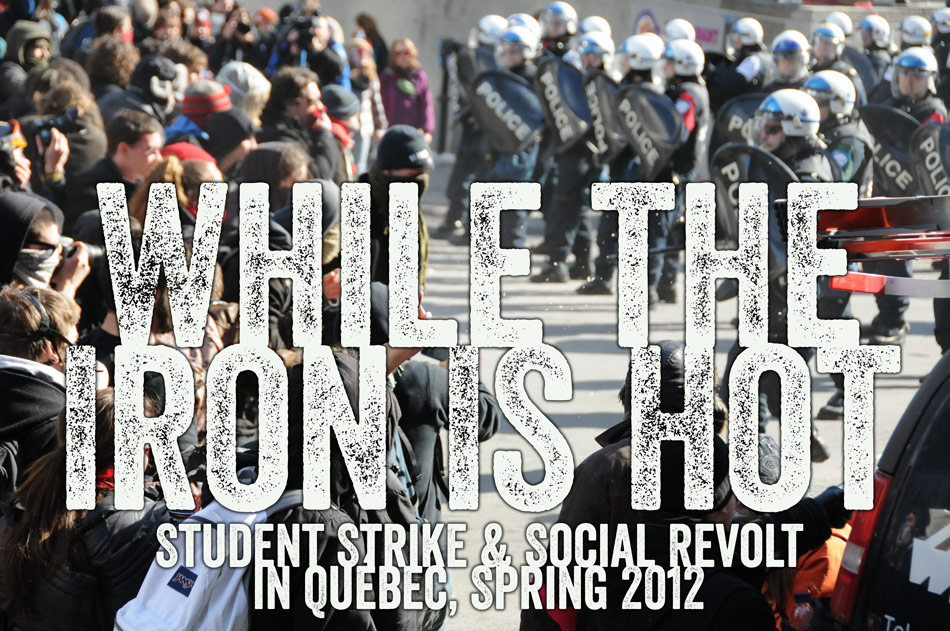
This is the second part of a two-part series; for a chronological presentation of the events analyzed here read [While the iron is hot. Student strike and social revolt in Quebec, spring 2012](/2012/08/14/as long as the iron is hot-student strike and social revolt in Quebec-spring-2012)
To complete the chronology, we asked our Montreal correspondent the following questions, which he answered with the collaboration of other Printemps érable participants. The interview concludes with an epilogue that brings events up to date at the time when the rallying movement began to block the resumption of the semester.
It is important to remember that our coverage focuses almost exclusively on events in Montreal, while the strike had an impact across the entire province of Quebec. The strike has developed differently in this city, a multilingual and sprawling metropolis with dozens of overlapping anarchist scenes and a rich history of anti-capitalist resistance compared to the rest of the province. Many anarchists and other radicals inhabit a limited number of neighborhoods in a ring around downtown Montreal, making it a major trouble spot for the struggle.
How did militant street tactics develop and spread over the course of the strike? What can anarchists elsewhere in North America learn from this?
When one wants to discuss the tactics used by militants in the streets of Montreal and elsewhere in Quebec, and talk about how they have changed, it is often said that the tactics escalated over time, and whenever things were pacified, it is implied that the tactics were de-escalating. Entire demonstrations, some of them incredibly large, are described as confrontational or non-confrontational. This kind of language is woefully inaccurate. These expressions cannot convey more than a feeling, the mood of the moment, but they leave the specific mechanisms of the processes opaque.
The point here is not to argue that tactics can never be arranged in some sort of loose conceptual hierarchy, from those that are less effective in causing harm to property or those defending it - and therefore involve less risk - to those that are riskier and more effective. For example, from lower to higher intensity:
1. Give the middle finger to the riot police, 2. Throw stones at them, 3. Throw Molotov cocktails at them.
The categorization is arbitrary and variable, intensity is not strictly defined, but it can be useful to think about tactics this way.
Compared to most other North American cities, in Montreal the use of certain tactics by street fighters - including anarchists, Maoists and hooligans, whose politics are not well defined - is more normalized and less questioned. This was the case long before the student strike began in February. Black bloc and masks, building barricades or just throwing traffic cones into the street, throwing rocks and other projectiles, deglazing and looting stores... when a Montrealer hears that a hockey riot has taken place, she can make an educated guess as to which of these tactics were used before knowing the details. The same applies to days like March 15th or May 1st, to reformist demonstrations where anarchists deem it worth intervening, and to spontaneous demonstrations that occurred after the police murdered someone.
It is accurate to say that over the course of the strike, a significant number of participants from diverse political backgrounds escalated their street tactics to the same level as the aforementioned anarchists, Maoists and hooligans. Throughout February and March, or in earlier demonstrations such as the one on November 10, 2011, anarchists who employed black bloc tactics or wore masks were often the only ones physically confronting police and destroying capitalist property. This left her feeling strange and isolated to many other people. Although the tension between the pacifists and the street fighters did not disappear, the street fighters were much more numerous afterwards, and some of them were running around with huge fleur-de-lysé flags - a sure sign that people other than “the usual suspects” were taking up the fight against the police.
On the other hand, it would be inaccurate to claim that anarchists as a whole have expanded their practice of street fighting. Since the start of the strike, anarchists have done the same things as usual, the difference is that they do it more often. Every year in Montreal there are reformist demonstrations where anarchists challenge the code of conduct imposed by the organizers, anti-capitalist demonstrations where the only people who want to impose limits on the anarchist street fighters are the police, and spontaneous expressions of anger when the police do something particularly heinous. The strike produced all three types of events at a much greater frequency than they would otherwise occur, but the anarchists' approach to each of these events was essentially always the same.
To be confrontational, it is also inaccurate to say that the movement has become more confrontational over time, as there were attempts to block bridges and highways as early as February and early March, whether they were successful or not. What happened is that at CLASSE's March congress, the decision was made to adopt more confrontational tactics as an organization - after a few of its core members had already been pursuing such a strategy for weeks. This simply meant that there were more resources for those organizing confrontational actions, which led to a greater frequency and diversity of targets: the port, the state-owned alcohol distribution company “depot,” and occasionally downtown high-rises or events like Salon Plan Nord. In many places, the intention of the campus and classroom blockades from the start was not to let anyone in, for whatever reason. And people use whatever tactics were necessary to achieve this goal.
One can argue that as the weeks have passed, militants have gradually chosen their targets more intelligently and carried out their plans more skillfully. But even though they tried to be more confrontational, things were just different at different times and varied between different people. The ceasefire between the leaders of CLASSE and the government, the loss of Francis Grenier's eye, the experience of seeing cops running in fear from you... all of these have had a complex impact on the courage and anger of various participants in the movement, sometimes contributing to a more confrontational attitude.
Having said all that, there were also some innovations on the roads. For one thing, street fighters increasingly brought with them tools—hammers, to be precise—that were used to make projectiles out of Montreal's crumbling streets, rather than foraging for rocks and other projectiles. Second, the street fighters have started counting out loud to coordinate their efforts, whether trying to break out of a cauldron - which worked on May 20 - or throwing stones at the police.
Another novelty was signs, which were rarely seen at demonstrations in recent years before November 10, 2011. The most common sign format is a combination of plexiglass, panels, foam, cardboard and chlorophyll - the stuff election signs are made of - drilled together. The idea of painting them to look like the covers of politically sound books from The Coming Uprising to 1984 came to Montreal from Rome, where students had used the tactic during anti-austerity demonstrations in late 2010. Even if the signs lived up to their promise, especially when made of sturdy, lightweight material like the signs used by insurgent strikers in northwestern Spain, their actual use was haphazard and it is questionable how useful they would be during fast-moving demonstrations on the streets of Montreal. They were useful in the open fields of Victo, and they would have been useful on April 20th if anyone had brought them; On both days both sides had fixed positions and there was less hand-to-hand fighting and more rubber and plastic bullets. On the other hand, in a situation like May Day, it's unclear how signs - which are usually not carried by the strongest people - could be of any use against the relentless waves of riot cops. So far, signs have been used primarily for symbolic purposes: they are mostly carried at passive demonstrations like March 22nd, perhaps an attempt to add a touch of militancy to the carnival of fleur-de-lysé flags and papier-mâché dolls.
There were also interesting developments regarding what was happening on the streets. Especially after the new special law was passed, people in black bloc clothing - and what the media presented as black bloc clothing, such as anyone wearing a mask and looking vaguely "anarchist" - were more often approached by others in the streets and praised: "You're so brave to do things like that." There is now much greater solidarity between people dressed to fight and those who are not, including several cases where unmasked people put themselves in harm's way to pull fellow street fighters from the clutches of police. There’s even a sports fan style chant – ALLEZ LEZ NOIRS! – which literally (and horribly) translated into German means “Forward Blacks!” Crowds of hundreds of people shouted those words at the top of their lungs.
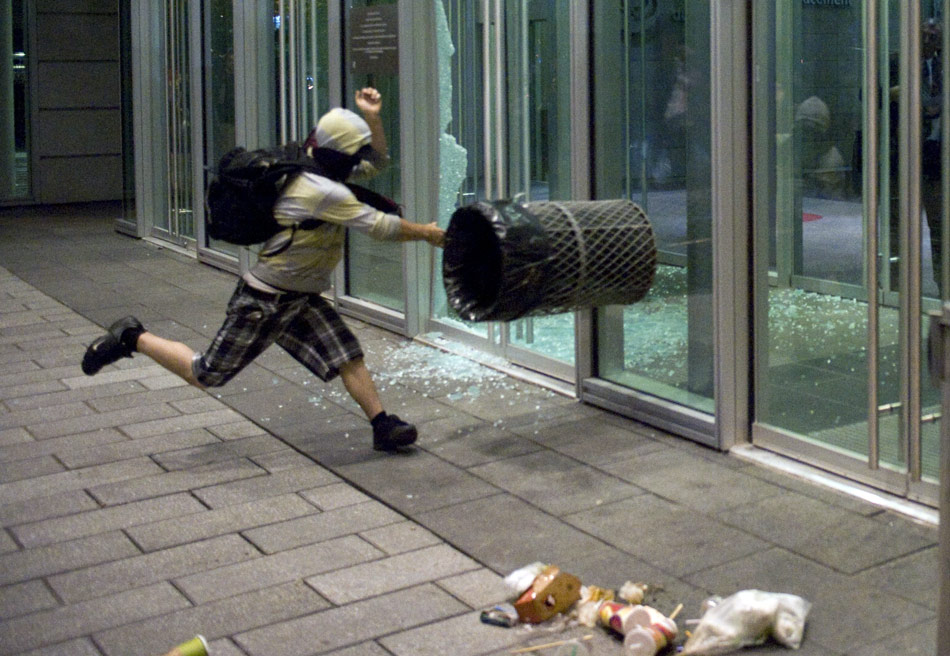
It is now widely understood that it is a good idea to build barricades in almost any situation. This has occasionally led to very good barricades, which consisted of large amounts of rubble, building materials, loose furniture from nearby cafes and - increasingly - fire. However, more often than not people would just drag one or two things onto the street and no one would join in. Sometimes someone would dump trash on the streets without even looking for projectiles, but seemingly believing that doing so would magically stop police vehicles. It's one thing if you don't have the time to build effective barricades or are unable to persuade others to help you. But doing something that has no impact on the police while making the streets more disgusting for the people who live there and unnecessarily annoying them - that's a whole different matter.
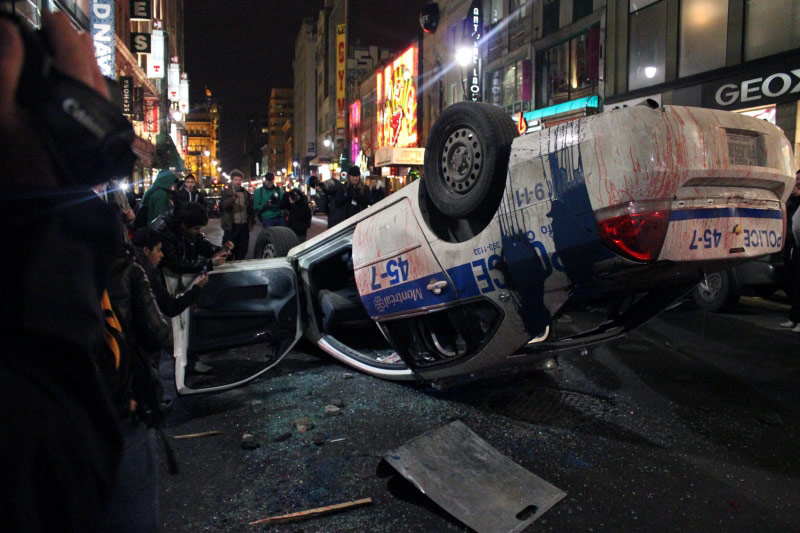
Riot police are able to carry out their interventions because they can move freely through the side streets, but a more widespread practice of erecting strong barricades at the awakening of a demonstration would not only disrupt the normal functioning of capitalism, but also make successful police interventions much more difficult, especially as the pace of the demonstrations increases. Montreal would be a good place to introduce tactics used by European street fighters: overturned dumpsters and luxury cars pulled or pushed onto the street can slow down the police much more effectively than a few traffic cones.
There was also an increasing use of Molotov cocktails, which for a long time was rare in confrontations on the streets of North America. Their use was sporadic and it is unclear what conclusions can be drawn from them. In any case, it is important to recognize that some people are now willing to go to this point.
At first, very few people wore masks or goggles on the streets, but the experience of police brutality and CLASSE's explicit call for direct action and economic disruption quickly changed that. What had always been a small minority became the majority of participants in many demonstrations. All it took was a critical mass of people in March and April that grew through efforts to verbally support the normalization of these practices, whether through the distribution of texts or the explicit recommendation of CLASSE at the Grand Masquerade on March 29th.
In addition to the explosion in the use of masks and goggles, there was a significant increase in black bloc attire by other militants, just as many more experienced street fighters began to opt for the "light bloc" instead. “Light Bloc” means wearing different clothes than you normally wear and hiding your face and other identifying characteristics, but not trying to achieve a uniform appearance. This is in the hope that if arrests are made before the crowd disperses, individual crimes will not be blamed on anyone who gets caught. The reason is that the Light Bloc allows Street Fighters to disappear into a colorful crowd more effectively than in Black Bloc clothing, which prevents Street Fighters from appearing like outsiders. This way they do not attract preventive police attention. One lesson that many local anarchists learned from the March 12, 2011 demonstration - when individuals wearing Black Bloc clothing were targeted and preemptively arrested - is that one should be wary of overusing or fetishizing Black Bloc tactics. Many were skeptical beforehand, but afterward the black blocs virtually disappeared until February 2012, whereas previously they were regular features of anti-capitalist demos.
Some experienced street fighters in the anarchist milieu were critical of the new behavior of regularly wearing black in the streets. They repeated the constructive criticism made after an attempted general strike in Oakland on November 2, 2011. This habit separates street fighters from those around them - arguably inhibiting confrontational behavior rather than spreading it - without significantly improving everyone's ability to confront police, especially since there is ample evidence that people can break the law and get away with it whether they're wearing black or not. Since the street fighters in this city are poor at staying together, it is not uncommon for isolated individuals wearing black to become scattered into the crowd, creating unnecessarily dangerous situations.
Ultimately, there is still not enough communication among those fighting on the streets. People stick to their own groups most of the time; Different groups rarely stay together in a moving demo for a long time, and it is possible that many fighters do not know what to say to others when they see them on the street, or how to tell them. Even if it is clear that it would be important to disseminate information, it is not clear what information should be disseminated and when. the reality of social awkwardness cannot be dismissed. Just like in a pub or at a party, people tend to stick with their friends rather than venture out to meet new people.
Everything is getting better, albeit too slowly. One change is that now, when fighters throw rocks into windows while there are people on the other side of the glass, others often approach them with the suggestion that they use a hammer or a piece of metal from the trash instead. When some throw from behind, others declare that it is better to go forward and ensure that only the intended damage is done.
There is also a growing debate about whether minor economic damage caused by whatever inconsequential property destruction is worth it. Ultimately, of course, the individuals themselves will decide. This debate reflects the insinuation that some anarchists tend to measure the success of an action only by how many windows were broken, how many police cars were burned down, and so on. In any case, by such standards the strike was an unqualified success. Instead of criticizing those who think this way - or those who create this caricature - one might simply accept that there are legitimate reasons to applaud capitalist property damage and recognize that the wider spread and more frequent use of tactics that do this - as has happened in Montreal since February - is a laudable goal.
While we're in the middle of posing abstract hypotheses, how can anarchists make sense of the kind of chaos that recently swept Montreal in their own cities?
There is no easy answer to this. In Montreal, certain anarchists have been working for years to ensure that the boundaries imposed by the state - mainly the police - and sometimes also by the organizers, movement politicians or the peace police during demonstrations, are violated. It is important to see this as an infrastructural project. This includes obtaining and building materials, gathering and dissecting information, making plans, and developing strategic acumen. All this organizing creates and replicates a tradition: confrontation with police is now normalized in Montreal, more so than in most North American cities. But as much effort, energy, and passion as it took, the reality is that Montreal's political culture, different from any of its neighboring cities, made it easier. This culture could not exist without Quebec's unique history over the last fifty years; it cannot simply be repeated elsewhere.
Wherever a militant political culture comes from, however it is cultivated, anarchists should look for those who are ready to fight. In Quebec, this includes students, particularly those students who have participated in some way in CLASSE's campaign against the government. In many parts of North America, it appears that university students – no matter how politicized they may seem – are generally unwilling to translate their politics into any action that might negatively impact their career prospects or their weekend plans. If anarchists elsewhere - many of them students themselves - want to see their cities explode like Montreal, they might want to start by seeking connections with people who might be a little harder to build with, at least initially.
What forms has state repression taken? And how did the participants respond to it?
The state's natural response to resistance is repression. In Quebec, resistance has existed at many different levels and, accordingly, repression has taken a variety of forms.
We can identify three categories of repression here: the tactics that school administrators used to dissuade students from doing inappropriate things; the physical violence that the SPVM and the SQ have developed against the people on the streets; and the conditions that Quebec's judicial authorities, in collaboration with the police and the government, have used to prevent people from carrying out further actions in the future.
Administrators' policies vary from school to school. While many schools - particularly Anglophone institutions - are managed by staunch neoliberals, it is possible that some administrators are more left-wing in some sense. In general, administrators have chosen to do their job without consideration, controlling and suppressing any tendency toward direct action among their students. Some have done their jobs less enthusiastically and less effectively, but they are not allies - far from it.
Many schools have threatened students with a variety of academic consequences and other punitive measures, from expulsion to a certain amount of community service. These measures include failing young people, expelling them, terminating them from university-paid jobs, temporary banishments from campus, and imposing fines - in short, pushing them out or applying pressure until they leave on their own. Since one of the aims of austerity measures is to shrink the secondary education system, any decline in student enrollments is welcome. Universities can inflict less pain than the courts. However, administrators - whose role can be compared to that of the police, as they are involved in enabling the normal functioning of capitalism - have often collaborated with police investigators to secure convictions against militants. Their actions impact people's families, their wallets, and in some cases, their immigration status in Canada. Even without forgetting our criticism of schools and the soulless middle-class lives led by academics, it should be clear that it is unacceptable for people to let these petty authority figures determine their fate.
Various schools, particularly Concordia and McGill, spent hundreds of thousands of dollars on extra security to protect their campuses. Because of the private security issue, there has often been rhetoric to the effect that private security guards are not our enemies in the same way as the police, that many of them are hard-working migrants just doing their job, and that picking fights with them is a bad idea. This is ridiculous. Private security goons have played a crucial role in gathering information for the administrators and the police - and like the police, they have often hurt people and gotten away with it.
Now let's discuss the police's repressive tactics.
>"We are not for the creation of a police state; we know that it is necessary to work with the population and create connections. But that's what groups exist for. [Our job as police officers is repression.](http://zeroanthropology.net/2009/03/18/our-job-is-repressionthe-police-is-a-paramilitary-organization) We don't need a social worker as a boss, we need a general. The bottom line isthe SPVM is a paramilitary organization– let’s not forget that.”
These are the words of Yves Francoeur, head of the Montreal police union, said in 2008 during a rebellion in Montréal-Nord. Considering that the worker-employer relationship at SVPM couldn't be better, one can imagine that this statement reflects the entire leadership's understanding of their role. From the beginning, and even before the strike began, the Montreal police approached the student movement with a counterinsurgency strategy.
According to British imperialist Sir Frank Kitson's conceptual hierarchy, an insurgency has three stages. In the first stage it poses no real threat and is just a potential uprising; in the second stage it disrupts the economy but is not seriously threatening; only in the third stage can he really threaten the government. So the correct approach for a counterinsurgency force is to comprehensively monitor the movement while it is in the first stage and its security practices are not yet very developed, so as to prevent it from reaching the second stage, and then ruthlessly destroy it if it reaches the second stage, in the hope of preventing the threat to state security.
In 2012, the movement moved from the first stage in Kitson's hierarchy to the second stage. The SPVM's response was somewhat more limited than was deemed appropriate by Kitson for British subjects in India, Ireland and Malaysia. That's probably because the Montreal police, unlike the colonial police, often need people in elected office and the judicial authorities to support their plans - and the latter often have less strategic acumen. Nevertheless, from the beginning, the police's goal was to destroy the movement's power. The source of this power is, first, the number of people willing to take to the streets and, second, the willingness of many of these people to go beyond the limits imposed on protest. The police approach was to dissuade people from doing certain things and, knowing the importance of skirmishes, to dissuade people from participating in demonstrations where these things happen, while allowing people to participate in more passive demonstrations.
Perhaps the police were a bit too reserved at the beginning of the strike because they had to deal with students. It is pointless to make assumptions about the collective psychology of the SPVM, but they may have sincerely believed that most of the students were good citizens and that the riots were only instigated by anarchist invaders. That changed quickly. Instead of collaborating with the police, the student movement decided to provide a place for the troublemakers; Very soon anyone wearing a red square could be treated as a troublemaker.
The police made extensive use of pepper spray and baton attacks throughout the strike, supplemented early on by stun grenades that soon began to characterize every demonstration; Plastic and rubber shot were used more sparingly. Over time, the authorities moved from trying to control the demonstrations to actively attacking them with the police, but merciless offensives like those on May Day were rare.
There have been multiple reports of male police officers sexually harassing female detainees. They tried to routinely cause as much pain as possible to those arrested; When they searched people's bags, they emptied bottles of water or lemon juice over the contents. Much of it was filmed, however the SPVM has good PR and a good relationship with the mainstream media. The fact that the videos exist on YouTube doesn't mean anyone sees them, and it seems that only those who already hate the police seek them out. In any case, there is strong support from certain sections of the population for “giving the CLASS-holes what they deserve,” and if the police get a reputation for being brutal and unpredictable, then so much the better for them.
Compared to the rhetoric of Toronto police after the G20 summit or Vancouver police after the 2011 hockey riot, spokespeople rarely say anything like "We'll catch everyone." They knew this would be an impossible task. Instead, they implied that they will punish everyone. Everyone who takes to the streets will suffer, one way or another.
In addition, a few people were specifically targeted to deal with them with the full cooperation of the Crown and the media.
Emma Strope, who was first arrested and charged during the Grande Masquerade on March 29, was targeted on the nights of April 24 and 25, the first two night demonstrations. When she was arrested by the police far away from the demonstration, before it was declared an illegal gathering, they made it clear to her that they were targeting her and that they would make her life hell.
Police searched the homes of Roxanne Bélisle and François-Vivier Gagnon - two of the four people who turned themselves in to police shortly after their faces were shown in the media because they were wanted by police in connection with the May 10 smoke bomb incident. Yalda Machouf-Khadir's house was also searched. Police conducted the search to look for black clothing and items that could be linked to the attack on Beauchamp's office on April 13 or the events at the Université de Montréal the day before; it ended up confiscating anarchist literature and flyers against the police.
A militant struggling with problems that have nothing to do with politics - he was the first to discover his sister's lifeless body after she committed suicide - was arrested on June 11 while driving out of Montreal with his family to attend his sister's funeral in Saguenay. It is widely accepted that the SQ, who pulled his car out on the highway about an hour and a half's drive from the island, knew his situation and singled him out at the worst possible moment to get him to cooperate, promising that if he did so he would still be able to attend the funeral.
These are isolated and particularly egregious incidents. More common behavior has included surveillance of "known activists" - after all, there are far too many of them for that to be an easy task - application of no-contact conditions or conditions that limit a person's ability to participate in demonstrations, and a condition that has so far only been applied to Emma Strople and two others: exile. These three people are banned from the judicial district of Montreal - which includes most of the island of Montreal - for all purposes except when they have to go to court. All three have lived here for years. And even before receiving release conditions, however oppressive, many people were denied bail and detained for periods up to several weeks.
On the streets, police have deployed plainclothes cops, sometimes large numbers, to facilitate the arrest of troublemakers - and perhaps to gain control of the front of the demonstration in order to steer it in a direction desired by police strategy, although this is difficult to confirm and could just be paranoia on the part of a section of the militants. There will usually be more than one group of plainclothes police officers, with at least one group trying to gather information on those causing trouble and at the same time trying to track down their positions. Another group follows them from the demonstration, and often a third then makes the arrests. There is clearly a growing concern on the part of the SPVM that their plainclothes cops are identifiable and could risk serious physical harm on the streets.
Anarchists have responded to this in several ways, albeit inadequately. One thing anarchists have done well is carrying on the tradition of prison solidarity noise marches, which has made it easier for many more people to attend them. On March 29th, there was a demonstration that disrupted normal operations at the Palais de justice (yes, the Palace of Justice) in solidarity with those facing charges related to the occupation at the Cégep du Vieux. On April 28, there was a solidarity demonstration with 75 people at the Tanguay Women's Prison, where Emma Strople was being held at the time; This was perhaps one of the largest noise demonstrations that had taken place in Montreal up to that point. On May 16th, there was a larger demonstration consisting of over 100 people expressing solidarity with three of four people detained for the smoke bomb incident on May 10th, as well as every other victim of police and judicial repression during the strike.
Despite these efforts, the anarchists' response - and the movement in general - was seriously flawed. There has been no consistent campaign to disseminate information about those currently facing the harshest consequences of anyone in the movement. There was no message that if the authorities get away with persecuting these people, that will enable them to do the same to everyone else. The only thing that happened was that, on a few isolated occasions, a few brave people made an effort to avenge the wounds inflicted on their comrades - like on March 7, when militants took to the streets to avenge Francis Grenier's eye at the first night demonstration of the strike. There were also demonstrations at the courthouse and prison in solidarity with those caught up in the justice system. Both of these are good. Passion is important. However, we need to develop a strategy that can really support people, build a movement around them that will threaten our enemies and dissuade them from trying this with others.
How were decisions made during the strike? How did anarchists get involved or intervene in the processes? What was anarchist in decision making during the riots?
However they manifest themselves, as direct democracy of general assemblies, as representative democracy of certain states or otherwise, democratic ideals are always inherently authoritarian and thus contrary to projects of liberation. This has been effectively done elsewhere. You have to understand this principle in order to understand anarchist participation in strikes.
There is a powerful tradition of direct democracy on Francophone campuses. Direct democratic decision-making was a key component of the left-wing social movements of the 1960s that challenged the state and forced, among other things, the creation of the Cégep system and the Univerité du Québec. In the years following the so-called Quiet Revolution, the new political class of the Quebec welfare state successfully bureaucratized workers' unions and community-initiated health clinics; the people in power distrusted the people's ability to make decisions for themselves. This bureaucratization was less successful in schools, as professors continued to participate in radical politics and students developed an autonomous and militant political culture. This was particularly true in schools in and around Montreal.
Many students agree that a broadly canvassed General Assembly is the ultimate authority on what students should do in the strike, including what can legitimately be done with school buildings. If a general assembly votes to strike, every student is obliged to strike. If a vote is taken to occupy the building, many believe it is incontrovertible that this should be done. Student associations and particularly resistant departments have revived these ideas as institutions with their propaganda and teaching in classrooms.
But there is also opposition to these ideas from within the student milieu, most visibly from students who support Charest's tuition increase - many of whom wear a green square in protest of the strike. They are roughly equivalent to the Young Conservatives or the Young Republicans in other parts of North America. These people would argue that “most students are leftists to begin with” and that the real radical position would be – watch out! – to bring fiscal responsibility to the campus. Mimicking the leadership of the Liberal Party, they oppose general assemblies for two reasons. First, since they do not hold secret elections, students opposed to the strike felt intimidated to express their unpopular opinions; and secondly, because the general assemblies do not deem it necessary to abide by the rules of the law.
Anarchist critiques of the assemblies are currently less visible – and, frankly, less coherent. In general, since the beginning of Occupy Montreal in October 2011, we have argued that general assemblies should be places for communication and logistical coordination and not a source of legitimate authority. However, some anarchists often justify their actions during the strike by saying that they are in line with democratic decisions of certain general meetings of student unions. This is particularly common among pickets and other disruptive actions at schools, when anti-strike students and faculty encounter pro-strike students and their supporters (including anarchists), often talking or yelling at each other.
Maybe anarchists don't see the contradiction here, or maybe they use cynical words to achieve a goal, like hitting the green squares in an argument. Either way, it is clear that these situations are not the best venue for introducing a more complex anarchist perspective, especially when that perspective is that those who identify with different interests in social war are irreconcilable enemies. However, if we are anarchists and we really think that, then we should say so!
Anarchists, who also happen to be students, have been involved in the General Assemblies with the utmost seriousness, sometimes even going so far as to “rock for a vote,” consuming precious hours of their lives to convince people to go to VVs and vote for a particular path. This may seem like a glaring contradiction, but there is a qualitative difference between this kind of activity and, say, the campaigning of regular radical left political candidates. Even when anarchists reject everything that defines them, successful strike votes have a social impact; they can create a space in which anarchist students can engage in the struggle—by marching, distributing literature, sabotaging public transportation systems, and so on—instead of worrying about their studies.
At least that was the theory. So far, successful strike votes have not protected against collective punishment, such as a forced return to class or the threat of losing a semester - which is, to say the least, costly.
Initial attempts by anarchists to organize their own general meetings, which they began a few weeks before the strike, did not work out as planned. The idea was to bring together anarchists from Montreal's myriad scenes, determine what different people were doing, and thus coordinate actions in a strategic way. They were not open meetings and as a result they were poorly attended, with very few people showing up. Many anarchists found it more promising to spend their time and energy outside of these gatherings, and one can hardly blame them for that.
It is easy to argue that if anarchists had devoted more energy to this process of getting to know one another and figuring out how to cooperate, they could have had a more lasting and measurable effect on the strike. But the simple fact is that people weren't ready to come together at that point, and they still aren't. Montreal's street fighters are divided into different cliques, and breaking that divide will be a slow process, if it is possible at all.
Recently, since the beginning of summer, CLAC has been trying to organize anti-capitalist meetings to create space for communication. This is a good undertaking in that it has produced some good results, including more anti-capitalist contingents in the nationwide demonstrations and a wider anarchist outreach, such as the anti-election campaign.
Anarchist interventions in neighborhood meetings – many of which were initiated by anarchists – met most expectations. Every neighborhood gathering is different, however many of them - including Mile End, Saint-Henri, Pointe-Saint-Charles, Hochelaga and Villeray - have a relevant number of anarchist participants. They show a different way of organizing, rooted in the immediate and pragmatic aspects of the struggle rather than on an assumed common ideological ground.
Epilogue: Preparing for the next round
The strike is not over, so this report cannot have a neat conclusion. After the Grand Prix weekend, when we began writing, the movement's street presence has dwindled to a few events, but there have been developments on other fronts. Militants have traveled far and wide to spread news of the battle in Quebec to other parts of the continent. CLASSE has organized strategic meetings in every populous neighborhood in Quebec, as well as in various cities in Ontario. The Prime Minister has called an election. Autonomous anti-capitalists have made their own call: They want people to come to Montreal from August 13th to 17th to help sabotage the special law and the start of the special semester - a whole 10 weeks of classes were crammed into five weeks, and the last opportunity offered by the government to students in striking schools to complete the semester was first extended into May due to the strike and then canceled entirely by decree.
Although CLASSE's official policy is to oppose the new special law - which, although it has been on paper for over two months, has not yet been applied to militants - it appears that the organization is holding back from organizing demonstrations or actions to block the rentrée, the return to class. This is sensible in their view and probably useful for anyone who will need legal assistance. CLASSE has a lot of money, but access to that money is precarious, and it is possible that breaking the law would result in funds being frozen or through direct debit penalties. This is not to say that CLASSE is afraid to oppose certain provisions of the new law. It will continue to organize disruptive demonstrations that do not cooperate with the police, although it is likely that these demonstrations will target institutions other than schools.
During the summer, CLASSE focused on spreading their message to the people of Quebec and the students of Ontario. From an anarchist perspective, this message is inadequate, to say the least. The coalition's new manifesto "Share Our Future" - the English translation of which makes even the worst translations by Montreal anarchists look pretty good - contains a few hypocritical references to marginalized elements in our society and other topics that anarchists in particular wanted to include, but that's all. Worse, instead of sounding passionate, it sounds like exactly what it is: the product of a consensus process among people whose approaches to politics and strategy vary widely. Consequently, it is a litany of the lowest common denominator rather than an inspiring call to arms.
Meanwhile, the election is underway, and Parti Québécois leader Pauline Marois is doing her best to redirect the power of the strike movement into her election campaign. She and her leading candidate Léo Bureau-Blouin, who was president of the FÉCQ until June, politely asked the student movement not to cause any difficulties during the campaign. They argued that disruption would play into the Liberals' re-election strategy. They probably will, but that doesn't matter. If the strike movement does not effectively sabotage the special semester, those who refuse to go to class will suffer the consequences, and the movement's rapport de force will deteriorate significantly, no matter which government comes to power on September 4th. A large part of the movement thinks that the most important thing is to remove Charest from power - when in fact the most important thing for the movement is to learn to trust in its own strength.
Student associations have already voted to approve the rentrée at a few schools. Others, like those at the Cégep du Vieux Montréal - who voted in the spring to remain on strike until free education is achieved in Quebec - will continue to fight.
For its part, the CLAC has launched an anti-election propaganda campaign and is issuing a call for three demonstrations: one on the day the election is announced; one for the chair debate, although it appears there will be different ones; and one for the day of the election itself.
It is unclear what the plan is for the first week of the rentrée, but a multilingual website has been set up to let people know the plans as they are decided. Three Cégeps will open on August 13th and a total of fourteen will open in the same week, but whether or not the student unions will have extended their strike mandates at each school until August 10th is still unclear. Another website was set up to regulate sleeping accommodations and transport.
There have also been two "national" demonstrations since the Grand Prix, one on June 22nd - a small and passive event with less than 100,000 people - and another on July 22nd, which was a little bigger and a little more exciting. An anti-capitalist contingent broke away from the main march and defied the subsidiary law P-6 and the special law, although the militants did no more than disrupt traffic.
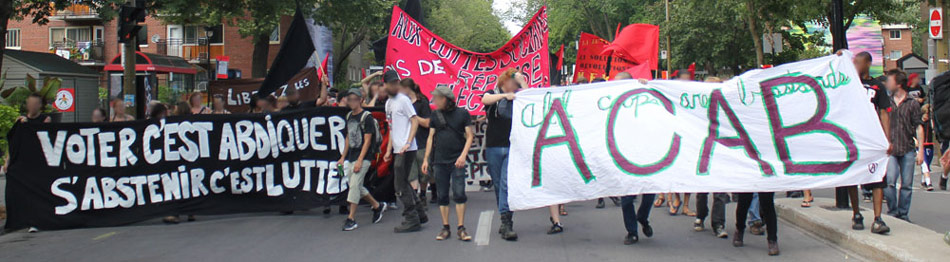
On the morning of August 1st, Jean Charest announced the 40th general election of Quebec. Coincidentally, this was also the night of the 100th consecutive night demonstration, and both the student federations and neighborhood assemblies had planned to give the demonstration more life than in recent times. Gatherings from the neighborhoods north and east of Berri Square organized parades, which gathered more people as they passed through all the neighborhoods before reaching the square.
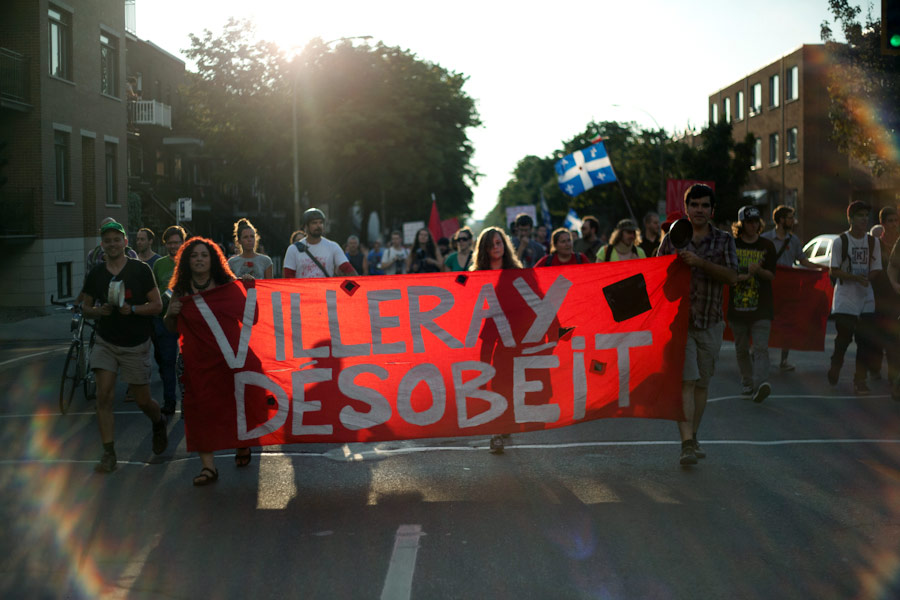
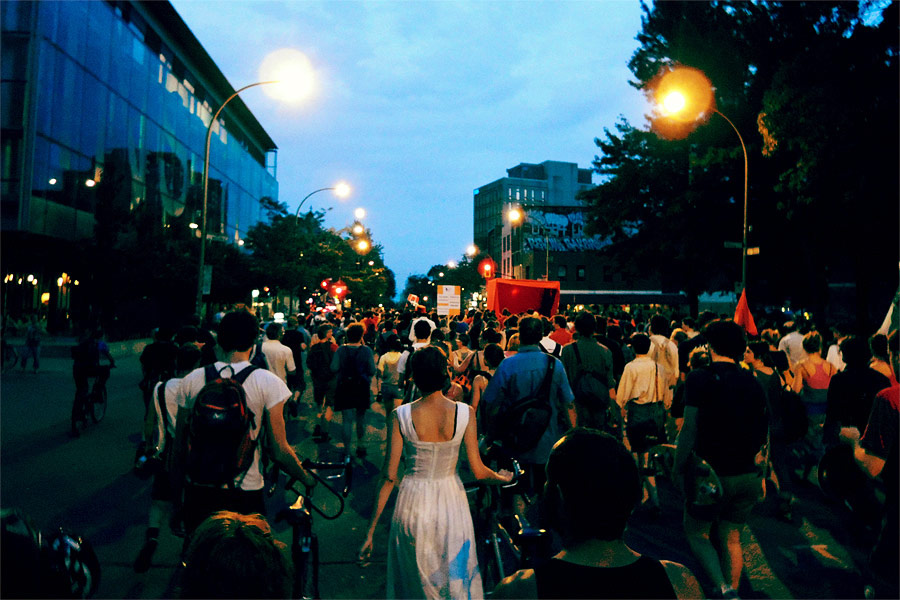
There were clashes with the police. Bank windows were smashed and garbage containers were dragged onto the street. The police used their usual weapons: batons, pepper spray, flashbang grenades. A total of 15 people were arrested.
The fight continues.
*[Read part 1 here](/2012/08/14/while-the-iron-is-hot-student-strike-and-social-revolt-in-quebec-spring-2012)
Translated by et al.
[PDF](http://magazinredaktion.tk/docs/Blame_Canada.pdf) [eBook](http://magazinredaktion.tk/docs/blame_canada.epub) [Blog entry](http://magazinredaktion.tk/blame_canada.php)
Read the full story at the source →
Source: CrimethInc.