
Germany · CrimethInc. DE · · 2h
A New Issue of Inside Front : For Anarcho-Punks and Hardcore Anarchists
English (original) · Read in Deutsch ⇄
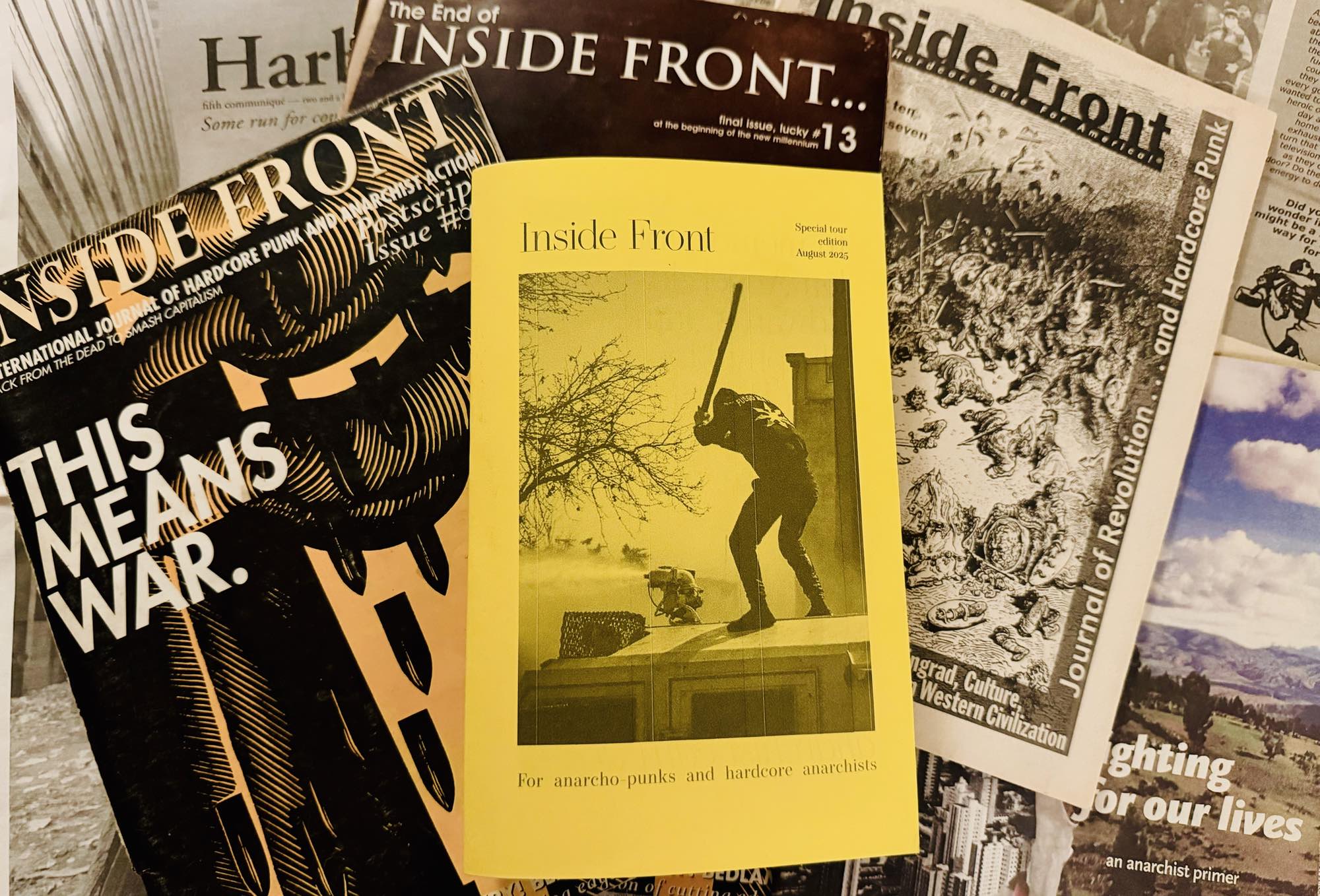
Over three decades ago, some of the first people to collaborate on CrimethInc. projects met via the international networks that had developed in the zine underground associated with the hardcore punk scene. One of the first projects they collaborated on was the hardcore zine Inside Front, the archives of which are available here.
In those days, without the internet, how did people discover and pass on anarchist ideas and tactics?
By embedding these values in rebellious subcultural milieus such as the punk scene—by reading dogeared books about the Yippies, the Situationists, and the Spanish Civil War—and by having adventures.
These three elements—subculture, reading, and adventure—came together in the hardcore journal Inside Front.
The last issue of Inside Front came out in 2003.
In August 2025, as the hardcore band Catharsis was preparing to play their first shows debuting their album “Hope against Hope,” the team behind Inside Front suddenly came out of retirement and threw together a new issue of the magazine in a week flat.
As a consequences of some wrongheaded notions about authenticity and immediatism, the issue never appeared online, though Catharsis distributed them from New York City to Budapest.
Never, at least, until now.
We’ve added this new issue of Inside Front to our online archive, so you can print and distribute your own copies.
From the introduction:
We hastily prepared this special limited edition of Inside Front in just a few days, scrambling to finish it in time for the record release shows for the Catharsis LP “Hope against Hope.” Although it has been well over two decades since the previous issue, many people who contributed to previous issues of Inside Front sent new material for this one—not to mention at least one contributor who was not yet born when the first issues of Inside Front appeared.
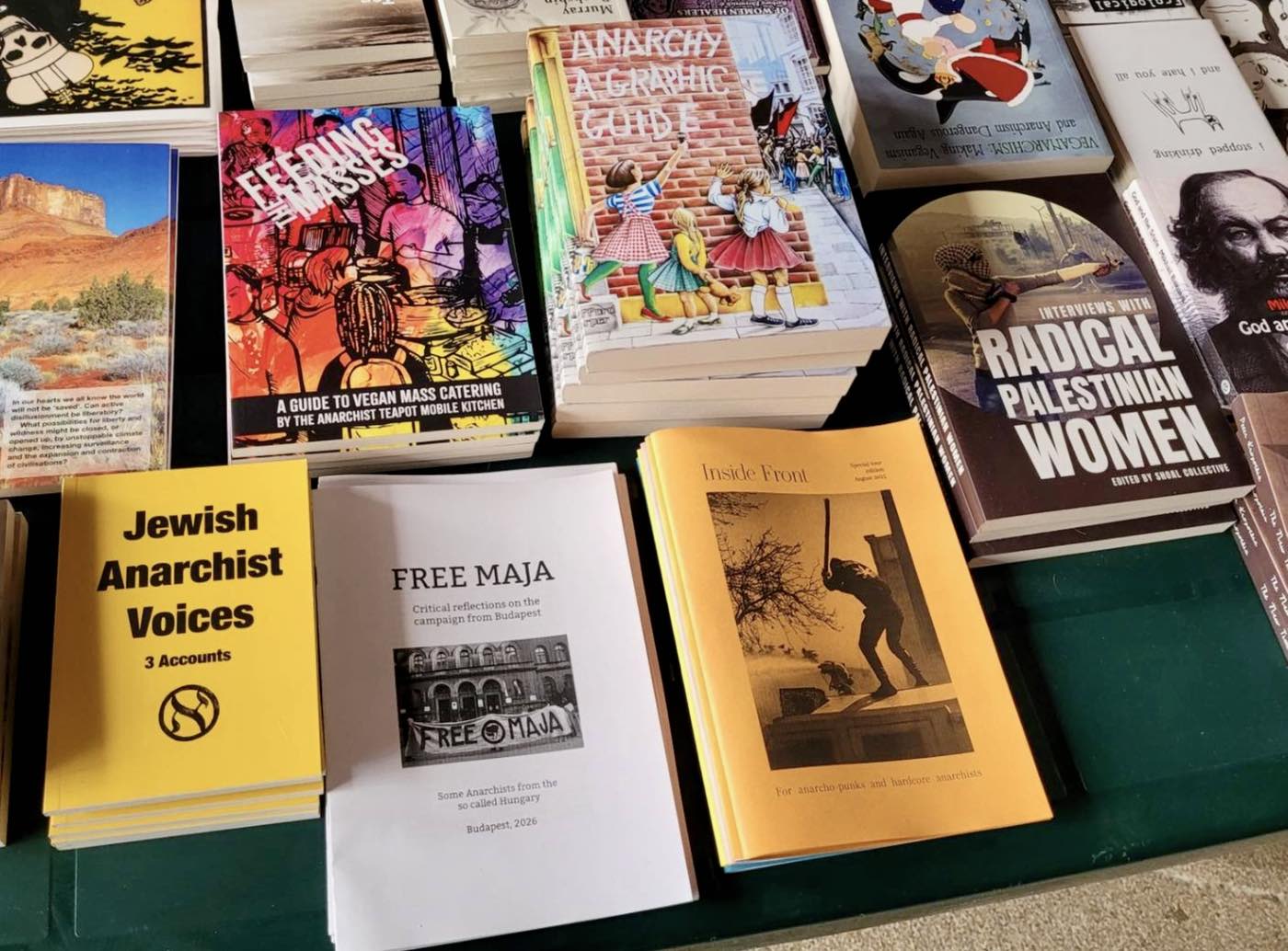
Copies of the new issue of Inside Front on a literature table in Budapest. This is like sighting a coelacanth in the wild.
From a review by Martin on the Counterforce site:
The cover says “For anarcho-punks and hardcore anarchists” and I could just stop the review right there. This might be the epitome of “perfect zine” for me. The first non-meta content is “Like Weeds – A Dialogue about HIS HERO IS GONE’s Timeless Anthem” in which two thinkers trade increasingly deep and heady observations and anecdotes about the song and it’s context (even more impressive when you realize both parties are almost certainly completely sober).
There’s also a relatable story about en EXTREME NOISE TERROR CD triggering scrutiny at the US border, a show review from someone’s first hardcore show ever, top-10 lists, a few reviews, ideas for a Stateless Fair, and a pair of parallel accounts from fighters in the Syrian civil war bonding over a Czechoslovakian hardcore song they all happened to know, and the struggle to finally download and listen to the song in the middle of a war zone.
It feels like a special and unique zine, since it draws on energy built up over 20+ years since the last issue. I’m not sure if Inside Front will return in a more permanent way, but I hope this issue gets wider distribution than just the CATHARSIS tour so more of you can enjoy it.
From the introduction to the zine:
Why hardcore, still, today, in the year 2025?
In the 1990s, in a time of social peace (at least in the United States), the hardcore scene was ahead of the times in that it was hyper-connected, internationally networked, and artistically experimental.
Today, the hardcore scene is increasingly conservative, artistically speaking (though we challenge you to prove us wrong!). It’s no longer any better networked than any other social milieu. But it is now old-fashioned in a potentially explosive way, because it involves physical collectivity, togetherness that unfolds on a slower time frame than the virtual reality of internet relations.
People have also become more aesthetically literate than they used to be. Whereas both a blast beat and a black bloc were completely foreign and incomprehensible to most people in 1999 (and both models derived both their strength and their limits from that fact), today, a much wider range of people can understand both of them. Yet as these reference points have become more widely shared, a crucial detail of the punk program has been lost: context is everything.
The very same song can be meaningless in an expensive club and transformative in a squatted space of resistance. Banksy has demonstrated this in the field of the visual arts. Pussy Riot did the same when they performed “Punk Prayer” at Moscow’s Cathedral of Christ the Savior in February 2012. Real, living art has to break the frame.
As the social peace that used to exist crashes and burns, countless people are grasping for new ways of connecting and fighting. Hardcore and punk still have something to offer people today-perhaps now more than ever.
The story goes that a participant in the defense of Weelaunee Forest once said that, proportionate to their numbers, punks were the most impactful participants in that movement. Those from any other walk of life could learn about the situation without necessarily feeling impelled to take action—but punks could not learn about anything without immediately asking how they themselves could take action in relation to it.
Do it yourself: this is still the key.
Read the full story at the source
Source: CrimethInc. DE