
World Africa Is a Country
Picturing the bandits
A peace deal in Katsina, Nigeria, lets one armed group buy biscuits and plan for Hajj, but not lay down its weapons. Photographer Terna Iwar tells the Nigerian Scam what he saw.
English (original) ·Read in Deutsch ⇄
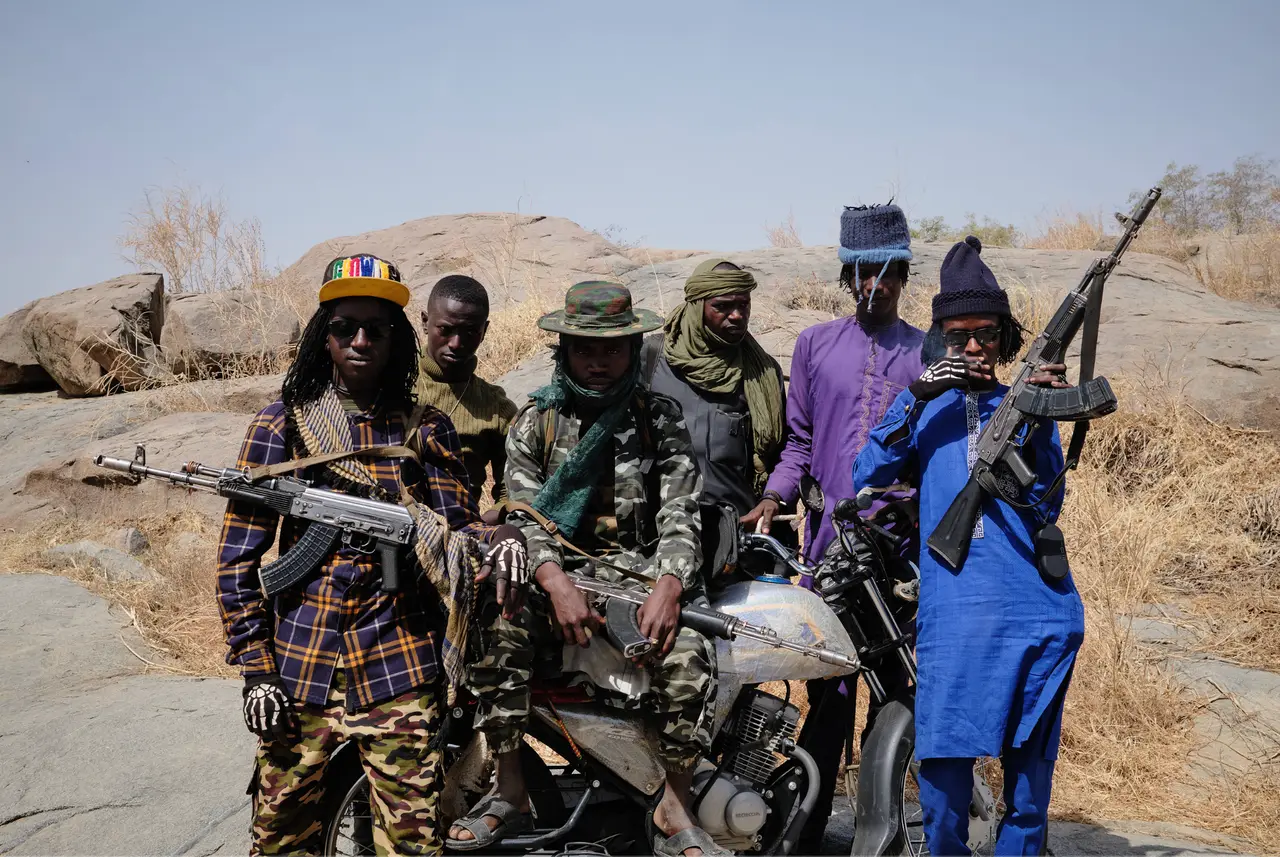
In June, the Guardian published “Brutal and Emboldened: How Nigeria’s Bandit Crisis Spun Out of Control,” a report from Katsina State in Nigeria’s northwest, where communities in local government areas such as Batsari have struck peace deals with the armed groups that have terrorized them for years. The photographs were taken by Terna Iwar, an Abuja-based photographer and artist who traveled with the Guardian’s West Africa correspondent, Eromo Egbejule, and a local stringer — without a security escort — to meet one of those groups under a neem tree near the border with Niger.
On the latest episode of the Africa Is a Country podcast, the Nigerian Scam talks to Terna about that encounter: why he kept his camera in plain sight from the moment he arrived, how the group saw itself (as protectors of their communities, not bandits or terrorists), and what the peace deal actually gives them. Access to shops and medicine, and an end to their families’ shame, are on the table; disarmament is not, since other armed groups are still out there. Terna describes a landscape of abandoned towns and clinics, electricity poles without cables, and border posts that barely function. He also reflects on the central dilemma of conflict photography: how to portray people as more than one-dimensional without losing sight of the horrific acts they have committed.
Listen to the show below, and subscribe on your favorite platform.
Sa’eed Husaini
Well, look, I guess we should talk banditry and photography, which are some of the key words for the day. So yeah, we’re talking about banditry and shooting the bandits, quote, unquote, today. And the conversation is with a longtime comrade, collaborator, or friend, Terna Iwar, who’s also a well-known photographer, artist, and creative. So, Terna, thanks for coming on the show, man.
Terna IwarThank you for having me.
Sa’eed HusainiHomecoming in some ways, right?
Terna IwarIn many ways, yes.
Sa’eed HusainiWe hope. So feel free to raid the fridge. You don’t need to take your shoes off. The normal protocol. So, this is inspired by a recent article, “Brutal and Emboldened,” a Guardian article about how Nigeria’s bandit crisis is spinning out of control. We want to talk about banditry, but not necessarily only about the dynamics and history and stuff. We’ve had part of that conversation previously with James Barnett, and we’ll have more of that kind of more historical, if you will, conversation going forward. But I think part of what we want to dive into is a bit of the experience, right, of encountering this camp, going to the camp, and shooting, or photographing, the bandits — and then, of course, your assessment, based on that experience, of what the hell is going on with banditry in Nigeria. I’m sure there’ll be elements of the conversation maybe you don’t want to get into right now. We’ll respect that, but of course, as detailed or as granular as you want to get, there’s space for that. And so, just by way of a little bit more background, Terna was part of a team that went up to Katsina, if I’m not mistaken, and had an exclusive interview with at least one camp of AK-47-wielding bandits. Got their perspective, but also kind of hung out with them. They seem pretty relaxed in the photos, and I guess it’d be interesting to get your take on how you got them to be so chilled out in the photos, and what they thought of you as well, shooting at them from the camera. So I don’t know, man. Maybe by way of intro, you could just talk a little bit about how you got into this and what that was about, and how freaked out were your parents hearing that you. . . . However you want to get into it.
Terna IwarWell, again, thank you for having me. Talking about the work I do is not something I often get to do, so I think this might even help me metabolize what that was like. So Eromo, the West Africa correspondent for the Guardian, reached out. We’d been talking back and forth for a while about potential stories and stuff that I was working on, what I was interested in doing, and when this came up, he thought that it would be a great fit, since a lot of the work that I’ve been doing in photojournalism revolves somehow around conflict. I just kind of found myself shooting a lot of conflict stuff, banditry, the aftermath of people’s lives changing in the most horrific, drastic ways. Initially, because of the nature of the story, it was very, very tightly kept. I didn’t even know specifically where we were going, but I knew the situation in Katsina, where I think 23 different local governments all have very intense bandit problems.
Sa’eed HusainiYeah, that’s insane.
Terna IwarAnd I had heard that there were efforts to curb that locally, not on a state or national level. And then in having conversations with Eromo, he let me know that there are groups of bandits that have accepted a peace deal with the local communities, for varying reasons. They chose to accept a peace deal. And so the goal was to go there, speak to the bandits, speak to the people that negotiated, speak to the communities, try and understand: What is this peace deal? Why would these bandits accept a peace deal? And why are they in banditry to begin with? Going there, we had a stringer, a contact on the ground, that helped us navigate. Of course, there were talks of, should we go with security? Should we not? Ultimately, we decided not to, because we felt very strongly at the time that showing up to these places with police or military would clamp down on the story and would basically make everyone unwilling to speak. And so we went there.
Sa’eed HusainiI mean, probably it would have slightly increased the shootout possibility, right? I don’t know if you guys were thinking that, but it would seem to me.
Terna IwarMaybe if they were active bandits, then for sure. They would probably feel like we’re entrapping them or something, or it was a sting operation. But they had already accepted a peace deal. Reaching them was a whole different thing. We went to a community outside of the mining town, Nahuta, I believe before getting to Batsari, and we had to take a bike. I think it was like a 40-minute bike ride out of town to get to the mining town, and then another 15 minutes to get to where they were, because part of the deal was that they are not allowed to be in town within specific times, and I think they are not allowed to come into town with their weapons. Basically, their movement within the mining town and any town is very restricted, just so that everybody feels comfortable. And so we had to go out to them. Initially, I think they even wanted us to meet them at their base camp, but we eventually negotiated a neutral place, under a neem tree, to meet them.
Sa’eed HusainiYeah, that’s nuts. So you did meet them, and — could you just talk us through, before we get to the meeting itself and what the vibe was like there, what were you thinking that morning, when you guys were going to head out to go meet up with bandits? Was there any part of you that was thinking, Damn, this could be it? Or were you feeling pretty confident about the peace deal? Were you like, No, it’s fine, the peace deal will keep things safe?
Terna IwarWell, I think a thing about it, for me specifically — I can’t speak for anyone else — is if you’ve done your due diligence, you can only work based on the information that you have. And the information I had was these people were willing to talk. They had accepted the peace deal. That was the information I had. And not to say journalists are never betrayed, or that the people who are willing to talk to you might not turn on you, but from everything I had read and researched, it wasn’t a very common occurrence. And it seemed to me like a lot of these groups do want to tell their story. They have a need to be out there just as much, or to be seen as people rather than boogeymen. I think every terror group out there, at least in this day and age, is trying to sanitize itself in one way or the other. And plus, if you’re going to do this type of work, you can’t think of the worst-case scenario. You take it into consideration. You list all the things that could go wrong, and then you work to minimize your risk. We did do a very thorough risk assessment before we went there.
Sa’eed HusainiNo, fair enough. At one level, it sort of sounds like a more intense version of living in Nigeria, doesn’t it?
Terna IwarThat is exactly right. That is exactly right.
Sa’eed HusainiIt’s not like anybody’s guaranteed anything, really. No, that’s a fair point. When you talk about them wanting their story to be told — of course, there’ve been a few investigations that have talked to them directly. There was, of course, the BBC documentary. Different group — I think that was a Zamfara group, right? And now Katsina. And James Barnett and Murtala Ahmed Rufa’i and various people have been talking to them. We interviewed James Barnett a while back. But this is as close as we’ve gotten, in a way — having someone who’s within our ranks very much face to face with the bandits. And it’s that face-to-face element I want to now explore. I suspect OAG wants to come in with questions. But so you arrive at the neem tree, and it’s a bunch of guys. Some of them have dreads, the kind of military uniforms in some cases. What was your first impression seeing the guys, and how did you folks feel received? And sorry, how did you feel about the camera? Did that require extensive negotiation?
Terna IwarWell, not even. Whenever I go to any place where it’s fairly dangerous — well, depending on the kind of danger — I don’t want to hide. In this particular case, I wanted them to see the camera and be comfortable with the fact that there is a camera on the scene right from the jump. So I didn’t put it in my bag. It was right in front of me, facing everyone, from even before we got to Batsari. And then when we got to Batsari, because we had to wait a little bit, I was already taking pictures, I was already making images, walking around, familiarizing myself, and in a very large way, familiarizing anyone that would come up to us with the camera. If I had gotten there, and then after they start talking, I suddenly whip out a camera, I’m sure they would be like, Wait, wait, wait, what’s happening here? But right from arrival, the camera was very visible. And then I asked them directly — or, well, asked — but basically I raised it up, and I was like, “I’m here, notice me,” and I immediately started taking pictures. So I think there is a little bit of audacity, but also you kind of have to sensitize people to the camera. Even if it wasn’t bandits, if it was anyone, a camera suddenly being put in your face is not nice. It’s actually quite aggressive.
Sa’eed HusainiThat sounds like experience talking, because now that you say it, it makes perfect sense. But one might have been tempted to be a bit shy with it, or, as you say, pull it out of your bag mid-conversation. But I can see how that would be maybe a terrible idea. So now I’m really curious about — no, let me let you keep going. I thought you were going to say something.
Terna IwarI was going to say that it is a good point about being shy, because I’m not generally the very forward, aggressive type. So I think maybe some of the ways in which I interact with these guys are very careful, even as I’m trying to capture stuff that can be dangerous.
Sa’eed HusainiRight. And so I’m curious about what their impressions of you guys were, and whether they made jokes, or how they read you guys in this.
Terna IwarI would give a lot of credit to the stringer. I think he did a lot of work to familiarize himself with them, or to get in their good books, because when we got there, they were very prepared to have a conversation. I would even imagine that they went out of their way — not that I know what they do all day, but I would imagine that they moved things around to make it happen. Before we got there, we were told that we should bring Coke, Fanta, and bread, because it’s apparently a very strong sign, and a thing that a lot of these bandit groups love. We didn’t, but we were told that that would help in the appeasement. But when we got there, they were relatively welcoming. Of course, there were some people that were very standoffish. There were some people that were giving us not very good looks. But in the main, they were very welcoming. I think even later on, at some point, they offered us Coke and food, when they were going on break and for prayers.
Sa’eed HusainiThat’s interesting, and again, it doesn’t necessarily align with the portrayal that one generally gets from a distance about what these guys are like. Even the talk about Coke and bread — in the civil society kind of reports, there’s a lot of emphasis laid on drugs and people being kind of out of their minds and being a bit reckless, but the guys you’re describing don’t sound exactly like that. So what were your first impressions, really? From the pictures, clearly the guys were armed. But beyond those basic facts, did they appear and give off a vibe that you expected? Did anything stand out?
Terna IwarIn many ways, yes. I would say I’ve been to a prison or two before, and I’ve shot many different places that were going through very tough times, and what I found is most people in most places are not that different. The circumstances and the things they do might be different. Look, what I’ll say is, in all my time on this earth, I’ve met maybe two people who I looked into their eyes and I knew this person had killed a person. I just knew. But most people don’t wear either their atrocities or their traumas on their sleeve. They find ways to bury all of that very deeply. And when you meet them, you don’t know what someone is or what they’ve done. It was no different with these guys. They just seemed like regular people, until you started talking to them about what they are doing. Because ultimately they are still bandits, peace deal or no peace deal. It’s not until you get into the details, into the weeds, that you realize, okay, this person — we don’t see the world the same way. But first impressions are always like, yeah, regular guy.
OAGA guy you could play football with.
Terna IwarYeah, you could literally. And they start telling you about their own hopes and dreams, and you’re like, okay, regular guy. But then, if you talk about the other stuff, their banditry and their way of life and all that, it’s very horrific. So in some ways I wasn’t surprised. I was a little bit surprised by their unwillingness to engage with what they were doing, but people always make excuses and rationalize all kinds of things.
OAGIt’s interesting, what you’re saying about them not engaging with what they are doing, and the general perception of what people think. But let’s step back and zoom in on them. Do they keep tabs on the political scenery — the bandits, I’m saying, who we are assuming have some sort of amnesty going on? Are they interested in Peter Obi, or are they Obidient? Would they like for Kwankwaso to be there? That type of thing. And do they maybe think they’re going to graft into the political thing, like voting? If they’re not going to do that, then is it going to be by way of arms? Because people that are looking to have their sins forgiven and maybe at some time be reintegrated back into society — do they see themselves. . . . Maybe the broader question I’m asking is: Do they see themselves participating politically, voting, then at some point integrating back into society and being normal, in quotes? Their hopes and aspirations of being normal, and not staying in the bush forever. Did you get a sense of that from the discussion?
Terna IwarYes, there is an awareness. Actually, I would say there is a very strong awareness of social injustice — social injustice in that they and their people have been disenfranchised by the government. That was a thing that they kept coming back to when we were discussing why they are doing what they are doing. There was a very strong emphasis from them that the government has failed them. That was part of why they said they were doing what they are doing, and part of why they kept doing it, because they said successive governments would make promises and would never keep them. There was even a little bit of lamentation there, where they were like, they’ve tried to talk to the government, and there are a lot of people that don’t want to engage. Now, I should say, there are, I think, over 30 different bandit groups. We were told that there were many, many bandit groups, some operating across different communities. Some have basically made a community their home base. And so nothing that these guys say speaks for all these bandit groups, but for these guys specifically, this is what they were talking about. They had tried to talk to the government. They’d tried negotiating with the government even before they became bandits. It was because the government was not fulfilling their end of the deal. They talk about how they took up arms to begin with to try and protect their people, ostensibly from other bandit groups.
Sa’eed HusainiRight. So they were vigilantes in some way, previously.
Terna IwarThey much prefer that term, vigilante, to bandits. Because the leader of the group, Abu Radde, said he really didn’t like the term bandits or terrorists. It makes them upset. They are not criminals.
OAGWhat would he have preferred?
Terna IwarWell, they feel like they are doing all of this to protect their people.
Sa’eed HusainiYeah. So the vigilante or community security kind of thing.
Terna IwarThey didn’t use the term vigilante, but they did say they are doing it to protect their people.
Sa’eed HusainiRight. Pretty crazy. No, OAG, let me let you in.
OAGYeah, but in the face of insecurity, do they have an idea of how they’ve been branded, and how the federal government, or maybe even the state government, is working to kind of flush them out? Do they understand the kind of negative PR they are getting?
Terna IwarThey understand that very clearly. Yes.
OAGSo that’s my point. If they are seeing it this way, and the bloodshed component of their work is becoming more pronounced these days — I know they said they’ve tried to talk to the government — have they explored maybe other ways? I know it’s just political, but maybe forming a political pressure group or something, without the violent aspect. That’s why I was asking more about their politics.
Sa’eed HusainiYou’re trying to push your own solution, right? They need to register with INEC.
Terna IwarNo, I don’t think they are thinking in terms of political solutions at all. They are done with that. I think they’ve done what they’ve seen other communities do, and what they know how to do. It seems like the logical conclusion, or the logical next step, for them is to take up arms, not explore politics or go into politics or try and change things through the system.
OAGSo did they come up with any form of suggestions that would make them consider dropping their arms, or anything that they want the government to do for them to then consider dropping their arms? Did they mention anything?
Terna IwarWell, I think that is included in the peace deal. The peace deal does not include disarmament. They find themselves in a situation where all of them have families. They have parents who are part of communities that I believe they’ve also terrorized. So their families are now pariahs, or were pariahs, and part of what they wanted was for their families to be able to move around without feeling shame. One. And for they themselves to gain access to, well, the amenities of civilization: be able to go to the shop and buy something, buy biscuits, be able to get medication — just the benefits that you get from living as part of a community with some sort of economy. And in exchange, they agreed not to terrorize anyone. They refused to give up their guns, because they said there are other groups that are still — because remember that they are still herders, specifically. They are still herders, and I believe — well, maybe not them, I don’t know — but they are protecting their cattle from rustlers and other bandit groups. So they said that they can’t give up their weapons because these other groups are not giving up their weapons, and they need to protect themselves. But it comes back to — that’s why they couldn’t come into town, because they can’t come into town with their weapons.
Sa’eed HusainiRight. All this talk about the government — their views on the government — sort of inspires a certain question. Because all this time, actually, we’ve said very little about the security agencies. You mentioned you considered the pros and cons of having some of them around, but looking at the images you shared, it doesn’t really look like there’s much security presence. And even in the story you’re telling, of them feeling the need to stay armed because there are other armed groups, nowhere are they mentioning going to report to the police. As somebody living in Nigeria, we can all imagine why that’s the case. But I just wonder, going out there, how remote or ungoverned, quote, unquote, do these spaces appear? Was there any government presence at all? Did you see schools out there, or electricity? Or are they really just kind of out there, cut off from the governed bits of Nigeria?
Terna IwarTo a large extent, I think the Guardian did a fantastic — well, it is part of the body of work that we’re doing, but they put out an article talking about the insecurity across the Sahel, and a thing that they found is that the Sahel and these northern parts of Nigeria are places that the government doesn’t really penetrate into. I think either th ey find it difficult to govern, or there are not enough resources, natural resources, there for them to really care about. Or, for whatever reason, there is very little presence of the government or any governing structures there.I didn’t see a school. But again, we stopped off in town — we took a car, stopped off in the township, and then took a bike, almost 40 minutes, 30, 40 minutes’ bike ride into the wilderness, really. And we passed through several abandoned towns. We even passed through an aid center — it used to be a hospital, or a clinic, sorry — that was abandoned when bandits had destroyed it. We passed abandoned towns, abandoned clinics. On our way there, we saw signs of burgeoning development, in that there were electricity poles that had been placed to take light to certain remote areas, but there were no cables on them. So I guess maybe that project was also abandoned. This area that we’re in, I would say, is really just abandoned. The government is not — or maybe they tried at some point in time, but they are not trying to connect these areas to the rest of the country. And where we actually met them was even more remote. Just bare fields and trees for miles around.
Sa’eed HusainiRight. Okay.
Terna IwarAnd plus, where we were is very close to the border. In fact, before we went to meet them, we did go to three different border points with Niger. There’s not very much there either.
Sa’eed HusainiEven the people who live there?
Terna IwarYeah, people live there, but yeah.
Sa’eed HusainiSo would you know it’s a border, or is it that people just say, “Hey, this is a border”?
Terna IwarNo, we went to the known ones. The main one — as I understand it, not a lot of people use it, but it’s very official. The road is done, the gate is very big, there is security there. They check whatever they are checking. They inspect cars and all that. Very built-out situation. The second border crossing we saw was basically three security guys and a hut with a plank across. The third one had a customs office, and this was the one that is close to Batsari — well, closer, a couple of miles away from Batsari. They had the customs building there, but as far as I’m aware, it’s not operational. Perhaps it is. I don’t know. But it didn’t seem like it was operational.
Sa’eed HusainiRight. And how you’re describing it, it also didn’t seem like if you rode through with 100 guys on motorcycles and AKs, anything would really stop you. You could probably just keep going.
Terna IwarPlus, how do you police miles and miles of — you could drive a kilometer on either side of any one of these borders, cross, and no one could stop you. It’s not like there’s a long fence. Well, it’s only America that can do such a thing.
Sa’eed HusainiAnd even there.
Terna IwarAnd even there, you could drive on either side of the border and just cross. Which is literally what these guys do.
Sa’eed HusainiI mean, who can blame them? Borders, of course, classically an administrative fiction more than anything. Really fascinating. I know we’ve kept you for a while. Just another couple of questions before we let you go. I want to come back to seeing this through the lens of a photographer, but one more detail that stuck in my mind is this mining question. Because you stopped by a mining town, and for a lot of Nigerians, one easy explanation of banditry — even for some kinds of left analysts, or at least let’s call them anti-imperialist analysts — has been that this is all about mining: that there are foreign interests in cahoots with certain domestic interests that control the mines, and the bandits are just a distraction, or they’re just the security guys that make sure that the illicit mining global conglomerates or cabals continue to extract their coins from these areas. Not to force you to respond to all of that, but how did the mining element seem connected, if at all, to the lives of these guys? Do these guys mine, or do they go around the mines? Or did it feel like two different dynamics altogether?
Terna IwarThe guys at the mines were very clear, and they were very insistent, that the bandits, Abu Radde’s group, have nothing to do with their operations.
Sa’eed HusainiInteresting.
Terna IwarYeah, they were very insistent that that was the case. I can’t say anything to that, because to my mind, I don’t see how that could be. But they insisted that that’s the case — that they don’t interfere, and they’ve never interfered, and they don’t pay a tax to the bandits.
OAGLet me just jump in. Is there a general message that they have? Because with social media and all, we see it — and it might not be the same ones you’re talking about — but we see them flaunting money, even doing giveaways and all that. And I think popularity and fame is starting to creep in with bandits now. So do they have a general message which they’re trying to pass across? And what would their vision of the future be like? Because I’m sure they don’t want to be bandits — well, I don’t want to say I’m sure they don’t want to be bandits forever — but what would their picture of the future be like, coming from your interaction with them and the feelers that you got from them?
Terna IwarFrom them, I didn’t get very. . . . I mean, Abu Radde himself was very excited to be going on Hajj. This is one of the things that he was very excited about now that there is a peace deal. There was another young guy — I think he’s like 17, even — who had left school to join Abu Radde’s gang, and he seemed excited to go back. Well, if not excited, he was very interested in the idea of going back to school. He left in SS1 or so. So a lot of the guys that we spoke to — these are the kinds of things that they cared about in their future.
Sa’eed HusainiIt almost seems like banditry is kind of a part-time thing, or a transitional thing, for a lot of people. They’re doing it, but it’s not the only thing they do, or the only thing they want to do. It’s just kind of part of their hustle. Not to be simplistic, but is that unfair?
Terna IwarI would say it is not unfair, in that my impression is, if they felt like they had other options, they wouldn’t be bandits.
Sa’eed HusainiGot it.
Terna IwarBut banditry is a thing where, once you step in, you’re already in. Like podcasting — you’re staying. You can’t be a bandit part-time, I don’t think so, and it doesn’t seem like they even are bandits part-time. But it is also true that they want more for themselves than being bandits. It seemed, again, from their perspective, from what they were saying, that this is not the life that they chose — or they chose that life because they had no choice. When we asked them, “Okay, so what about all the people that you’ve killed, all the destruction, death?,” their simple answer, which again was an avoidant thing, was, “Things happen.” Things happen. But they kept coming back again to the fact that they are only doing this because the government has failed them.
Emeka UgwuI joined late, and I’ve been listening for the most part, trying to get a sense of where the conversation is coming from and where it’s going. So my own question is maybe a spinoff from my failure to get a holistic grip of the conversation. But I’m interested, ideologically — and I don’t want to label it Islamic — in ideas about what awaits them in the afterlife. So my question is: Is there any sense that these guys don’t have a sex life? Do they have conversations about women? Are they getting married?
Terna IwarThere are a lot of them that are married.
Emeka UgwuNo mass marriage, all that?
Terna IwarWell, I don’t know. Abu Radde, I know, is married. I know a couple of the other guys are married. I don’t know about the young guys. We asked them what they do for fun, and they said that there’s this game that they play where they basically beat each other to impress women. I’m blanking on the word.
Sa’eed HusainiI’ve seen this.
Terna IwarI think it’s a game of endurance, where they are whipping each other. I found that fascinating.
Emeka UgwuIsn’t that more of a cultural thing? Because right from when I was young, they’d say if you want to marry, in some parts of the north, you endure some kind of beating. I don’t know if that’s more cultural than anything else.
Terna IwarYeah, I only bring that up because Emeka was asking about marriage. So clearly they’re —
Sa’eed HusainiInterested in babes. Some of them are married. As elsewhere in the world, there are cultural particularities around courtship. I’ve heard of Shadi before. I’ve seen some videos, too, of guys in the Sahel putting on what looks like makeup and dancing in a row — guys who dance the hardest.
Emeka UgwuWould that be a tribal thing, I would think? Would that be right?
Sa’eed HusainiI mean, so this relates to maybe my penultimate question, which is around swag. They were dressed cleanly in the pictures you took.
Terna IwarThey had brand-new bikes.
Sa’eed HusainiRight. The bikes were new. The military fatigues were sort of sharp. They looked kind of ironed, and they were also kind of posing. There was a guy who was rocking a mean-ass cigarette. They had gloves and stuff. The guys had dreads. Can you talk us through the swag a bit? Because I kind of felt like they were swagging out a little bit. Not to summarize it, but was there an element of coolness at play here?
Terna IwarI think the particular guy you’re thinking of, with the long dreads and the dark shades — I think that’s just him. He’s also the one that I mentioned was interested and a little bit excited about going back to school. So I don’t know about. . . .
Sa’eed HusainiYouthful exuberance.
Terna IwarYeah, I think maybe he’s at that point in his life, and, being not far from, I guess, the wider culture, there are things that he’s interested in that maybe some of the other guys aren’t.
Sa’eed HusainiRight. So he might have a TikTok account, maybe.
Terna IwarBut there is a thing about uniforms, especially military uniforms. Despite the fear that they evoke in Nigeria, I think there’s a way in which uniforms have been designed to look sharp. It’s hard to see a person in fatigues that does not look a certain kind of imposing and sharp. I guess my question would be, how did they get access to it? I’m thinking about that now, and I don’t know why it didn’t occur to me then.
Sa’eed HusainiAs with a lot of vigilante or community protection kinds of groups, they seem to end up with one form of uniform or the other. In a way, these things are things you can buy in the market too. Even the army guys buy their own uniforms in the market.
Emeka UgwuAh, so true. The same way army personnel buy their own.
So, staying on this swag thing. I’d imagine that bandits who are — I don’t even know whether to call them bandits — but young and have TikTok accounts, there would be some trend within the larger society. Of course, because of location, that would be hard. But when they raid, they make money. That’s why they flaunt it. Flaunt it for what? For who? What are they flaunting? Are they telling the Nigerian population that banditry pays? Or are they trying to use TikTok the way I think it’s used within that generation — some of them use it to show off, maybe to impress women? I think some of these social media platforms really promote stuff like hookup culture. Or is it that these guys are not even participants in this? I think some research has suggested that that’s why they go and kidnap schoolgirls. I’m not saying this particular group that you’ve spoken to, but I’d imagine they want to wear some of the trendiest sunshades, boots. Because at the end of the day, why is it a racket that pays, and why is it something that they are drawn to over time, to the point where they feel the urge to show off their loot — again, not this particular group, but even some bandits that rustle cows? Or I don’t know whether vigilantes are paid for any of the work that they do, at least up in that region. Because I’m almost certain that vigilantes in the southeast who look out for bandits, or who are trying to act as security against bandits — I don’t know how well they are paid, if they’re even paid. I’m sure they are not paid well.
Terna IwarI think there are a bunch of different types of these bandit groups. There are the ones that are very Islamist in what they’re doing — they’re pushing the religious agenda. And then there are other ones who are, I think, doing it for money. These guys, again, say that they’re doing it to protect their people and to protect themselves from other bandit groups.
Emeka UgwuAnd their cows.
Terna IwarAnd their cattle, yeah.
Sa’eed HusainiIn their own self-conception.
Terna IwarIn their own mind, yeah. In their own self-conception, yes. But I think the broader thing here, to your question, Emeka, I think there is a culture in Nigeria of money above all, and it might be that these groups that are celebrating and boasting on social media are tapping into something that is a broader occurrence in Nigeria. It’s hard to be young on social media and not buy into the broader value system that is being promoted.
Sa’eed HusainiMy final question, and probably should be our final question, just because we’ve kept you for a while. It’s maybe a general question that you’ve encountered before, around conflict journalism and conflict photography, but I wonder how you think about it in this case. Talking to you now, I feel some sympathy for these guys, right? I think you’ve kind of humanized them, because they don’t really look like this sort of bloodthirsty —
Terna IwarIt’s not by intention.
Sa’eed HusainiNo, but if you explore anybody’s perspective enough, they come across as not just irrational and bloodthirsty —
Terna IwarNot one-dimensional.
Sa’eed HusainiThat’s the main thing, really. They come across as not one-dimensional. They’re multidimensional suddenly. And of course, looking at the images you took of them, too, they’re respectful images, right? You’ve not treated them as clowns or African savages. In the pictures, they look human. They just look like people one might meet. I guess the question is an ethical one. You’ve also highlighted that these are people who have — in their own telling, and the groups that they affiliate with, or bandits more generally, as we all know — committed some pretty heinous atrocities. How does one strike the balance? As a photographer, how do you think about managing that tension between trying to portray people as people, meaning not one-dimensional, but then also grappling with the tragedy and the trauma that this whole phenomenon has brought about? I’m sure there’s no easy answer to that, but I just wonder what your thinking on that is.
Terna IwarThat is one of the central questions for me, actually, because at every point in time, I’m very aware of who these guys are, or what they have done, right? I see my work — as passé or as bland as it may sound — as witnessing what is happening, carrying a story back so that everybody else can understand. I try very hard not to place judgment on whoever the subject is. I think a part of what I’m doing requires me to be able to understand the person in front of me in a way, but at the same time, not pass judgment. I don’t want my subjective perspective to taint or to paint or to color the work I’m doing. Inevitably, it’s hard to do that, and I guess even the fact that I’m trying to understand who I’m working with, the people that I’m taking pictures of, also comes out in the images. But really, ultimately, I’m there to witness and to tell the story as I’ve seen it. If I had gone there and the feeling of the place was very tense and violent, and you could smell the smoke in the air and see death in these people’s eyes, the images probably would have shown that. That wasn’t what I saw. But the thing that I worry about is this humanizing aspect, right? Because I do see them as more than one-dimensional. But at the same time, it’s important to hold several ideas in your head at the same time. These are human beings that have wants, needs, desires. They want more for themselves. They believe it is their right, and I can see how that is true for almost anyone. But at the same time, they committed horrible, irredeemable acts, and that also has to be front and center and reckoned with. And sometimes I worry that the work I’m making does not actually properly capture both sides. But in going there, I have a way in which I approach making images, and so far it’s worked. It allows people to open up. It definitely allowed them to feel a bit more comfortable with me, which I think is only a good thing.
Sa’eed HusainiI agree. I think it’s credit to your skills and experience, and it’s helpful for observers, because it doesn’t do us any favors to try to simplify them or see them in a one-dimensional register. I think it is important to actually try to grapple with that tension, and not resolve it so easily either way, because that doesn’t lend itself to sustainable solutions either. So I think you’ve done very important work here — of course, you and the Guardian and Eromo.
Terna IwarExcellent work by Eromo. He’s amazing.
Sa’eed HusainiAbsolutely, and he’s somebody we’d be very keen to talk to as well. But not only because you’re our guy, but also because I think the photographer’s lens — a picture says a thousand words, for sure, but getting the context of how those pictures were taken, and why, and what the moment felt like, is also very enriching. So, look, thanks for making the time to have this conversation.
Terna IwarNo, thank you for having me.
Sa’eed HusainiAmazing. Hope we can have it again, maybe on a slightly lighter subject matter. Emeka, any final thoughts? Vote of thanks?
Emeka UgwuNo, that’s it.
Sa’eed HusainiFair enough. Okay, Terna, nice one, man. We’ll let you go. Stay well.
Terna IwarStay safe, folks. Cheers, guys.
Sa’eed HusainiAll right, man. Take care, fellas.